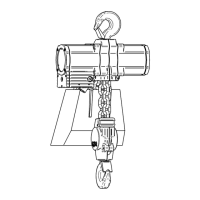
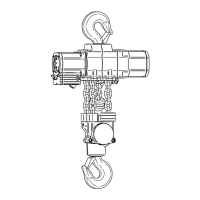
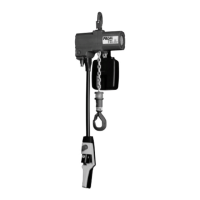
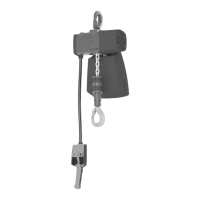
This document describes the JDN PROFI 2 TI hoist, serial numbers P408756-P408757, providing operating and assembly instructions.
Function Description
The JDN PROFI 2 TI hoist is designed for lifting and lowering loads within its rated capacity using a vertically arranged chain. It is also suitable for horizontal pulling of loads. When combined with a trolley, it can perform overhead horizontal movement of loads. The hoist is equipped with a vane motor, an integrated brake, and a rope control for sensitive, one-handed operation.
The lifting and lowering motion is controlled directly from the rope control. Pulling the green handle cone initiates lifting, with harder pulls increasing speed and easing up reducing speed. Similarly, pulling the yellow handle cone initiates lowering, with harder pulls increasing speed and easing up reducing speed. All control switches automatically return to the neutral position when released, stopping movements instantaneously and securely holding the load.
The hoist incorporates a lifting limiter and a lowering limiter. The lifting limiter, activated by a buffer on the bottom block/load sleeve, switches off the motor if moderately deformed. The lowering limiter, activated by a buffer on the empty end of the chain, stops movement but does not switch off the motor. These limiters are primarily for emergency use, and operators must monitor load hook movement to prevent damage to the buffers.
Important Technical Specifications
- Load Capacity: 2 t (2.2 tn.sh.)
- Number of Chain Strands: 2
- Weight (standard lift 3m/10ft, with control): 34 kg (75 lbs)
- Chain Dimension: 7 x 21 mm
- Weight of Chain: 1.0 kg/m (0.67 lbs/ft)
- Air Pressure (Nominal): 6 bar (85 psi)
- Air Consumption (Lifting with nominal load): 1.2 m³/min (42.5 cfm)
- Air Consumption (Lowering with nominal load): 1.5 m³/min (53 cfm)
- Hose Connection: G 1/2
- Hose Dimension (inside): 13 mm (1/2 inch)
- Motor Output (Lifting Motor): 1 kW
- Lifting Speed (with nominal load): 2.7 m/min (9 ft/min)
- Lifting Speed (without load): 5.5 m/min (18 ft/min)
- Lowering Speed (at nominal load): 5.5 m/min (18 ft/min)
- Noise Level (Lifting with nominal load): 76 dB(A)
- Noise Level (Lowering with nominal load): 78 dB(A)
- Driving Mechanism Classification: M4 / 1Am (according to ISO 4301/FEM 9.511)
- Chain Classification: M3 / 1Bm
- Explosion Protection Classification (EC directive 2014/34/EU and DIN EN 1127-1):
- II 3G Ex h IIB T4 Gc X
- II 3D Ex h IIIB T130°C Dc X
- II 2G Ex h IIA T4 Gb X
- II 2D Ex h IIIA T130°C Db X
- Additional "X" marking indicates specific explosion protection considerations for light alloy metal or impact-sensitive dusts.
- Permissible Ambient Temperature Range: -20°C (-4°F) to +40°C (+104°F)
- Thermal Resistance of Chain and Hook: 150°C (302°F)
Usage Features
The PROFI 2 TI is designed for safe, proper, and efficient operation. Key usage features include:
- Versatile Load Handling: Capable of vertical lifting/lowering and horizontal pulling.
- Overhead Movement: Can be used for overhead horizontal movement when combined with a trolley.
- Sensitive Control: Rope control allows for precise, one-handed operation.
- Safety Devices: Equipped with lifting and lowering limiters, and a braking function that stops movement instantaneously upon release of controls.
- Explosion-Protected Design: Suitable for applications in explosive areas, with specific markings and guidelines for use in such environments.
- Robust Construction: Sturdy design requiring minimal maintenance.
- Compressed Air Operation: Requires a nominal pressure of 6 bar (85 psi) and clean, dry working air meeting specific particle size and density requirements.
- Oblique Pulling: Possible with special safety precautions, but a chain box may not be used.
- Dead End Chain Mount: Ensures the idle chain does not dangle, preventing hazards.
- Emergency Lowering Device: Constructed similarly to an emergency brake, allowing for controlled lowering in emergencies, though with potential for increased engine surface temperature.
Improper Use Prohibitions:
- Changing load capacities with load position (as it lacks a load capacity display).
- Exceeding load capacity.
- Breaking free or towing loads.
- Loading the hook at the tip.
- Catching falling loads.
- Transporting people.
- Jogging controls or switching direction during ongoing motion.
- Starting limiters under normal operating conditions.
- Keeping the chain taut in the central part at limit positions.
- Transporting changing masses.
- Oblique pulling without proper precautions.
- Use in critical areas (e.g., nuclear plants, over acid baths), or outside permissible ambient temperatures.
Maintenance Features
The PROFI 2 TI requires regular inspection and maintenance to ensure safe and reliable operation.
Maintenance and Inspection Intervals:
- Daily: Check control device, direction of movement, brake function (without load), and visually inspect lifting/lowering limiter buffers.
- Annually: Check lifting limiter, lowering limiter, brake function (with nominal load), hook/shackle/eyelets, silencer, all bolted/pin connections, connections/hose lines for damage, and control valve for sealing efficiency.
- As Required: Lubricate the chain.
- Every 200 Full Load Hours / Every 5 Years: Check lifting motor.
- Whenever Chain is Replaced: Check chain sprocket, chain guide, and hook mount.
- Every 5 Years: Replace chain (in corrosive environments), check gearbox and perform lubricant change, check and lubricate rotor/pinion shaft connection, and check/lubricate chain sprocket bearings.
Lubrication and Greasing:
- Motor Lubrication: JDN high performance grease (item no. 11904) for oil-free compressed air operation. Replace after 250 operating hours or 5 years.
- Chain Lubrication: Use special lubricant or vehicle engine oil. Clean heavily soiled chains before lubrication. In high corrosion potential areas (e.g., offshore), use specialty lubricants.
- Bearings and Gearbox: Lithium-saponified grease (DIN 51825: KP2K-20).
- Re-lubricating Lifting Motor: Involves disassembly of the engine, refilling lubricant chambers with high-performance lubricant, and reassembly with proper lubrication of braking surfaces, rotor bearings, and vanes.
- Operating Materials: Only JDN original operating materials and lubricants should be used. Mixing synthetic and mineral oils/greases is prohibited.
Checks and Repairs:
- Control Device: Ensure all elements return to neutral position and function correctly.
- Braking Function: Test with and without load to ensure the chain stops within an acceptable time.
- Buffers: Replace if cracked, permanently deformed, or damaged.
- Chain Sprocket: Replace if wear dimensions exceed specified limits.
- Chain Guide and Hook Mount: Replace housing if wear dimension reaches 0.9mm.
- Hook, Shackle, Eyelets: Replace if dimensions (x, y, h) are outside limit values or if axial clearance exceeds 2.5mm.
- Silencer: Inspect flow resistance and clean/replace elements if lifting speed is below 80% of speed without silencer.
- Lifting Motor: Check vane wear (replace vanes and starting aids if worn), and inspect braking surfaces for wear/damage (replace brake piston or middle part if necessary).
- Chain Replacement: Follow specific steps for disassembly and assembly, ensuring proper alignment and using only genuine JDN chains. Record chain replacement in the test book.
Safety Precautions:
- Wear protective gloves when touching hot or cold metallic surfaces.
- Maintenance work must only be performed by trained and qualified personnel.
- Carefully loosen and remove engine covers due to pre-tensioned springs.
- Ensure the product is disconnected from the energy supply during assembly work.
- Do not twist the chain during installation or replacement.
- Clean plastic surfaces with a damp cloth to prevent electrostatic charging.
- In explosive atmospheres, ensure proper earthing, prevent friction/impact sparks, and avoid using materials that could react with acetylene.

 Need help?
 General

 To Next Page