FUEL & PROPANE SYSTEM
PROPANE USE AND SAFETY
Propane is a colorless and odorless gas that, in the liquefied state,
resembles water. An odorant (usually a sulfur compound) is added
as a warning agent. If you smell propane within the RV, quickly and
carefully perform the procedure listed on the propane system label.
This label has been placed in the RV near the range, for models
equipped with a propane system.
When a propane container is low, there may be a concentration of
an onion or garlic-like odor, which can be mistaken for a propane
gas leak. After the propane container has been refueled, the odor
will usually disappear. If not, turn off the valve(s) and have the
propane system inspected by your dealer or qualified propane service
representative.
Propane Leak Test
Leaks may be found easily with a soapy water solution. Do not use a
solution containing ammonia or chlorine when locating leaks. These
products are corrosive to copper gas lines and brass fittings, which
could result in deterioration of the copper and brass components.
Apply the soapy solution to the outside of the gas piping fittings. If a
leak is present, the soapy solution will “bubble” at the leak point. If
a leak is indicated, shut off the propane system valve(s) and contact
your dealer or qualified propane service representative immediately.
Using the Propane System
Use the following steps for propane operation:
1. Close ALL burner valves and controls.
2. Open the main valve in the propane tank slowly to avoid a rush
of propane vapor through the excess flow valve, causing propane
“freeze-up.” Should you experience propane “freeze-up”, close
the main valve and wait 15 minutes before trying again.
3. Listen carefully as propane begins to flow. If a hissing noise is
heard for more than one or two seconds, close the main valve
and contact your dealer to have the propane system tested.
4. Light the appliances as needed and directed in the appliance
manufacturer’s owner manual located in the Customer
Information Packet.
Keep the propane container valves closed at all times unless you are
using the propane gas system or are having the propane container
filled.
Make sure that you read and fully understand ALL safety
requirements for handling and operation of the propane system.
The propane system must be handled with care. If you have any
questions or concerns, consult with your dealer and/or the specific
appliance manufacturer.
If you have double cylinders on your RV, use only one at a time.
Otherwise, the propane supply will be drawn equally from both
cylinders until the supply has been totally exhausted. Using one
cylinder until it is empty and then using the second cylinder will allow
you to fill the empty cylinder at your convenience without running out
of propane.
(See page 60)
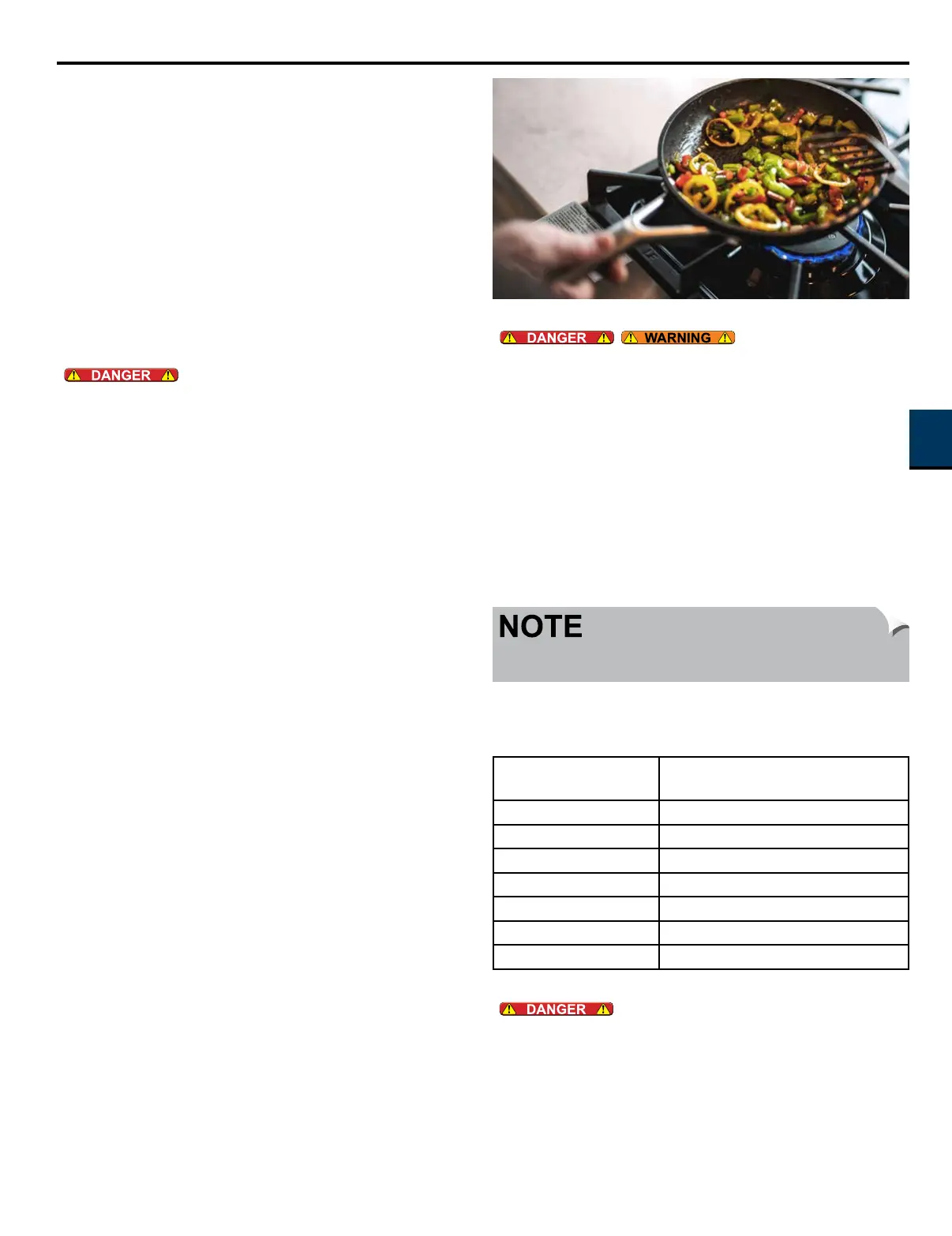
Cooking With Propane Gas
Unlike homes, the amount of oxygen supply is limited due to the size
of the RV. Proper ventilation when using the cooking appliance(s) will
help avoid the danger of asphyxiation.
Calculating Propane Gas Usage
Most RV gas appliances are operated intermittently, and each has
a different BTU rating. You will need to consider this when planning
your propane supply and consumption. During cool temperature or
high wind conditions, furnace consumption can be extremely high.
To calculate your propane supply, take the BTU ratings for your
propane appliances and divide that into the BTU availability. Each
gallon of propane gas (3.785 liters) produces about 91,500 BTU’s
(96,528 kilojoules) of heat energy.
Propane consumption chart
The following chart provides average propane consumption
information.
(See page 60 & page 59)
Unless there is heavy use of hot water, the on-demand water heater
consumption of propane is minimal.
Appliance Average BTU Consumption per Hour
On Demand Water Heater 60,000 (max setting)
Refrigerator 1,200 – 1,500
Furnace 35,000 – 40,000
Range/oven 7,100
Range, rear burner 6,500
Range, front burner 9,000
Outside Grill 10,000
Traveling with Propane
Make certain your propane tank is properly fastened in place, and
your tank valves are closed during travel.
(See page 60)
Page 57
FUEL & PROPANE SYSTEM
7




 To Next Page