24
Subwoofer Placement and Polarity Setting
Because the human ear cannot easily recognize where low frequencies are originating from (they are said
to be “nondirectional”), subwoofer placement is not nearly as critical as main channel speaker positioning.
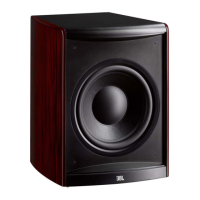
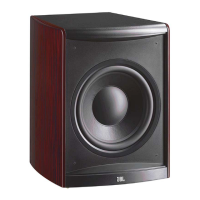
The LSR4312SP is designed to be placed directly on the fl oor and not elevated or mounted in any way.
The sixth (bottom-most) DIP switch on the rear panel of the LSR4312SP allows you to manually set the
polarity of the subwoofer to either 0° (no change) or 180° (inverse polarity). The correct polarity setting
is automatically enabled when an RMC calibration is carried out for a networked LSR4300 system and
the switch should always be left in its OFF (0°) position. When RMC is enabled, the switch has no effect.
However, if you are using the LSR4312SP in a non-networked system (i.e., with main speakers other
than the LSR4328P or LSR4326P), you’ll need to manually place this switch in whichever setting yields
a stronger perceived bass response at the mix position. (See Appendix C on page 41 in this manual for
more information about using the LSR4312SP with speakers other than LSR4328P and LAS4326P.)
When a single subwoofer is being used to reproduce the low frequencies of a stereo system (that is, with
bass management), it should optimally all be placed somewhere between the two main speakers. Precise
central placement is not necessary. Centered positioning in the room can sometimes cause unwanted
cancellation, so it is recommended that the subwoofer be slightly placed off-center
and not at the
midpoint between the left and right walls.
When two subwoofers are used to extend the low frequency of a stereo system, one subwoofer should be
placed near the left speaker and the other subwoofer should be placed near the right speaker.
If a single subwoofer is being used in a surround sound setup (whether or not bass management is being
used), it should be placed somewhere near, or behind, the front Center channel speaker.
Reference - Subwoofer Placement


 To Next Page