EasyManua.ls Logo

Jeep UNIVERSAL CJ-2A - Page 109

Jeep UNIVERSAL CJ-2A
281 pages
Print Icon
To Next Page IconTo Next Page
To Previous Page IconTo Previous Page
Loading...
F
FUEL
SYSTEM
When
the
windshield
wiper
motor
is
turned
on,
but
manifold
vacuum
is
greater
than
the
vacuum
created
by
the
booster
pump,
air
flows
from
the
wiper
motor
through
both
valves
of
the
vacuum
booster.
As
manifold
vacuum
drops
off
as
a
result
of
the
engine
operating
under
low
speed
and
high
load,
the
vacuum
created
by
the
vacuum
booster
will
be
greater
than
engine
intake
manifold
vacuum
and
:the
pump
will
operate
the
wiper
motor
when
the
wiper
control
switch
is
turned
on.
Refer
to
Fig.
131.
Remove
the
eight
cover
attaching
screws
and
1ockwashers,
and
remove
the
cover,
diaphragm
spring
and
spring
seat.
Detach
the
diaphragm
rod
from
the
rocker
arm
and
remove
the
diaphragm.
The
valve
assemblies
are
pressed
into
the
cover
and
body
and
lightly
staked.
They
may
be
removed
with
the
point
of
a knife
blade.
If
installing new
valves
be
sure
the
inlet
and
outlet
valves
are
correctly
positioned
and
stake
them
lightly
with
a
small
punch.
Assemble
the
vacuum
pump
in
the
reverse
order
of
disassembly,
drawing
the
cover
attaching
screws
up
evenly
and
tightly.
F -43. Fuel Pump Testing
Four
tests
are
presented
in
following
paragraphs
to
test
for
proper
operation
of
the
fuel
pump.
In
addi-
tion,
check
the
following:
a.
Check
for
secure
mounting
of
the
fuel
pump.
The
rocker
arm
may
be
working
the
entire
pump
up
and
down,
rather
than
just
the
pump
dia-
phragms.
b.
Remove
and
clean
the
fuel
sediment
bowl.
c.
Check
all
fuel lines.
F-44. Volume·Check
To
measure
fuel
pump
capacity
(amount
of
fuel
delivered
in
a
given
time)
di:sconnect
the
pump-to-
carburetor
line
at
the
carburetor
end.
Place
the
open
end
of
the
line
in
a
suitable
container.
Start
the
engine
and
operate
at
normal
idle speed.
Delivery
should
be
one
quart
U.S.
[1
ltr.]
within
one
minute.
F -45. Pressure Check
To
measure
fuel
pump
pressure
(force
of
fuel de-
livery)
disconnect
the
pump-to-carburetor
line
at
the
carburetor
end.
Plug
a
pressure
gauge
and
T-fitting
into
the
open
end
of
this
line
and
into
the
carburetor.
Start
the
engine
and
operate
at
normal
idle
speed.
Pressure
should
be
2
~
to
3%: psi.
[0,716 a 0,264 kg-cm2]
at
1800
rpm.
and
at
16n
[406 mm.]
above
the
outlet.
F-46. Vacuum Check
To
measure
fuel
pump
vacuum
(pull
of
the
pump
at
the
inlet
side)
disconnect
the
pump-to-fuel-tank
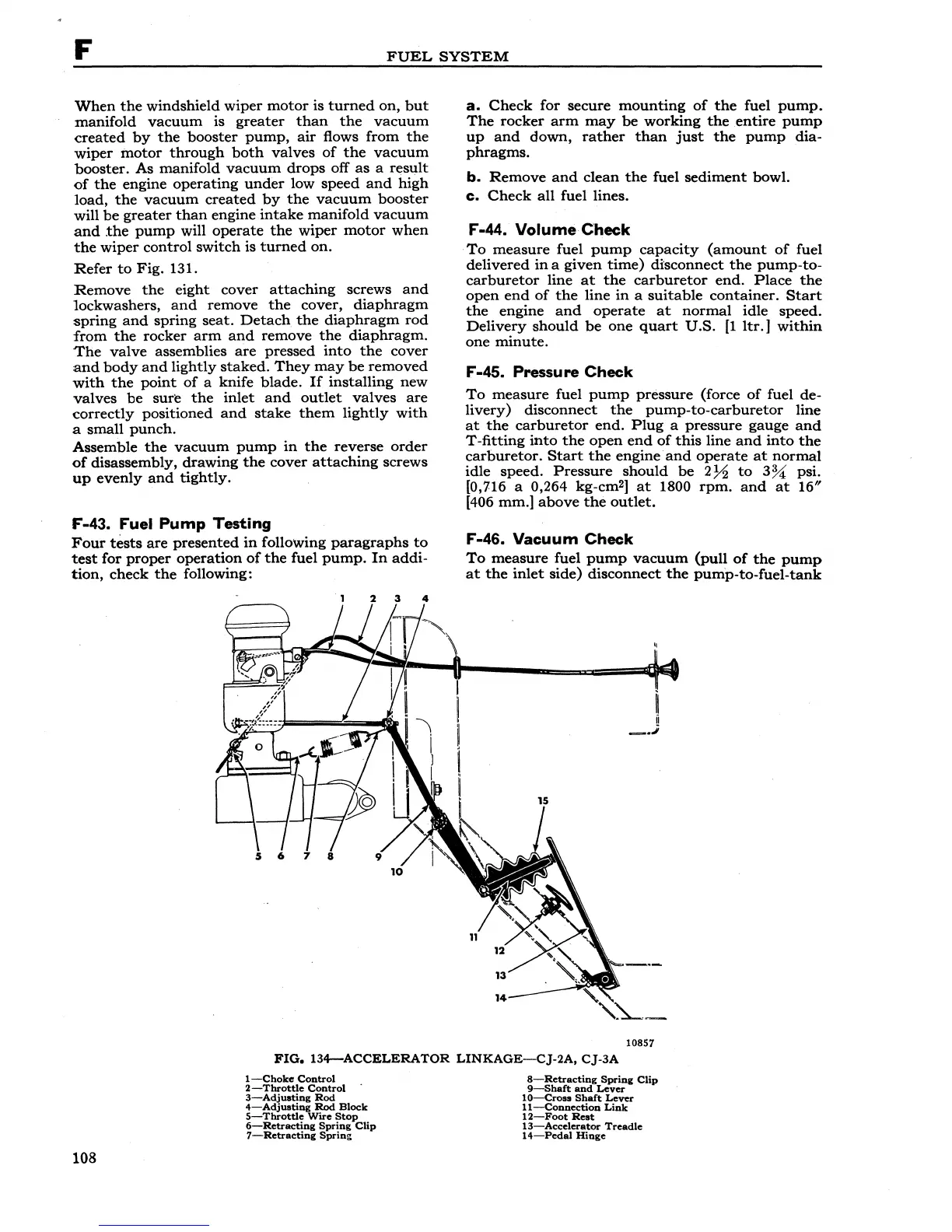
10857
FIG.
134-ACCELERATOR
LINKAGE-CJ-2A,
CJ-3A
108
1-Choke
Control
2-Throttle
Control
·
3-Adjueting
Rod
4-Adjuating
Rod
Block
5-Throttle
Wire
Stop
6-Retracting
Spring
Clip
7-Retracting
Spring
8-Retracting
Spring
Clip
9--8haft
and
Lever
10-Cross
Shaft
Lever
11-connectioli
Link
12-Foot
Rest
13-Accelerator
Treadle
14-Pedal
Hinge