EasyManua.ls Logo

Jeep UNIVERSAL CJ-2A - Page 140

Jeep UNIVERSAL CJ-2A
281 pages
Print Icon
To Next Page IconTo Next Page
To Previous Page IconTo Previous Page
Loading...
'Jeep'
U
NIVERSAL
and
'
Jeep
'
DISPATCHE
R
I
b.
Voltage
do
es
not
build
up-regulator
ou
t
of
a
d-
j
us
tment, field
circuit
open,
grounded
s
er
ies
circuit.
See
test
8.
1-
40. T
est
Se
ven
Re
mov
e
the
r
egulato
r
cover
and
with
the
gener
a
to
r
oper
a
ting
at
a
medium
speed
hold
the
circ
uit
breaker
contacts
closed.
a.
Ammeter
shows
no
charge--open
circuit
breaker
sh
un
t
winding,
in
c
orrec
t
setting
of
circuit
breaker
,
or
dirty
contacts.
C
lean
contacts
and
r
eset
ci
rcuit
breaker
as
in
P
ar.
I-27a.
If
the
circuit
breaker
can-
not
be
se
t,
th
e
shun
t coil
is
open
and
the
reg
ula
to
r
sh
ou
ld
be
removed
f
or
overhau
l.
b.
No
generat
or
outpu
t-
clean
th
e
circuit
breaker
contacts
and
try
the
test
again
.
If
there
is
still
no
charge
th
e series
windin
gs
ar
e
open
and
the
regu
-
la
tor
should
be
removed
for
overhau
l.
1-41 . T
est
Ei
ght
Run
the
generator
at
idle
speed
and
momentari
ly
connect
a
jump
er
from
the
F-terrninal
to
the
regu-
lator
base.
a.
Voltage
builds
up
--open
field
ci
rcui
t
or
r
egula
-
to
r
out
of
adjustment.
See
test
9.
b.
Voltag
e
does
not
build
u
p-g
rounded
series
cir-
cuit.
R
emove
regulator
for
overhaul.
1-
42. T
es
t
Nin
e
Operate
at
a
medium
sp
eed
with
t he
ju
mper
re-
moved.
Rem
o
ve
th
e
regulator
cover
and
hold the
voltag
e
regulator
contacts
cl
os
ed.
a.
Voltage
builds
up
-
voltage
r
eg
ul
ato
r
contacts
burned
or
dirt
y
or
in
correct
regulator
set
t
in
g.
Clean
the
contacts
and
adjust
the
regulator
as
in
Par.
I-27.
b.
Volt
age
does
not
build
up
- cle
an
con
tac
ts
and
repeat
test
.
If
th
e
voltage
still
does
not
build
up
,
see
test
10.
1-
43. T
es
t Ten
Remove
the
regulat
or
c
over
and
hold
the
c
urr
ent
regulator
contacts
closed.
a .
Voltag
e
builds
up- c
urr
ent
re
gu
lat
or
contacts
burned
or
dir
ty
or
in
cor
rect
re
gul
ator
setting.
Clean
the
contacts
and
adjust
the
regulator
as
in
Par.
I-27.
b.
Volt
age
does
not
build
up
-
clean
the
contacts
and
repeat
th
e
test
.
If
the
voltage
still
does
not
build
up
remove
the
regulator
for
an
overhaul.
1-44.
STARTING
MOTO
R
Th
e
starting
motor
is
similar
in
construction
to
th
e
generator,
bu
t
the
d
esign
of
the
parts
is
different
due
to
it
being
necessary
for
the
starting
motor
to
handl
e a
large
amou
nt
of
current
for
short
intervals.
Both
motor
and
generator
requir
e
a
frame,
field coils,
armatur
e
and
brushes
.
Fig.
157
illustrates
a
typical
s
ta
rting
motor,
the
in
-
ternal
construction
of
which
is
represen
tat
iv
e
of
all
the
motors
u
sed
on
the
models
discussed
here.
T
here
are
some
differences
in
starting
switch
con-
t
rol
and
flywheel
drive
mechanism
which
are
covered
separate
ly
. Also,
the
12-volt st
arting
motor
has
no
band
cover,
i
tem
3.
Eff
ective
with
Model
CJ-3A
veh
i
cl
e
Serial
No.
30973, a 4Yz"
[11
,43 ern.}
star
ting
motor
was
adopted.
Thi
s
change
incorporat
ed
a
new
star
t
in
g
swi
tch
and
flywheel
drive
whi
ch
are
described
separately
below.
This
starte
r
is
equipped
with
seal
ed
type
absorben
t
bronz
e
bearings
and
no
lu
brication
is
required.
Th
e service
procedures
ou
t-
lined
below
will
appl
y
to
the
s
tart
in
g
motors
of
all
the
models
covered
here.
1-
45. Mai
nte
n
ance
Procedure
A
per
i
odic
inspect
i
on
should
be
made
of
th
e
star
t-
ing
cir
c
ui
t.
Whi
le
the
interval
between
these
checks
will
vary
accordin
g
to
the
type
of
service,
it
shoul
d,
under
normal
cond
itions,
be
m
ade
every
500
hour
s
of
operation.
At
th
is c
heck
the
foll
owin
g
points
shoul
d
be
inspected.
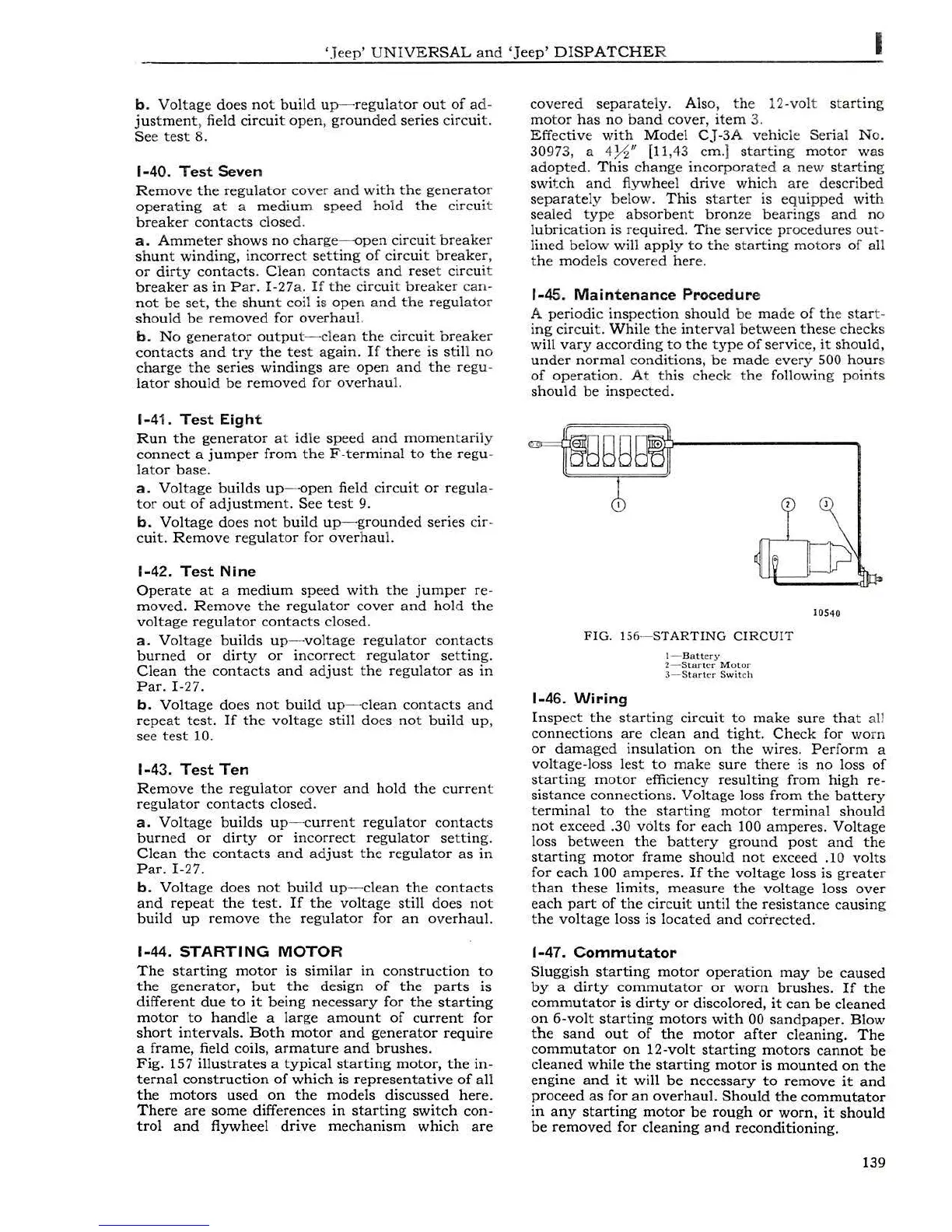
FI
G.
!5
6-
STAR
TING
CIRCUIT
1-46. Wiri
ng
!-
Batt
ery
2-
Stnrtcr
Mo
tor
3- St
Arter
Swit
ch
105
40
Inspe
ct
the
starting
c
ir
cu
it
to
ma
ke
su
re
tha
t a
ll
connections
ar
e
clean
and
tight.
Ch
eck
for
wo
rn
or
damaged
ins
u
lation
on
the
wires. P
erfo
rm
a
voltage
-loss l
est
to
make
sure
the
re
is
no
loss
of
starting
motor
efficiency r
esulting
from
high
re
-
sis
tance
connections.
Volt
age
loss
from
the
battery
terminal
to
the
starting
motor
termin
al
should
not
exce
ed
.30
volts
for
each
100
amperes
.
Voltage
loss
between
th
e
battery
ground
post
and
the
star
ting
motor
frame
shoul
d
no
t exceed
.1
0
volts
for
each
100
amperes.
If
the
voltage
loss is
greater
th
an
these
limi
ts
,
measure
the
vo
lta
ge loss
over
each
part
of
the
circuit
un
til
the
resistance
causing
the
voltage
loss
is
located
and
cor
r
ected.
1-47.
Commu
ta
tor
Sluggish
starting
motor
o
peration
may
be
caused
by
a
dirty
commutator
or
worn
brushes.
If
th
e
commutator
is
dirty
or
discolored,
it
can
be
cleaned
on
6-volt
s
ta
rting
motors
with
00
sandpaper.
Blow
the
sand
out
of
the
motor
after
cleaning.
The
commutator
on
12-volt
starting
motors
cannot
be
cleaned
while
th
e
starting
mo
tor
is
mo
u
nted
on
the
engine
and
it will
be
necessary
to
remove
it
and
proceed
as
for
an
overhaul.
Should
the
commu
t
ator
in
any
starting
motor
be
rough
or
worn,
it
should
be
removed
for
cleaning
and
reconditioning.
139