EasyManua.ls Logo

Jeep UNIVERSAL CJ-2A - Page 74

Jeep UNIVERSAL CJ-2A
281 pages
Print Icon
To Next Page IconTo Next Page
To Previous Page IconTo Previous Page
Loading...
'Jeep'
UNIVERSAL
and
'Jeep'
DISPATCHER
E
E-59.
Inspection
of
Valves, Springs,
and
Guides
Clean
the
valves
on
a
wire
wheel,
making
sure
that
all
carbon
is
removed
from
the
top
and
the
under-
side
of
the
heads
and
that
all
gum
and
varnish
deposits
are
removed
from
the
stems.
Polish
the
valve
stems
with
steel
wool
or
crocus
cloth.
Visually
inspect
all
valves
for
warpage,
cracks,
or
excessive
burning
and
discard
if
one
of
these
conditions
exists.
Replace
any
worn,
pitted,
or
corroded
valves
that
cannot
be
cleaned
with
a
wire
brush.
Replace
any
valves
when
seats
are
pitted,
burned,
or
corroded
so
badly
that
they
cannot
be
cleaned
up
with
a
light
refacing
on
.a
valve
refacing
machine.
Replace
valves
with
marks
of
scoring
or
abrasion
visible
on
the
stem.
Replace
any
valves
with
bent
stems
which
will
be
apparent
when
the
valve
is
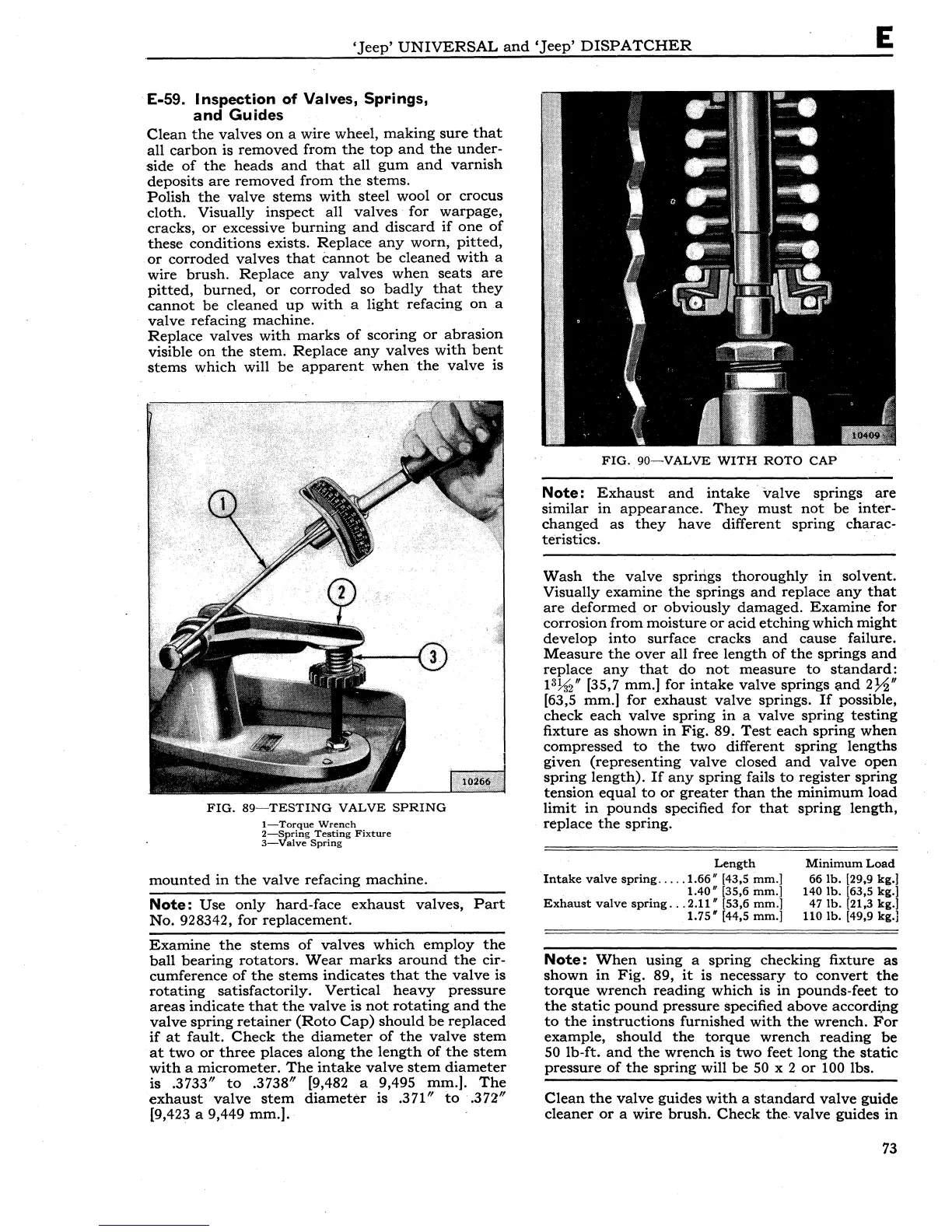
FIG.
89-TESTING
VALVE
SPRING
1-Torque
Wrench
2-Spring
Testing
Fixture
3-Valve
Spring
mounted
in
the
valve
refacing
machine.
Note:
Use
only
hard-face
exhaust
valves,
Part
No.
928342, for
replacement.
Examine
the
stems
of
valves
which
employ
the
ball
bearing
rotators.
Wear
marks
around
the
cir-
cumference
of
the
stems
indicates
that
the
valve
is
rotating
satisfactorily.
Vertical
heavy
pressure
areas
indicate
that
the
valve
is
not
rotating
and
the
valve
spring
retainer
(Roto
Cap)
should
be
replaced
if
at
fault.
Check
the
diameter
of
the
valve
stem
at
two
or
three
places
along
the
length
of
the
stem
with
a
micrometer.
The
intake
valve
stem
diameter
is
.3733"
to
.3738" [9,482 a 9,49S
mm.].
The
exhaust
valve
stem
diameter
is .371"
to
.37Z"
[9,423 a 9,449
mm.].
FIG.
90-VALVE
WITH
ROTO
CAP
Note:
Exhaust
and
intake
valve
springs
are
similar
in
appearance.
They
must
not
be
inter-
changed
as
they
have
different
spring
charac-
teristics.
Wash
the
valve
springs
thoroughly
in
solvent.
Visually
examine
the
springs
and
replace
any
that
are
deformed
or
obviously
damaged.
Examine
for
corrosion
from
moisture
or
acid
etching
which
might
develop
into
surface
cracks
and
cause
failure.
Measure
the
over
all free
length
of
the
springs
and
replace
any
that
do
not
measure
to
standard:
13!1
2
" [3S,7 mm.]
for
intake
valve
springs
and
272"
[63,S
mm.]
for
exhaust
valve
springs.
If
possible,
check
each
valve
spring
in
a
valve
spring
testing
fixture
as
shown
in
Fig.
89.
Test
each
spring
when
compressed
to
the
two
different
spring
lengths
given
(representing
valve
closed
and
valve
open
spring
length).
If
any
spring
fails
to
register
spring
tension
equal
to
or
greater
than
the
minimum
load
limit
in
pounds
specified for
that
spring
length,
replace
the
spring.
Length
Intake
valve
spring
.....
1.66"
[43,5
mm.]
1.40"
[35,6 mm.]
Exhaust
valve
spring
...
2.11"
[53,6
mm.]
1.75'
[44,5
mm.]
Minimum
Load
66
lb.
[29,9 kg.]
140
lb.
[63,5 kg.]
47
lb.
[21,3 kg.]
110
lb.
[49,9 kg.]
Note:
When
using
a
spring
checking
fixture
as
shown
in
Fig.
89,
it
is
necessary
to
convert
the
torque
wrench
reading
which
is
in
pounds-feet
to
the
static
pound
pressure
specified
above
accordi.ng
to
the
instructions
furnished
with
the
wrench.
For
example,
should
the
torque
wrench
reading
be
SO
lb-ft.
and
the
wrench
is
two
feet
long
the
static
pressure
of
the
spring
will
be
SO
x 2
or
100 lbs.
Clean
the
valve
guides
with
a
standard
valve
guide
cleaner
or
a
wire
brush.
Check
the.
valve
guides
in
73

Related product manuals