EasyManua.ls Logo

Jeep UNIVERSAL CJ-2A - Page 95

Jeep UNIVERSAL CJ-2A
281 pages
Print Icon
To Next Page IconTo Next Page
To Previous Page IconTo Previous Page
Loading...
F
FUEL
SYSTEM
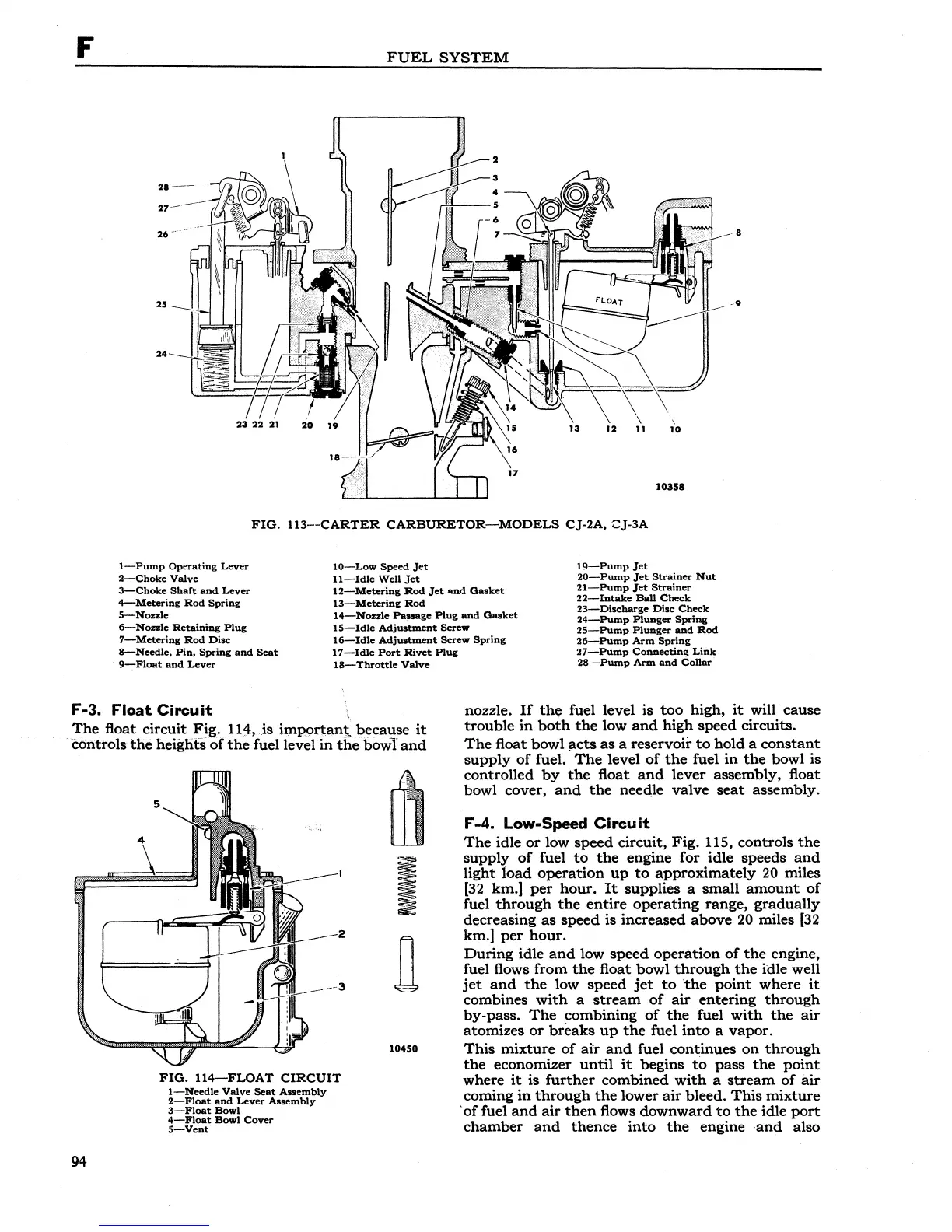
FIG.
113--CARTER
CARBURETOR-MODELS
CJ-2A,
CJ-3A
1-Pump
Operating
Lever
2-Choke
Valve
3-Choke
Shaft
and
Lever
4-Metering
Rod
Spring
5-Nozzle
6-Nozzle
Retaining
Plug
7-Metering
Rod
Disc
8-Needle,
Pin,
Spring
and
Seat
9-Float
and
Lever
10-Low
Speed
Jet
11-ldle
Well
Jet
12-Metering
Rod
Jet
,.nd
Gasket
13-Metering
Rod
14-Nozzle
Passage
Plug
and
Gasket
15-ldle
Adjustment
Screw
16-Idle
Adjustment
Screw
Spring
17-ldle
Port
Rivet
Plug
18-Throttle
Valve
19-Pump
Jet
20-Pump
Jet
Strainer
Nut
21-Pump
Jet
Strainer
22-Intake
Ball
Check
23-Discharge
Disc
Check
24-Pump
Plunger
Spring
25-Pump
Plunger
and
Rod
26-Pump
Arm
Spring
27-Pump
Connecting
Link
28-Pump
Arm
and
Collar
8
·9
F-3. Float Circuit
nozzle.
If
the
fuel level is
too
high,
it
will
cause
trouble
in
both
the
low
and
high
speed
circuits.
The
float
bowl
acts
as
a
reservoir
to
hold
a
constant
supply
of
fuel.
The
level
of
the
fuel
in
the
bowl is
controlled
by
the
float
and
lever
assembly,
float
bowl cover,
and
the
need,le
valve
seat
assembly.
The
float
circuit
Fig
...
114,
is
important.
because
it
controls
the
heights
of
the
fuel level
in
the
bowl
and
94
FIG.
114-FLOAT
CIRCUIT
1-Needle
Valve
Seat
Assembly
2-Float
and
Lever
Assembly
3-Float
Bowl
4-Float
Bowl
Cover
5-Vent
10450
F-4. Low-Speed
Circuit
The
idle
or
low
speed
circuit,
Fig.
115,
controls
the
supply
of
fuel
to
the
engine
for
idle
speeds
and
light
load
operation
up
to
approximately
20 miles
[32
km.]
per
hour.
It
supplies
a
small
amount
of
fuel
through
the
entire
operating
range,
gradually
decreasing
as
speed
is
increased
above
20 miles
[32
km.]
per
hour.
During
idle
and
low
speed
operation
of
the
engine,
fuel flows
from
the
float
bowl
through
the
idle well
jet
and
the
low
speed
jet
to
the
point
where
it
combines
with
a
stream
of
air
entering
through
by-pass.
The
combining
of
the
fuel
with
the
air
atomizes
or
breaks
up
the
fuel
into
a
vapor.
This
mixture
of
air
and
fuel
continues
on
through
the
economizer
until
it
begins
to
pass
the
point
where
it
is
further
combined
with
a
stream
of
air
coming
in
through
the
lower
air
bleed.
This
mixture
,
of
fuel
and
air
then
flows
downward
to
the
idle
port
chamber
and
thence
into
the
engine
and
also

Related product manuals