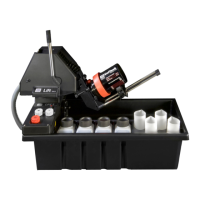
chemicals for the tank as it is loaded.
Be aware that with some black and white films, the processing times are different for 35 mm, 120,
and sheet films of the same type, and may require a larger volume than minimums stated for the
tank.
You should not use any tank or drum combination that would require more than the maximum
volume of solution, even if it would physically fit the processor. Use of more than the maximum
volume of solution will overburden the rotation motor, and may eventually damage it.
Caution: Always start with completely dry reels, tank or drum. Loading wet will be difficult and
cause watermarks on the film.
Caution: JOBO's reels and center cores are designed to connect to each other. The center core
and the reel are locked together, preventing the reel from rotating independently from the tank, or
rattling. Do not substitute other reels or center cores. Using non-JOBO components will likely
cause damage to the film or inferior processing.
Notes:
Different reels have different volume requirements. Be sure that the reel with the highest volume
requirement is chosen for reference when combining types of reels in one tank. Some tanks have
two volumes of chemicals listed on its side. One volume is for 'Inversion' the other is for 'Rotary'.
The inversion volume is the amount necessary for hand processing. The rotary volume is what is
required for use with a JOBO processor.
If you are using a tank with an extension module (# 1530 or # 2560), the total volume required is
the sum of the tank and all modules added together. Be careful to note that some labels on
modules refer to the volume requirements of the module by itself, while others refer to the volume
requirements of the module and base tank together. Check the tank (or module) number stated on
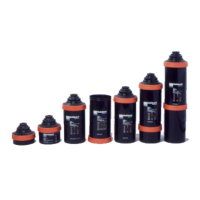
the label to verify. Use the tank and drum table page to identify the tank and modules This table
also has the volume requirements listed.
The plastics used in JOBO film tanks or drums are safe for use with any currently available infrared
film. They are opaque to the frequencies of infrared light to which the films are sensitive. This
includes the Konica and Kodak High Speed Infrared films for black and white, and Kodak Aero-
Infrared Color (E-4) film. Different handling techniques may be required for loading or processing
these special purpose films. Observe the film manufacturers' instructions.
Caution: Do not use print drums to process sheet film. All modern films have an anti-halation layer
coated on the back (base) side of the sheet. This layer is removed during processing by chemicals
flowing over the base side of the film. The rails of the print drums inhibit the flow of chemicals to
the base side. If the backing of the film is not cleared during processing, dark spots or lines will be
evident on the film. Print paper does not have an anti-halation coating and therefore is not affected
by this issue. Some duplicating or display transparency materials processed with print chemicals
also have an anti-halation backing, so check the manufacturer's specifications to see if it does. If
the transparency material does have an anti-halation backing, it must be processed in a film or
Expert Drum.


 To Next Page