
 Need help?
Do you have a question about the Johnson Controls YORK Tempo YLAA0080SE and is the answer not in the manual?
Details Johnson Controls' warranty terms, conditions, and claim procedures for the equipment.
Lists applicable safety and quality standards and codes the YLAA chillers comply with.
Outlines primary responsibilities of operating personnel for personal and machinery safety.
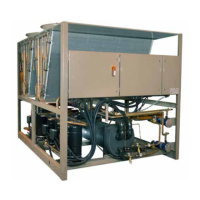
Describes the chiller's compressors, cooler (evaporator), condenser, and control center.
Explains the coding system used to identify unit features, capacity, and design.
Details immediate post-receiving inspection for damage and reporting procedures.
Specifies limitations for voltage, temperatures, and flows to ensure safe and efficient operation.
Details the absolute minimum and maximum voltage limits for unit operation.
Details electrical data for micro panel power supply, including voltage and current protection.
Lists voltage codes and their corresponding unit power minimum and maximum ranges.
Explains minimum circuit ampacity, disconnect switch requirements, fuse sizes, and wire grounding.
Presents elementary wiring diagrams for single/dual point wiring options across multiple sheets.
Provides installation instructions for Durulene vibration isolators.
Provides installation and adjustment instructions for SLRS seismic isolators.
States that commissioning must be performed by authorized Johnson Controls personnel.
Lists basic checks to be made with unit power switched OFF, including inspection and refrigerant charge.
Details checks for power on, including switch settings, compressor heaters, water system, and flow switch.
Lists unit checks to perform before initial start, including inspection, piping, and refrigerant.
Details checks for panel power, voltage, setpoints, options, and condenser fan cycling.
Describes the chiller's operating sequence from power application to compressor staging and shutdown.
Introduces the microprocessor-based control system for chiller operation.
Explains how pressing the STATUS key displays current chiller operating status messages.
Explains the calculation and programming of system trip volts for high current.
Defines unit safeties as faults causing all compressors to shut down, with auto-reset and lockout conditions.
Indicates a safety shutdown due to low ambient temperature, with restart conditions.
Shows a safety shutdown due to low leaving chilled liquid temperature, with restart conditions.
States that soft start must be selected as 'DISABLED' on all chillers.
Details the discharge pressure cutout function and its interaction with the mechanical HP switch.
Explains that 'LIQUID CHILLER' must be displayed, warning against other modes.
Provides a quick reference list of status key messages categorized into General, Fault, and Unit Safeties/Warnings.
Warns to set the unit type to 'LIQUID CHILLER' to prevent compressor damage.
Explains how to obtain a printout of the last 9 Safety Shutdowns and their conditions.
Lists programmable limits and default values for program key settings.
Explains how capacity control is initiated based on permissive inputs and flow switch closure.
Explains anticipatory controls to prevent low-pressure cutouts by preventing loading below a threshold.
Details controls that unload the system before reaching safety limits due to high load or dirty coils.
Explains the programmable anti-recycle timer function to prevent short cycling.
Details how the Remote Reset Option allows setpoint reset via 0-10VDC or 4-20mA signals.
Mandates constant chilled liquid flow when using Return Chilled Liquid Control.
Warns against clearing buffers due to potential loss of important information.
Describes Service Mode for enabling/disabling outputs, changing configuration, and viewing inputs.
Covers chiller configuration settings like soft start, refrigerant type, and expansion valve type.
Stresses correct programming for soft start, refrigerant, and expansion valve type to prevent damage.
Explains how to view digital and analog inputs via OPER DATA key in Service Mode.
Lists common problems, their causes, and solutions for unit operation issues.
Troubleshooting steps for issues with the control panel display or unit operation.
Troubleshooting steps for low suction pressure faults, including charge, filters, and TXV.
Continues the troubleshooting table with more problems and solutions.
Troubleshooting steps for low liquid temperature faults, including cutout adjustment and sensor issues.
Troubleshooting steps for compressors not starting, including demand, sensors, and overload.
States that system maintenance is the owner's responsibility.
Warns that improper maintenance during warranty may void coverage.
Provides guidance on checking compressor oil level and oil analysis.
Describes reading/modifying chiller data via serial communication protocols.
Lists real-time error numbers and their descriptions encountered during communication setup.
Lists required setup values for BAS communication protocols.
Provides a detailed data map for BACnet and Modbus communications.
Continues the YorkTalk 2 communications data map, listing operational and fault codes.
Lists R410A pressure and corresponding temperature values for system diagnostics.
 General
| Brand | Johnson Controls |
|---|---|
| Model | YORK Tempo YLAA0080SE |
| Category | Chiller |
| Language | English |


 To Next Page