
 Need help?
Do you have a question about the Johnson Controls YORK Tempo YLAA0156HE and is the answer not in the manual?
Details Johnson Controls' warranty terms, conditions, and limitations for the equipment.
Discusses design standards, quality accreditations, and compliance with industry codes.
Lists applicable industry standards and codes that the chillers comply with.
Outlines primary responsibilities for safe operation, maintenance, and personnel.
Warns about hazards related to refrigerant pressure systems and the need for trained personnel.
Covers grounding, power isolation, and safe servicing practices for electrical components.
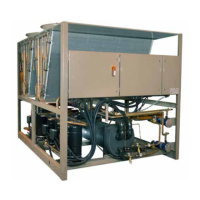
Describes the YORK YLAA Air-Cooled Scroll Chillers and their key features.
Provides an overview of the chiller's main system components and design.
Describes the NEMA 3R/12 cabinet, display, and keypad interface.
Details communication capabilities like BACnet, Modbus, and optional N2/LON.
Details available accessories and options for the chiller unit.
Identifies major components of the chiller unit with diagrams.
Explains the unit nomenclature (PIN) and its constituent parts.
Details the structure and meaning of the unit's basic nomenclature.
Details the options and codes for various features within the Product Identification Number.
Diagram illustrating the refrigerant flow path within the chiller system.
Explains the process and instrumentation of the chiller system.
Procedures and precautions for unit delivery, storage, and preparation.
Instructions for safely moving the chiller unit, including lifting points.
Pre-installation checks required before placing units in operation.
Guidelines for unit placement and necessary clearances for airflow and service.
Requirements for the unit's mounting foundation, ensuring stability and levelness.
General guidelines for connecting chilled liquid piping for efficient operation.
General requirements and recommendations for fitting duct work to the unit.
Information on factory-mounted wiring and requirements for field wiring.
Requirements for field power wiring, including disconnect switches and NEC compliance.
Diagrams illustrating single-point power supply connection options.
Diagrams showing control wiring inputs to the unit.
Diagrams showing control wiring outputs from the unit.
Details operational limitations for temperature and flow to ensure rated performance.
Specifies absolute voltage limits to prevent compressor damage.
Discusses evaporator pressure drop curves and water flow rates.
Presents physical dimensions, weights, and specifications for various YLAA models.
Detailed physical data including dimensions, weights, and component counts.
Provides essential electrical specifications and data for the chiller unit.
Details power supply requirements and circuit protection for the micro panel.
Explains electrical specifications, NEC compliance, and wiring considerations.
Provides electrical data for compressors and fans, excluding pump specifications.
Provides electrical data including specifications for pump configurations.
Explains electrical notes and provides a legend for designations.
Illustrates power panel and component connections.
Details the connection points and diagrams for the micro panel.
Explains the logic and mapping for condenser fan operation stages.
Instructions for installing and adjusting seismic isolators shipped after June 15, 2008.
Installation and adjustment instructions for SLRS seismic isolators.
Important note emphasizing that commissioning requires qualified Johnson Controls personnel.
Basic checks to be made with the unit power switched OFF.
Procedures for checking refrigerant charge, leaks, and evacuation.
Verify site supply voltage matches unit requirements and limits.
Steps for performing commissioning after applying power to the chiller.
Verify chilled water flow switch installation, wiring, and straight pipe runs.
Comprehensive checklist for pre-startup and startup procedures.
Checklist items for the system prior to initial start.
Detailed checks of unit components and piping before operation.
Procedures for unit startup, including panel checks and setpoint verification.
Procedure for verifying superheat and subcooling levels for system efficiency.
Steps for performing a thorough leak check on compressors, fittings, and piping.
Describes the chiller's operating sequence after power application and startup.
Introduction to the microprocessor-based control system.
Overview of the control system's capabilities and components.
Explains how to use the STATUS key to check current chiller operating status.
How to check current chiller operating status and interpret displayed messages.
Explains safety thresholds and faults causing system or unit shutdowns.
Defines system safeties that cause individual system shutdowns.
Defines unit safeties that cause all running compressors to shut down.
Explains the function of the display and print keys for accessing information.
Describes accessing and navigating unit and system operating parameters.
Explains the function of the PRINT key for obtaining printouts.
Describes obtaining a printout of information from the last 9 safety shutdowns.
Explains how to access and view unit/system safety shutdown information.
Instructions for programming cooling setpoints and range.
Explains the display and programming for leaving chilled liquid control.
Explanation of setpoints and ranges for return chilled liquid control.
Instructions for programming the seven-day schedule and holiday settings.
Explains how to access and program various operating parameters.
Describes accessing and programming various user-configurable options.
Explains selection between local panel control and remote BAS/ISN control.
Details options for manual or automatic lead/lag control between systems.
Explains chiller behavior after a power failure (automatic vs. manual restart).
Explains unit type setting ('LIQUID CHILLER' is mandatory).
Explains how the chiller controls its capacity based on cooling load.
Controls to prevent the unit from reaching low-pressure cutouts.
Controls to unload the system before reaching high-pressure safety limits.
Description of how the chiller controls leaving chilled liquid temperature.
Explanation of lead/lag operation and compressor sequencing for system balance.
Details on controlling return chilled liquid temperature via compressor staging.
Explanation of lead/lag and compressor sequencing for run-hour equalization.
Explanation of the anti-recycle timer function and programming.
Describes standard condenser fan control based on discharge pressure.
Explains the load limiting feature to prevent exceeding desired unit loading values.
How to perform temperature reset via BAS/EMS signals using voltage or current.
Information on enabling and using Service Mode for unit configuration.
Details on viewing and modifying unit outputs within Service Mode.
Configuration settings accessible in Service Mode, including refrigerant type.
How to view analog and digital inputs to the microboard in Service Mode.
Diagram showing the physical layout of the microboard and its connectors.
Procedures for checking digital and analog inputs and outputs.
Explanation of analog temperature inputs and sensor connections.
Table correlating chilled liquid temperature readings with voltage signals.
Explanation of analog pressure inputs and transducer connections.
General troubleshooting guide for common unit problems.
Table listing problems, their causes, and recommended solutions.
Troubleshooting steps for low suction pressure faults.
Troubleshooting steps for high discharge pressure faults.
Continuation of the troubleshooting table with more problems and solutions.
Troubleshooting steps for low liquid temperature faults.
Troubleshooting for motor protector or high pressure cutout faults.
Troubleshooting steps when compressors fail to start.
Troubleshooting steps for issues causing a lack of cooling effect.
Important notes regarding maintenance responsibilities and warranty implications.
Maintenance procedures related to the unit's compressors.
Details on reading and modifying data via serial communication protocols.
Detailed explanation of BACnet and Modbus communication protocols and data points.
Comprehensive data map table for BACnet and Modbus registers.
Continuation of the BACnet and Modbus data map table.
Details on Yorktalk 2 communication, including received and transmitted data.
Data map table for Yorktalk 2 communications.
Continuation of the Yorktalk 2 data map table.
 General
| Model | YLAA0156HE |
|---|---|
| Category | Chiller |
| Brand | Johnson Controls YORK |
| Type | Air-Cooled Chiller |
| Cooling Capacity | 156 tons (Nominal) |
| Compressor Type | Scroll |
| Refrigerant | R-410A |
| Dimensions (L x W x H) | Varies based on specific configuration; refer to submittal data |
| Weight | Varies based on specific configuration; refer to submittal data |
| Operating Voltage | 460V |
| Power Supply | 460V/3Ph/60Hz |
| Energy Efficiency Ratio (EER) | 11.5 |


 To Next Page