EasyManua.ls Logo

jotron Tron SART - User Manual

jotron Tron SART
24 pages
Print Icon
To Next Page IconTo Next Page
Loading...
92478_UM_ SART_F 1
Question and Answer IconNeed help?

Do you have a question about the jotron Tron SART and is the answer not in the manual?

Summary

Abbreviations and Definitions

COSPAS Definition

Space System for the Search of Vessels in Distress.

GPS Definition

Global Position System.

EPIRB Definition

Emergency Position Indicating Radio Beacon.

Additional Definitions

VSWR Definition

Voltage standing wave ratio.

Processor Definition

Processor circuit card controlling system operations and computations.

RCC Definition

Rescue Coordination Centre.

Warnings and Important Information

Handling Electrostatic Sensitive Devices

Observe handling precautions to avoid static discharges which may damage devices.

Manufacturers Responsibilities and Recommendations

Disclaimer on inaccuracies, right to change products, and advice on authorized service agents.

Battery Safety Data Sheet

Safety Advice for Battery Handling

Advice on keeping batteries from children, keeping dry, and first aid for contact.

Fire-Fighting Measures for Batteries

Suitable extinguishing media and special exposure hazards during thermal decomposition.

Protective Equipment for Battery Handling

Recommended protective gear for handling batteries and dealing with fire situations.

Radio Log and Operator Obligations

Radio Equipment Testing

Testing Schedule and Procedures

Covers weekly, monthly testing of equipment and handling false alerts.

Test and Maintenance Record

General Description

Tron SART Features

Details on watertight, buoyant, rugged design, handling, indicators, and battery unit.

Technical Specifications

Electrical Specifications

Details on frequency, temperature range, radiated power, sweep type, sensitivity, and antenna pattern.

Mechanical Specification

Information on materials used, transponder dimensions, and bracket dimensions.

Functional Description

General SART Components

Overview of the Tron SART's main parts: upper module, battery module, and O-ring/screw ring.

Upper Module Details

Description of the upper module's printed circuit boards, VCO, antenna, and housing material.

Battery Module Details

Information on the battery module, its replacement interval, and ease of replacement.

Installation

Mounting Brackets

Details on the three available mounting brackets: storage, outdoor lifeboat, and fixed lifeboat.

Using the 1 m Rope

Guidance on using the 1m rope for hanging the Tron SART inside a life raft.

Using the 1 m Pole

Instructions for using the 1m pole to extend the height of the Tron SART.

Operation Instructions

Activating the Tron SART

Step-by-step guide to activate the Tron SART, including switch operation and indicator signals.

Deactivating the Tron SART

Procedure for deactivating the Tron SART by moving the switch to the 'OFF' position.

Testing the Tron SART

Instructions for testing the Tron SART using a ship's radar, including radar display patterns.

Maintenance and Troubleshooting

Maintenance Schedule

Required maintenance intervals: every 6 months for testing and every 4 years for battery replacement.

Service and Warranty

Information on warranty validity, service procedures, and out-of-warranty service.

Replacing the Battery Module

Step-by-step guide for replacing the battery unit, including opening, disconnecting, and reassembling.

Battery Disposal Procedures

Guidelines for proper disposal, incineration, land filling, and recycling of batteries.

Service Agents

Jotron Group Subsidiary Companies

Contact information for Jotron UK Ltd., Jotron Asia Pte. Ltd., and Jotron USA, Inc.

Overview

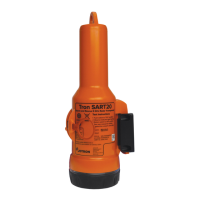
The Jotron Tron SART is an emergency radar transponder designed for search and rescue operations at sea, specifically to aid in locating distressed life rafts or lifeboats. It acts as a secondary alarm, helping search and rescue units (ships or helicopters) pinpoint the exact location of a distressed vessel within a larger area.

Function Description

The Tron SART operates by responding to radar signals from searching vessels. When interrogated by a 9 GHz radar signal, it immediately transmits a series of sweeps covering the complete maritime 3 cm radar band. These sweeps are detected on the radar screen of the searching unit, appearing as a distinctive pattern that guides them directly towards the distressed life raft or lifeboat.

The device is designed to be activated in emergency situations, typically after a primary alarm such as an Emergency Position Indicating Radio Beacon (EPIRB) or a distress call on VHF/HF radio has been initiated. Its operating range can extend up to 30 nautical miles, depending on the height at which the SART is placed and the radar height of the search and rescue unit. For instance, with the SART placed 1 meter above sea level and the searching radar at 20 meters, the range can be up to 10 nautical miles. For helicopters, the maximum distance can be approximately 30 nautical miles, depending on altitude. The transponder will not generate alarms beyond these distances.

The Tron SART is buoyant, ensuring it remains afloat if accidentally dropped into water. For optimal performance and maximum coverage, it should be placed in a vertical position and as high as possible. Metal objects close to the transponder should be avoided as they can limit its performance.

Usage Features

The Tron SART is designed for easy operation, with brief instructions printed directly on the unit.

  • Activation: To activate the Tron SART, the user must first break the seal at the switch, then pull the locking pin and ensure the switch moves to the "ON" position. An audible "BEEP" will confirm activation, and an indicator LED will begin to flash.
  • Placement: Once activated, the transponder should be placed or held in a vertical position as high as possible.
  • Indicators: The SART is equipped with both an LED and a built-in speaker. The LED normally flashes once per second to indicate that the SART is active. When a search and rescue unit approaches and the SART is hit by radar, the internal speaker will sound each time it is interrogated. A continuous sound from the loudspeaker signifies that the ship or helicopter is very close and continuously hitting the SART with its radar. At this point, a handheld VHF radio should be used to establish contact with the approaching rescue unit.
  • Deactivation: To deactivate the Tron SART, the switch should be moved to the "OFF" position, and the locking pin replaced.
  • Testing: The Tron SART can be tested using the ship's own 3 cm radar. During a test, the radar display will show different patterns depending on the range to the transponder. When close (less than 0.2 nautical miles), the signals may appear as rings. Further away (around 1 nautical mile), it will show rings at 2 nautical miles. When located more than 2 nautical miles away, the radar display will show 12 dots, indicating the direction to the transponder. Tests should be conducted in open sea to avoid interference from land echoes and should be kept as short as possible (maximum 5 minutes) to conserve battery capacity. A nearby ship's radar can also be used for testing, with communication established via a ship-to-ship VHF channel.
  • Mounting Options: Several mounting brackets and aids are available to facilitate correct mounting and use.
    • Storage Bracket (X-92422): This bracket is provided with the Tron SART for storage. It should be mounted vertically in an easily accessible location for emergencies.
    • Outdoor Lifeboat Bracket (X-93494): Designed for vertical mounting on the roof of a lifeboat, as high as possible. The 1-meter rope should be attached to a hook in the bracket to secure the transponder.
    • Fixed Lifeboat Bracket (X-92424): This bracket is fixed on the inside of the lifeboat. It involves removing a blind cover and mounting the bracket with the Tron SART top unit. A separate cover is mounted on the battery unit, and a cable connects the two parts.
  • Mounting Rope: A 1-meter rope with a shackle hook is included for hanging the Tron SART inside a life raft. It should be kept away from metal objects to prevent performance degradation.
  • Optional Pole: An optional 1-meter pole can be used to extend the height of the Tron SART, whether inside or outside a life raft/boat. The pole should be fully extended and locked by pulling hard, then held as vertically as possible during activation.

Maintenance Features

The Tron SART requires minimal but crucial maintenance to ensure its reliability in an emergency.

  • Six-Month Maintenance: Every six months, the transponder should be removed from its bracket and tested against a radar, following the procedure outlined in the usage features. This can be done using the ship's own radar or that of a nearby vessel.
  • Four-Year Maintenance (Battery Replacement): The battery unit, which comprises the complete lower half of the Tron SART, must be replaced every four years. The battery unit has an expiry date marked on it. Battery replacement can be performed on board by following a specific procedure:
    1. Open the transponder by turning the screw ring counter-clockwise.
    2. Remove the old battery unit by disconnecting the battery plug.
    3. Ensure the O-ring is correctly positioned at the upper part of the transponder.
    4. Place the enclosed silicagel bag inside the Tron SART.
    5. Fit the enclosed anti-corrosion adhesive tape to the inside of the new battery before assembly.
    6. Connect the new battery unit and attach it to the upper part.
    7. Tighten the screw ring by turning it clockwise.
    8. After replacement, the transponder should be tested according to the six-month maintenance procedure.
  • Battery Disposal: Used lithium batteries should be disposed of according to applicable regulations, which vary by country. Terminals should be insulated prior to disposal. Incineration should only be performed by trained professionals in authorized facilities. Batteries can also be sent to authorized recycling facilities or licensed waste carriers.
  • Warranty: The warranty is void if the unit has been repaired, modified, rebuilt by unauthorized personnel, or subjected to deliberate/accidental damage, or if Jotron's instructions regarding approved service agents are not followed. The standard warranty covers defects in materials and workmanship for 12 months from the end-user receipt date, limited to 18 months from purchase from Jotron AS.
  • Service Agents: For service and repairs, users are advised to consult authorized Jotron agents. Non-original maintenance or service parts may impair the equipment's function and performance. Jotron AS emphasizes that all service should ideally be done by authorized agents who possess the necessary equipment and training to test the beacon's operational functions.

jotron Tron SART Specifications

General IconGeneral
Frequency9.2 - 9.5 GHz
PolarizationHorizontal
Battery Life (Standby)96 hours
Battery Life (Active)8 hours
Operating Temperature-20°C to +55°C
Storage Temperature-30°C to +65°C
Waterproof RatingIP68
Storage Temperature Max+65°C
StandardsIMO, GMDSS, IEC 61097-1
Range5 nautical miles

Related product manuals