19
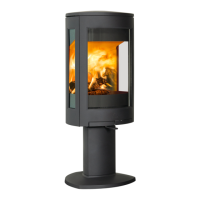
Jøtul F 370 U.S. 10036803_P12
7. Maintenance
7.3 Glass Care
7.3.1 Cleaning
While the air wash design will help keep the glass clean,
it is normal for some soot to accumulate on the glass
surface during low burn periods. This will clear off during
the next hot fire. Occasionally it will be necessary to
clean the carbon deposits and fly ash off of the glass.
If deposits are allowed to remain on the glass for an
extended period of time, the glass may become etched
and cloudy.
1. The glass must be COMPLETELY COOL.
2. Only use a cleaner that is specifically designed for this
purpose. DO NOT USE ABRASIVE CLEANING AGENTS.
7.3.2 Glass Replacement
Always operate the door slowly and cautiously to avoid
cracking or breaking the glass. Never use the door to
push wood into the firebox. If the glass becomes cracked
or broken follow the replacement procedure below.
7.1 Ash Removal
Ash removal will be required periodically depending
upon how frequently the stove is used. Always use the
stove mitt when handling ashes. Use a steel ash shovel
or poker to push ashes through the bottom grate into the
ash pan. This will minimize dust in the living area. Carry
the ash pan outdoors and empty into a steel container
with a tight-fitting lid. NEVER USE A PAPER OR PLASTIC
BAG AS AN ASH RECEPTACLE.
The container of ashes should be placed on a
noncombustible floor or on the ground, well away from
all combustible materials, pending final disposal. If
the ashes are disposed of by burial in soil or otherwise
dispersed, they should be kept in the closed container
until all coals and cinders have thoroughly cooled.
IMPORTANT:
NEVER OPERATE THE STOVE WITH A
CRACKED OR BROKEN GLASS PANEL.
Replace glass only with panels specifically
designed for the Jøtul F 370. Do not use
substitutes. Replacement glass can be
ordered from your Jøtul dealer.
Door Glass 221648
Side Glass, Outer 223210
Side Glass, Inner 223209
1. First loosen and then carefully remove the four glass
clips from the inside of the door. See fig. 20.
2. Remove all pieces of the glass panel and gasketing.
3. Remove all remaining debris from the glass area using
a wire brush.
4. Apply a small bead of gasket/stove cement and the
new gasket. Do not overlap the ends of the gasket
rope.
5. Center the new glass panel over the gasket and loosely
reinstall the glass clips. Tighten the clips, alternating
at opposite corners. Avoid applying uneven pressure
on the glass.
6. It may be necessary to retighten the glass clips after
the stove has burned and the gasketing has seated.
The procedure is the same for the side glass panels.
Consult fig. 21 for glass clip and gasketing orientation.
7.2 Chimney System Inspection and
Cleaning
The Jøtul stove is designed to burn cleanly and efficiently
when used according to the guidelines in this manual.
In order to maintain proper performance, you should
inspect the chimney and chimney connector at the
beginning of each heating season and then twice per
month during the heating season. Clean the chimney
whenever creosote and fly ash accumulation exceeds 1/4
inch in any part of the system.
Chimney brushes are available from your local Jøtul
dealer or hardware supply store. Your dealer can also
refer you to a reputable, professional chimney sweep
who will have all the equipment to ensure a complete
and proper job.
WARNING: FAILURE TO KEEP THE CHIMNEY CONNECTOR
AND FLUE FREE OF CREOSOTE BUILD-UP CAN RESULT IN A
CHIMNEY FIRE.
The use of abrasives will damage the glass, leaving a
frosted surface. Crumpled newspaper is an especially
good cleaning material.
3. Rinse and dry glass completely before lighting a fire.




 To Next Page