7
Jøtul F 370 U.S. 10036803_P12
4.2 Chimney Connector Requirements
Use 6” single wall or listed 6” double-wall stovepipe to
connect the stove to the chimney. Single wall stovepipe
must be black steel or stainless steel and have a
minimum thickness of 24 gauge.
Do not use aluminum or galvanized steel pipe for
chimney connection - these materials are not suitable for
use with solid fuel.
Follow these guidelines:
• Donotusechimneyconnectorasachimney.Itis
intended only as a connection device.
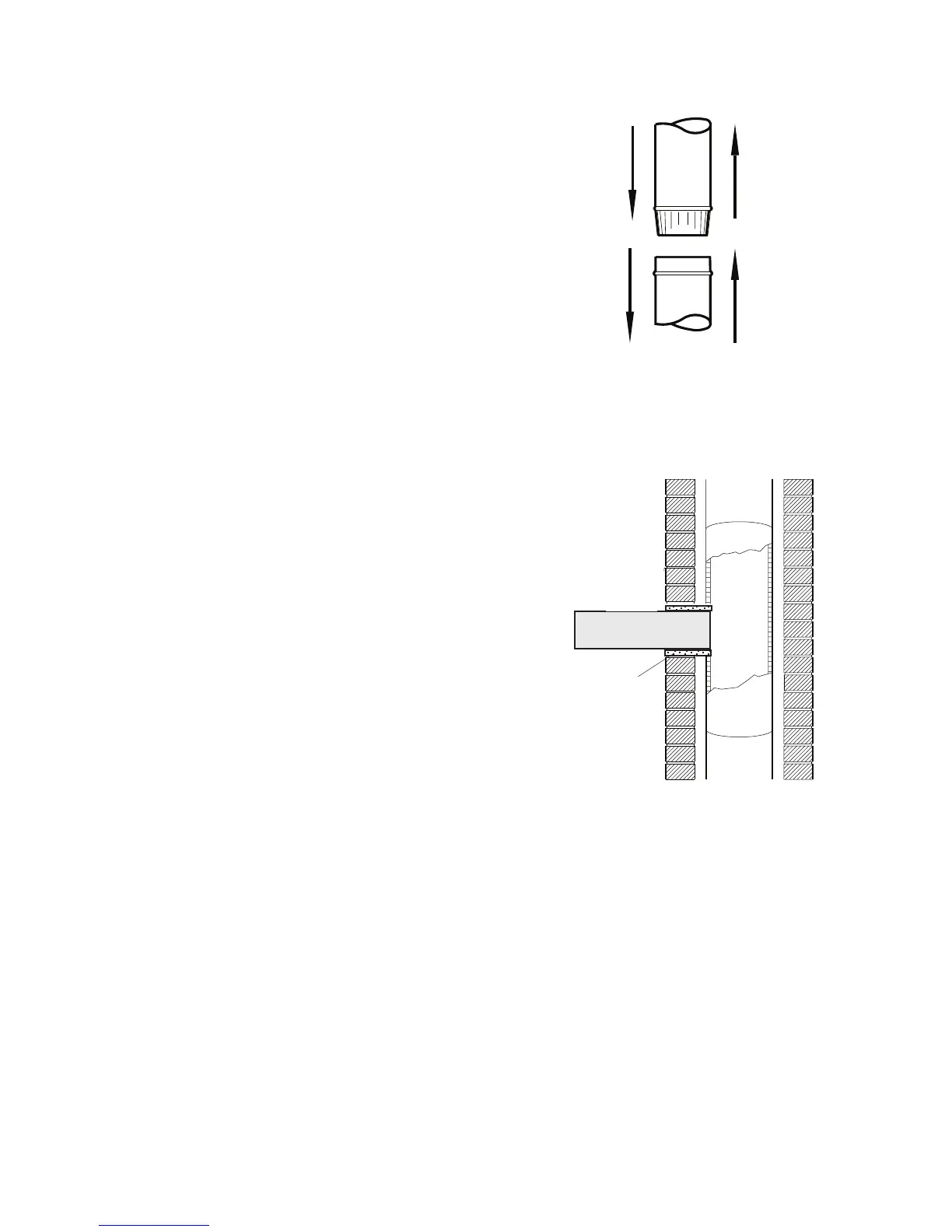
• Eachconnectorsectionmustbeorientedwiththemale
(crimped) end pointing toward the stove. See fig. 3.
• Secureallconnectorjointswiththreesheetmetal
screws. Use four self-tapping sheet metal screws at
the connection to the stove flue collar adaptor.
• Forthebestperformance,thechimneyconnector
should be as short and direct as possible, including no
more than two 90° elbows.
• The maximum vertical run of single wall stovepipe
should not exceed 10 ft. (305 cm).
• Themaximumhorizontalrunshouldnotexceed
3 ft. (92 cm) with a 1/4” rise per foot. Under no
circumstance should horizontal pipe be allowed to
slant down toward the chimney.
• Nopartofthechimneyconnectormaypassthrough
an attic or roof space, closet or other concealed
space, or through a floor or ceiling. All sections of
the chimney connectors must be accessible for
cleaning. Where passage through a wall or partition
of combustible construction is desired, the installation
must conform with NFPA 211 or CAN/CSA-B365, and is
also addressed in this manual.
• Donotconnectthisstovetoachimneyflueserving
another heating appliance.
4.2.1 Connecting to the Chimney
Masonry Chimney
When installing a Stove into a masonry chimney through
a “thimble” (the opening through the chimney wall to the
flue), the thimble must consist of ceramic tile or steel and
be securely cemented in place.
The chimney connector/stove pipe must slide
completely inside the thimble to the inner surface or the
flue liner. It may be necessary to make use of a thimble
sleeve (a pipe with a slightly smaller diameter than
standard stove pipe). See figs 4.
Figure 3. Chimney connector orientation.
Figure 4.
Masonry chimney connection through a thimble.
Thimble
Connector pipe must
be flush with the
inside of the tile liner
Chimney Connector
Flue Tile




 To Next Page