6
Jøtul F 370 U.S. 10036803_P12
4.1.1 Masonry Chimneys
Follow these guidelines when installing the stove into a
masonry fireplace:
• The masonry chimney must have a fireclay liner
or equivalent, with a minimum thickness of 5/8”
(14 mm) and must be installed with refractory mortar.
There must be at least 1/2” (12.7 mm) air space between
the flue liner and chimney wall.
• The fireclay flue liner musthaveanominal size of
8” X 8” (20 cm x 20 cm), and should not be larger
than 8”X 12” (20 cm x 30 cm). A round fireclay liner
must have a minimum inside diameter of 6” (15
cm) and maximum inside diameter of 8” (20 cm).
A larger chimney should be relined with an appropriate
code approved liner.
• Brick or modular block must be a minimum of
4” (10 cm) nominal thickness. Stone construction must
be at least 12” (30 cm) thick.
• Anewly-builtchimneymustconformtolocalcodes,or,
in their absence, must comply with national regulations.
• Anexistingchimneymustbeinspectedbyaprofessional,
licensed chimney sweep, fire official, or code officer to
ensure that the chimney is in proper working order. Any
repairs must be completed before installing the stove.
• Nootherappliancemaybeventedintothesameflue.
• Anairtightclean-outdoorshouldbelocatedatthebase
of the chimney.
4.1.2 Prefabricated Chimneys
A prefabricated metal chimney must be tested and listed for
use with solid fuel burning appliances; High Temperature
Chimney Standard UL 103 HT for the U.S. and High
Temperature Standard ULC S-629 HT for Canada.
The manufacturer’s installation instructions must be
followed precisely. Always maintain the proper clearance
to combustibles as established by the pipe manufacturer.
This clearance is usually a minimum of 2”, although
it may vary by manufacturer or for certain chimney
components.
4.1.3 Chimney Height
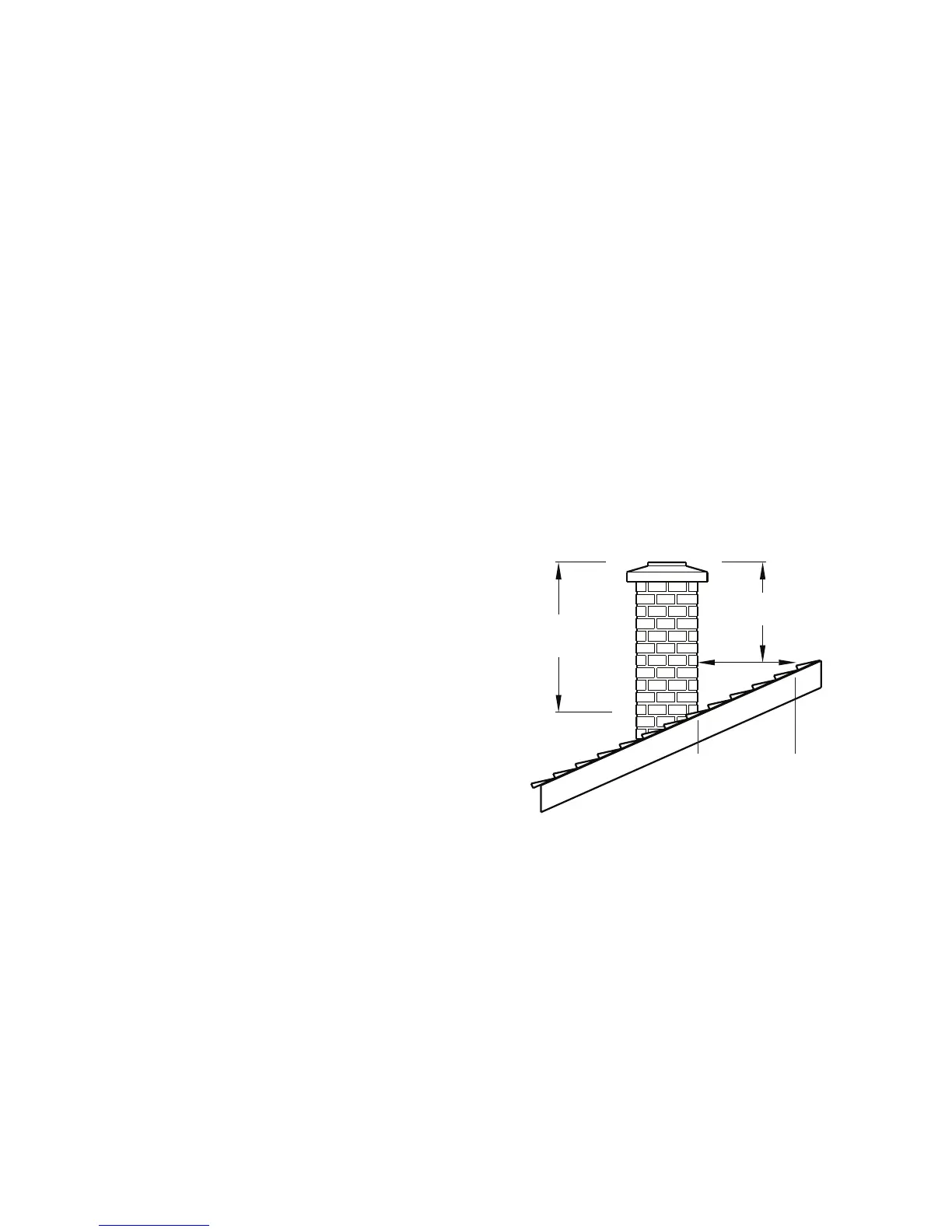
The chimney must be at least 3 feet (92 cm) higher than
the highest point where it passes through the roof and at
least 2 feet (61 cm) higher than the highest part of the roof
or structure that is within 10 feet (3.05 m) of the chimney,
measured horizontally. See fig. 2.
Chimneys shorter than 14 feet (4.27 m) may not
provide adequate draft. Inadequate draft can result in
smoke spillage when loading the stove, or when the
door is open. Poor draft can also cause back puffing
(ignition of gas build-up inside the firebox) and sluggish
performance. The minimum height does not, in itself,
guarantee proper chimney performance. Optimum draft
force should be in the .05 - .10 in. w.c. range measured by
a Magnahelic gauge. Draft at .07 w.c. is ideal.
Excessive chimney height can promote over-strong
draft resulting in high stove temperatures and short burn
times. Excessive draft can be corrected by installing a
butterfly damper. Your Jøtul dealer is an expert resource
to consult regarding draft issues or other performance-
related questions.
Figure 2. Chimney height requirements.
Minimum 3 ft.
92 cm
Minimum 2 ft.
61 cm
Minimum 10 ft.
304.8 cm




 To Next Page