
 Need help?
Do you have a question about the JUKI DDL-9000B-MS and is the answer not in the manual?
Procedure for assembling and mounting the thread stand unit.
Instructions for filling and maintaining the oil tank for lubrication.
How to confirm and adjust the oil splashes amount in the hook.
Steps for correctly inserting and securing the sewing machine needle.
Guidance on placing the bobbin into the bobbin case correctly.
Step-by-step process for threading the sewing machine head.
How to adjust needle and bobbin thread tension for optimal sewing.
Instructions for winding thread onto the bobbin.
How to adjust the pressure applied by the presser foot.
Procedure for setting the desired stitch length.
How to adjust the needle's final position during operation.
Adjusting the feel and travel of the sewing machine pedal.
Adjusting the connecting rod for pedal angle and operation.
Explains the different functions controlled by pedal input.
Adjusting the timing between the needle and hook for proper stitch formation.
Adjusting the switch for reverse feed stitching operation.
Setting the wiper position based on material thickness.
Adjusting the feed dog's height and tilt for material feeding.
Adjusting the timing of the feed dog movement.
How to operate and adjust the thread tension release mechanism.
Details on the presser foot micro-lifting mechanism and its adjustment.
How to sew condensed stitches by adjusting stitch length.
Adjusting the mechanism for feed conversion.
Daily maintenance, cleaning, and oil checks for the sewing machine.
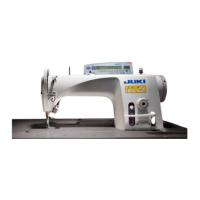
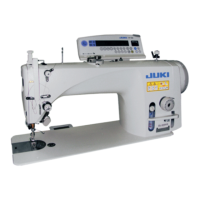
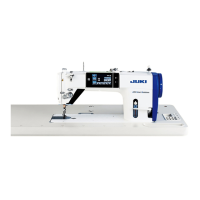
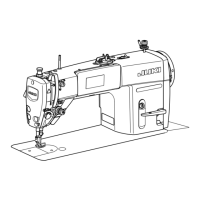
This document provides an instruction manual for the DDL-9000B series of industrial sewing machines, covering models such as DDL-9000B-SS, -MS, -DS, -SH, and -MA. The manual details installation, adjustment, and maintenance procedures to ensure optimal performance and longevity of the machine.
The DDL-9000B is a high-performance industrial sewing machine designed for various materials, from light to heavy-weight. Its primary function is to create precise stitches at high speeds, with features for thread trimming, reverse feeding, and condensed stitching. The machine is equipped with a micro-quantity lubrication system (S), a semi-dry system (M), or a dry system (D) depending on the model, ensuring smooth operation and reducing oil stains on materials.
The machine requires careful installation by two persons, avoiding holding the handwheel during transport. Protruding articles should not be placed where the machine rests. The under cover should be properly seated on the machine table, and rubber hinge seats and cushion seats must be fixed. The air vent cap must be removed before operation to prevent oil leakage from the gearbox. The knee lifter pressing rod and hinge are fitted, and the machine head is placed on cushions. The head support rod is securely attached, and the control panel is fixed with rubber packing. The safety switch arm must engage with the table within a specific range (2.0 mm to 3.5 mm) to prevent errors or damage.
The standard presser foot lift is 10 mm, adjustable up to 15 mm using the knee lifter adjust screw. Caution is advised not to operate the machine with the presser foot lifted too high (10 mm or more) as the needle bar may contact the presser foot, or if the adjustment screw is overtightened, leading to defective sewing or noise.
The thread stand unit is assembled and inserted into the machine table, then tightened with a nut. For ceiling wiring, the power cord is passed through the spool rest rod.
Before operation, the oil tank must be filled with JUKI NEW DEFRIX OIL No. 1 or JUKI MACHINE OIL #7. The oil level should be between the upper and lower engraved marker lines on the oil amount indicating window. Overfilling can cause leakage or improper lubrication. Refill oil when the indicating rod drops to the lower marker line. For new machines or after extended disuse, a break-in period at 2,000 sti/min or less is recommended. Clean oil must be used, and the oil hole cap should not be removed during operation or lost.
The power must be turned off before attaching the needle. Use specified needles appropriate for the thread thickness and material. The handwheel is turned to bring the needle bar to its highest point. The screw is loosened, and the needle is held with its indented part facing right, then fully inserted into the needle bar hole in the direction of the arrow. The screw is then securely tightened. For polyester filament thread, if the indented part is tilted towards the operator, thread looping may be unstable, leading to hangnail or breakage. Slightly slanting the needle's indented part to the rear side can be effective.
The bobbin is installed so the thread winds clockwise. The thread is passed through the thread slit and pulled in the direction of the arrow, ensuring it passes under the tension spring and comes out from the notch. When the thread is pulled, the bobbin should rotate in the direction of the arrow.
The amount of oil splashes in the hook is confirmed by placing a confirmation paper under the hook, 3 to 10 mm away from it, while the machine is operating at high speed. The ideal splash amount for DDL-9000B-SS, M is 0.5-1 mm (small) or 1-1.5 mm (large), and for DDL-9000B-SH is 1-3 mm (small) or 2-4 mm (large). The oil amount adjustment screw is tightened clockwise to increase oil or loosened counterclockwise to decrease it. For RP hooks (dry head), the oil amount should be reduced to a minimum, but not completely stopped. The oil tank should never be drained when using an RP hook.
The manual provides a diagram for threading the machine head, emphasizing not to pass the thread through section A.
Needle thread tension is adjusted by turning thread tension No. 1 nut clockwise to shorten the thread length or counterclockwise to lengthen it. Thread tension nut 2 is turned clockwise to increase or counterclockwise to reduce needle thread tension. Bobbin thread tension is adjusted by turning tension adjusting screw 3 clockwise to increase or counterclockwise to reduce it.
The bobbin is inserted deep into the bobbin winder spindle. The thread is passed from the spool on the thread stand, wound clockwise several times on the bobbin, and then the bobbin winder trip latch is pressed to start winding. The bobbin automatically stops when winding is finished. The winding amount is adjusted by loosening setscrew 4 and moving the bobbin winding lever. If the bobbin thread is not wound evenly, the handwheel is removed, screw 5 is loosened, and the height of bobbin thread tension 8 is adjusted so the bobbin center aligns with the thread tension disk 6 center. The thread tension nut 7 adjusts the winder tension.
The power must be turned off. Nut 2 is loosened. Turning presser spring regulator 1 clockwise increases pressure, and counterclockwise decreases it. Nut 2 is tightened after adjustment. Standard values for presser spring regulator addition height are provided for S, H, and A types.
The stitch length dial is turned to align the desired number with the marker dot on the machine arm. To decrease stitch length, the dial is turned while pressing the feed lever. The stopper can fix the stitch length dial.
The stroke of the thread take-up spring is adjusted by loosening setscrew 2 and turning tension post 3 clockwise to increase or counterclockwise to decrease. The pressure of the thread take-up spring is adjusted by loosening setscrew 2, removing thread tension (asm.) 5, loosening tension post setscrew 4, and turning tension post 3 clockwise to increase or counterclockwise to decrease. The standard state is when the engraved marker line on the machine arm aligns with the top of the thread take-up spring. For DDL-9000B-DS, careful adjustment is needed as the fully-dry hook can affect thread take-up spring performance, potentially causing thread breakage or balloon stitching if not working sufficiently. The thread take-up stroke is adjusted by moving thread guide 8 left for heavy-weight materials (increasing thread length) or right for light-weight materials (decreasing thread length).
The power must be turned off. The standard needle stop position is when the marker dot on the pulley cover aligns with the white marker dot on the handwheel. To adjust the needle up/down stop position, turn off the power, then turn it on while pushing switch 5 on the operation panel. Use switches 1 or 2 to update the setting number (121 for UP, 122 for DOWN) and switches 3 or 4 to specify the setting contents (F) within the range of -15 to 15. After setting, press switch 1 or 2 to confirm.
The power must be turned off. To adjust the pressure for depressing the front part of the pedal, hook the pedal pressure spring to the lower side for decreased pressure or upper side for increased pressure. To adjust the pressure for depressing the back part, turn the reverse depressing regulator screw 2 in to increase pressure or out to decrease it. The pedal stroke is decreased by inserting connecting rod 3 into the left hole 4.
The power must be turned off. The connecting rod is installed by moving pedal 3 to align motor control lever 1 and connecting rod 2. The pedal tilt is adjusted by changing the length of connecting rod 2 after loosening adjust screw 4.
The pedal operates in four steps: light depression of the front part for low sewing speed, further depression for high sewing speed, resetting to original position for stopping, and full depression of the back part for thread trimming. With an auto-lifter (AK device), light depression of the back part lifts the presser foot, and further depression actuates the thread trimmer.
The power must be turned off. The needle bar height is adjusted by turning the handwheel to bring the needle bar to its lowest point, loosening setscrew 1, and aligning the marker line on needle bar 2 with the bottom end of needle bar lower bushing 3. The needle and hook are positioned by loosening the three hook setscrews, turning the handwheel to normal rotation, and aligning the marker line on ascending needle bar 2 with the bottom end of needle bar lower bushing 3. Hook blade point 5 is aligned with the center of needle 4, with a clearance of 0.04 mm to 0.1 mm. Tighten the hook setscrews. Incorrect clearance can damage the hook or cause stitch skipping. RP hooks (dry hooks) are used for DDL-9000B-DS type and require periodic cleaning.
Pressing the moment switch lever 1 performs reverse feed stitching; releasing it resumes normal feed stitching. The switch position can be adjusted by loosening setscrew 2 and moving the switch up or down. Switch 1 can be used in two positions. To lower the switch position, loosen setscrew 3 at the back of the machine head and lower switch base 4.
The power must be turned off. The wiper position is adjusted according to material thickness. Turn the handwheel to align white marker dot 1 with marker dot 2 on the machine arm. Adjust for a 1 mm clearance between the wiper's flat section and the needle's side face. Tighten wiper adjust screw 3 to fix wiper 6 with wiper collar 4. To disable the wiper, push switch 5 for 2 seconds, change setting No. E to HP using switch 7 or 8, and change setting F from "on" to "off" using switch 9 or 10. Push switch 5 to confirm.
If the knife does not cut thread sharply, it should be re-sharpened and re-installed. Moving the counter knife mounting position in direction A increases thread length after trimming, while moving it in direction B decreases it. Extra care must be taken when sharpening the knife blade.
The power must be turned off. Standard feed dog height (when lifted to the highest from the throat plate) is 0.8 mm for 9000B-AS and 9000B-MA, and 1.2 mm for 9000B-SH. Adjust the height and tilt by loosening setscrews 2 and 4 in feed bar driving shaft 1 and feed bar rocker shaft 3, then turning both shafts with a screwdriver. The engraved marker dot of feed bar rocker shaft 3 should align with the engraved marker lines 8 and 9 of the feed dog. If only one shaft is adjusted, the feed dog height changes. The feed dog movement position can be adjusted by loosening setscrew 5 in feed rocker shaft arm 7. Care must be taken to prevent the feed dog from interfering with the thread trimmer unit.
The power must be turned off. Feed timing is adjusted by changing the stop position of vertical feed cam 1. Tilt the machine head, loosen two setscrews 2 in vertical feed cam 1, and turn vertical feed cam 1. Turning it in the (+) direction increases feed timing, and in the (-) direction decreases it. The standard position is when graduation 3 on the feed bar driving arm aligns with engraved marker line 4 for 9000B-AS and 9000B-MA, or marker line 5 (+20°) for 9000B-SH.
The power must be turned off. This mechanism allows sewing without slackening needle thread tension when the presser foot is lifted. To release, remove the cap in the machine head, loosen thread tension release changeover screw 1 with a hexagon wrench, and fix screw 1 on top of the thread tension release changeover plate 2. This prevents the thread tension disk from rising when the presser foot is lifted, and the needle thread tension is not loosened (it rises only during thread trimming). Screw 1 should only be used at the top or bottom position. The screw is factory-set to the bottom position. For machines with wipers, the wiper unit must be removed for adjustment.
The power must be turned off. For automatic reverse stitching, if forward and reverse stitches do not match, a rough correction can be made by adjusting the feed adjustment spring hook 1. For fine correction, function setting Nos. 51, 52, and 53 on the control box (SC-920) need adjustment. If the stitch does not match the target, loosen feed adjustment spring hook fixing screw 2 and slide 1 in direction A or B, then fix.
The power must be turned off before performing maintenance. Daily maintenance ensures longer machine life.
 General
| Stitch Type | Lock Stitch |
|---|---|
| Max Stitch Length | 5 mm |
| Needle Type | DB x 1 |
| Weight | 38 kg |
| Lubrication | Automatic |
| Motor Power | 550 W |
| Needle Size | 9 to 18 |
| Motor | Direct Drive Servo Motor |





 To Next Page

