
 Need help?
Do you have a question about the Juniper Day One+ QFX5120 and is the answer not in the manual?
Overview of QFX5120 switches, their models, and port configurations.
Details the process and necessary items for installing the switch.
Step-by-step guide for mounting the switch in a four-post rack.
Instructions for connecting power to the switch and verifying power supply status.
Describes the switch's factory-default plug-and-play operation.
Details how to customize factory default settings using CLI commands.
Resources for further learning and advanced configurations after setup.
Links to documentation, hardware guides, release notes, and software upgrades.
Links to video tutorials and training resources for Junos OS and QFX5120.
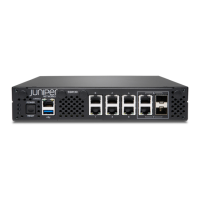
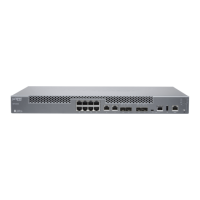
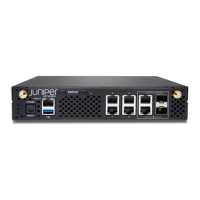
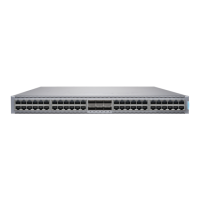
The Juniper Networks QFX5120 is a line of compact, 1-U fixed configuration Ethernet switches designed for a variety of network deployments, including top-of-rack, spine-and-leaf, high-density server connectivity, and campus distribution and core applications. These switches are engineered for simplicity, offering a straightforward path to installation and configuration, making them suitable for quick deployment in diverse network environments. The QFX5120 series includes models such as the QFX5120-48T, QFX5120-48Y, and QFX5120-48YM, each offering specific port configurations to meet different networking needs.
The primary function of the QFX5120 switches is to provide high-performance Ethernet switching capabilities within a network. They act as critical components in data centers and campus networks, facilitating communication between servers, other switches, and network devices. The switches support various port speeds and types, including 1GbE, 10GbE, 25GbE, 40GbE, and 100GbE, allowing for flexible connectivity options. The ability to channelize QSFP28 ports into multiple interfaces further enhances their versatility, enabling a single physical port to function as several logical interfaces, which can optimize port utilization and reduce cabling complexity.
The QFX5120 switches are designed to support advanced network automation features, including zero-touch provisioning (ZTP). This capability significantly simplifies the deployment process by allowing the switches to automatically configure themselves upon initial power-up, reducing manual intervention and potential configuration errors. This plug-and-play functionality is a core aspect of their design, aiming to get the switches up and running on the network with minimal effort.
For management, the QFX5120 provides a dedicated out-of-band management channel through its management interface. This allows network administrators to manage the device independently of the main data plane, ensuring continued access even if the network experiences issues. The switches are configured and managed using the Junos OS command-line interface (CLI), which offers a robust and familiar environment for network professionals. The CLI allows for detailed configuration of various network parameters, security settings, and monitoring functions.
The QFX5120 also supports essential security services, enabling administrators to secure their network infrastructure. This includes configuring user access features such as login classes, user accounts, access privilege levels, and user authentication methods to control who can access and manage the switch. Furthermore, the switches can be integrated into broader security frameworks, leveraging Juniper Security solutions to protect the network.
The QFX5120 switches are designed for ease of use, starting with their physical installation. They can be mounted in a standard four-post 19-inch rack or cabinet. The installation process is guided, ensuring proper placement and secure fastening. The switches come with preinstalled fan modules and AC power supplies, simplifying the initial setup.
Upon powering on, the QFX5120 switches load factory-default settings that enable plug-and-play operation. This means that for basic functionality, the switch can begin operating immediately after being connected to power. For more customized deployments, the switches offer a straightforward configuration process through the CLI. Users can easily customize the factory-default configuration with a few commands, creating a new active configuration file. The ability to revert to the factory-default configuration at any time provides flexibility and a safety net during configuration changes.
Key configuration steps include setting a root authentication password for security, configuring the management port IP address, defining the default gateway, and setting up a DNS server. The switches also support SSH service configuration, allowing for secure remote access and management. The management ports are clearly labeled (MGMT, C0, C1) on the rear panel, depending on the specific QFX5120 model, facilitating easy identification and connection.
The QFX5120 series offers various port configurations to cater to different network requirements. For instance, the QFX5120-48T model features 10GbE/1GbE BASE-T ports and QSFP28 ports, suitable for environments requiring copper connectivity and high-speed uplinks. The QFX5120-48Y and QFX5120-48YM models provide 25GbE/10GbE/1GbE SFP28 ports and QSFP28 ports, with the -48YM model specifically supporting MACsec on its SFP28 and QSFP28 ports for enhanced security at the physical layer. This variety ensures that the QFX5120 can be adapted to different network topologies and performance demands.
For network monitoring and management, the QFX5120 supports protocols such as SNMP and RMON, allowing administrators to collect data on network performance and events. It also supports Destination Class Usage (DCU) and Source Class Usage (SCU) data, along with accounting profiles, which are crucial for network planning, troubleshooting, and billing.
The QFX5120 switches are designed with high system availability in mind, incorporating features that facilitate maintenance and minimize downtime. They are equipped with dual hot-swappable AC or DC power supplies, providing 1+1 redundancy. This means that if one power supply fails, the other can take over without interrupting the switch's operation, allowing for replacement without powering down the device. The power supplies also feature LEDs (AC and DC LEDs) to indicate their status, and a fault LED (!) to signal any issues, aiding in quick diagnosis.
Similarly, the switches include five hot-swappable fan trays. This design allows for individual fan trays to be replaced while the switch remains operational, ensuring continuous cooling and preventing overheating. The fan modules are designed with airflow direction in mind, with AIR IN labels indicating the cold aisle and AIR OUT labels indicating the hot aisle, which is important for proper thermal management within a data center rack.
Grounding is a critical aspect of switch installation and maintenance, and the QFX5120 provides clear instructions for connecting a grounding cable to a proper earth ground. This protects the equipment from electrical surges and ensures safety. The grounding lug is secured to a protective earthing terminal on the switch, and guidelines are provided for dressing the grounding cable to prevent it from blocking access to other components or posing a tripping hazard.
For ongoing software management, the QFX5120 supports software upgrades, allowing administrators to keep the device updated with the latest features, security patches, and bug fixes. Documentation is readily available, including the "QFX5120 Switch Hardware Guide" and "Installing Software on QFX Series Devices," which provide detailed instructions for these procedures. The "Junos OS Release Notes" keep users informed about new and changed features, as well as known and resolved issues.
Juniper Networks also offers resources like "Juniper Networks Virtual Labs" for hands-on experience with the QFX5120 and Junos OS. These virtual sandboxes allow users to practice configurations and operations in a safe environment without affecting live network equipment. Additionally, a video library and training resources, such as the "QFX5120 Ethernet Switch (WBT)" and the "Juniper Learning Portal," are available to help users expand their knowledge and troubleshoot issues. These resources contribute to easier maintenance and a better understanding of the device's capabilities.
 General
| Model | QFX5120 |
|---|---|
| Form Factor | 1U |
| MPLS Support | Yes |
| VXLAN Support | Yes |
| EVPN Support | Yes |
| ACX Support | No |
| Power Supply | Dual redundant power supplies |
| Operating System | Junos OS |
| Management | CLI, Junos Space |



 To Next Page