EasyManua.ls Logo

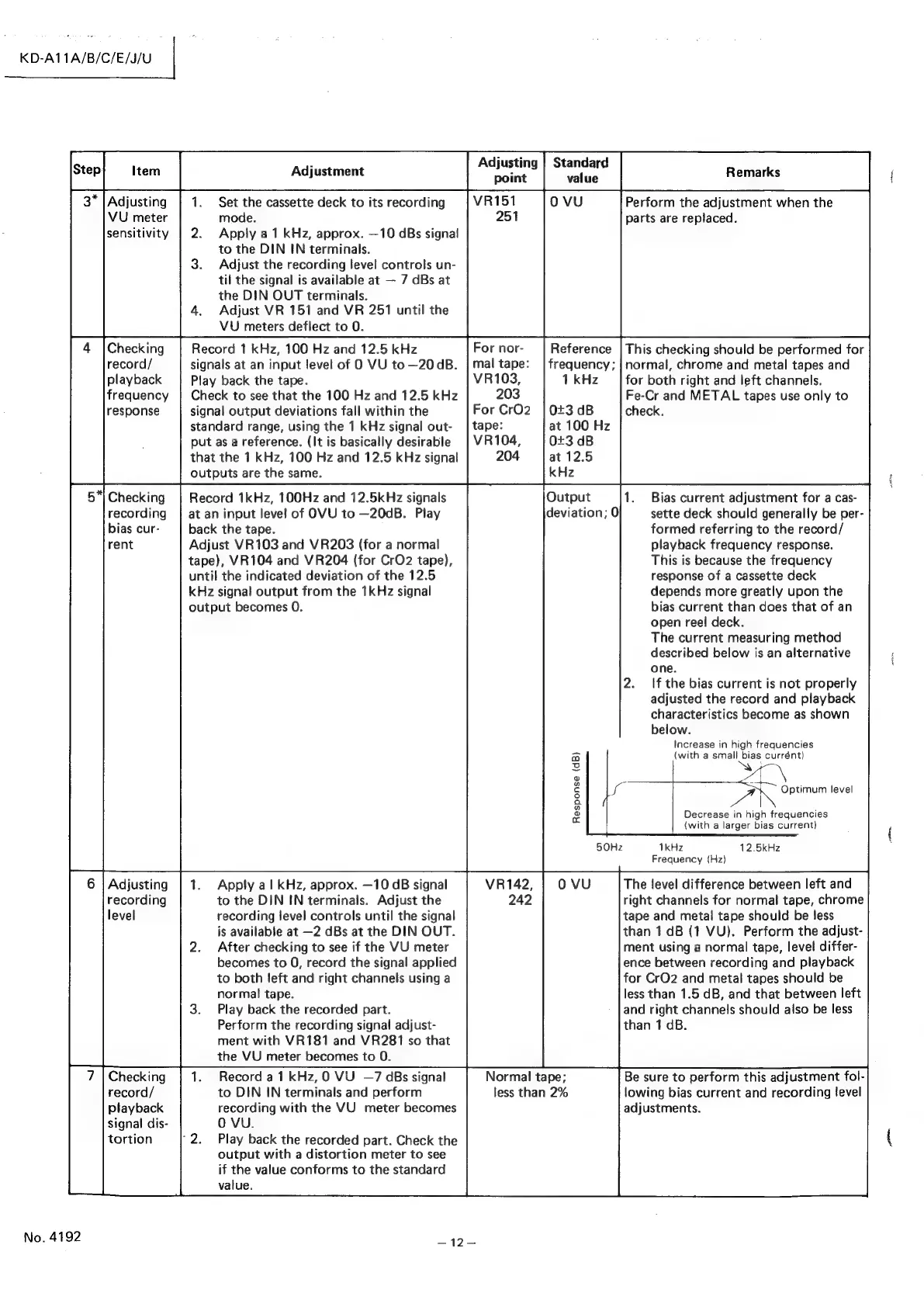
JVC KD-A11 - Page 12

JVC KD-A11
29 pages
Print Icon
To Next Page IconTo Next Page
To Previous Page IconTo Previous Page
Loading...
KD-A11A/B/C/E/J/U
No.
4192
sensitivity
Checking
record/
response
Checking
record/
playback
signal
dis-
tortion
Set
the
cassette
deck
to
its
recording
mode.
Apply
a
1
kHz,
approx.
—10
dBs
signal
to
the
DIN
IN
terminals.
Adjust
the
recording
level
controls
un-
til
the
signal
is
available
at
7
dBs
at
the
DIN
OUT
terminals.
Adjust
VR
151
and
VR
251
until
the
VU
meters
deflect
to
0.
Record
1
kHz,
100
Hz
and
12.5
kHz
signals
at
an
input
level
of
O
VU
to
—20aB.
Play
back
the
tape.
Check
to
see
that
the
100
Hz
and
12.5
kHz
signal
output
deviations
fall
within
the
standard
range,
using
the
1
kHz
signal
out-
put
as
a
reference.
(It
is
basically
desirable
that
the
1
kHz,
100
Hz
and
12.5
kHz
signal
outputs
are
the
same.
Record
1kHz,
100Hz
and
12.5kHz
signals
at
an
input
level
of
OVU
to
—20dB.
Play
back
the
tape.
Adjust
VR103
and
VR203
(for
a
normal
tape),
VR104
and
VR204
(for
CrO2
tape),
until
the
indicated
deviation
of
the
12.5
kHz
signal
output
from
the
1kHz
signal
output
becomes
0.
Apply
al
kHz,
approx.
—10
dB
signal
to
the
DIN
IN
terminals.
Adjust
the
recording
level
controls
until
the
signal
is
available
at
—2
dBs
at
the
DIN
OUT.
After
checking
to
see
if
the
VU
meter
becomes
to
O,
record
the
signal
applied
to
both
left
and
right
channels
using
a
normal
tape.
Play
back
the
recorded
part.
Perform
the
recording
signal
adjust-
ment
with
VR181
and
VR281
so
that
the
VU
meter
becomes
to
0.
Record
a1
kHz,
0
VU
—7
dBs
signal
to
DIN
IN
terminals
and
perform
recording
with
the
VU
meter
becomes
0
VU.
Play
back
the
recorded
part.
Check
the
output
with
a
distortion
meter
to
see
if
the
value
conforms
to
the
standard
value.
Perform
the
adjustment
when
the
parts
are
replaced.
For
nor-
Reference
|
This
checking
should
be
performed
for
mal
tape:
|
frequency;
VR103,
1
kHz
203
For
CrO2
|
043
dB
tape:
at
100
Hz
VR104,
0+3
dB
204
at
12.5
Response
(dB)
Normal
tape;
less
than
2%
normal,
chrome
and
metal
tapes
and
for
both
right
and
left
channels.
Fe-Cr
and
METAL
tapes
use
only
to
check.
Bias
current
adjustment
for
a
cas-
sette
deck
should
generally
be
per-
formed
referring
to
the
record/
playback
frequency
response.
This
is
because
the
frequency
response
of
a
cassette
deck
depends
more
greatly
upon
the
bias
current
than
does
that
of
an
open
reel
deck.
The
current
measuring
method
described
below
is
an
alternative
one.
If
the
bias
current
is
not
properly
adjusted
the
record
and
playback
characteristics
become
as
shown
below.
Increase
in
high
frequencies
(with
a
small
bias
currént)
Optimum
level
Decrease
in
high
frequencies
(with
a
larger
bias
current)
1kHz
12.5kHz
Frequency
(Hz)
The
level
difference
between
left
and
right
channels
for
normal
tape,
chrome
tape
and
metal
tape
should
be
less
than
1dB
(1
VU).
Perform
the
adjust-
ment
using
a
normal
tape,
level
differ-
ence
between
recording
and
playback
for
CrO2
and
metal
tapes
should
be
less
than
1.5
dB,
and
that
between
left
and
right
channels
should
also
be
less
than
1
dB.
Be
sure
to
perform
this
adjustment
fol-
lowing
bias
current
and
recording
level
adjustments.

Related product manuals