
 Need help?
Do you have a question about the KAKA Industrial Q01-5216 and is the answer not in the manual?
Inspect machine upon arrival for damage, check parts, and assemble as per illustrations.
Secure shear on a solid, level floor in a well-lit area using anchor bolts to prevent vibration.
Handle sharp blades with care, wear safety glasses and protective footwear, keep the work area clear.
Chart showing equivalent material capacities for different gauges and types for Model 37" and 52" shears.
Procedure to adjust back gauge by loosening knobs, sliding angle, setting pointers to zero, and locking.
Adjust blade clearance using a 0.002" gauge, loosen front/table screws, adjust, and retighten all screws.
Check for cutter head bowing and adjust mounting bolts; adjust blade height by dropping pin and adjusting yoke.
Instructions for sharpening upper and lower blades using a surface grinder, detailing edge relief and grinding sides.
This document outlines the operation and maintenance of a foot shear, a mechanical device designed for cutting sheet metal and other materials. The manual emphasizes safe and efficient use, providing detailed instructions for installation, operation, and blade maintenance.
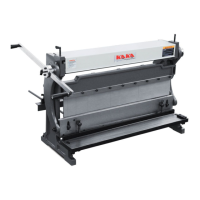
A foot shear is a manually operated cutting machine used to shear various materials, primarily sheet metal. It operates by means of a foot pedal, which actuates a moving upper blade against a stationary lower blade, effectively cutting the material placed between them. The device is designed for precision cutting, with features that allow for adjustments to accommodate different material thicknesses and desired cut lengths. Its robust construction ensures stability during operation, and its mechanical design provides a reliable cutting action without the need for external power sources. The shear is suitable for applications requiring straight cuts on sheet materials within its specified capacity.
Before operating the foot shear, it is crucial to ensure proper installation. The machine must be placed on a solid, level floor to prevent vibration and ensure accurate cuts. Anchor bolts are used to secure the machine to the floor, and a precision level is recommended to verify its levelness in all directions. Shims can be inserted between the floor and the shear's mounting surface to achieve perfect leveling. The work area should be well-lit to enhance visibility and minimize the risk of errors or accidents during operation.
Safety is paramount when using the foot shear. Operators are advised to wear safety glasses or goggles to protect their eyes from flying debris. Protective footwear is also recommended. The work area should be kept clear of obstructions to prevent slipping or tripping hazards. The knives of the shear are sharp, requiring extreme caution during operation, and hands must be kept away from the blade's reach at all times. The protective guard should never be removed, and the hold-down clearance should be set to the minimum gap required to feed the material, ensuring both safety and optimal cutting performance.
The foot shear is designed to cut sheet materials and should not be used to cut rods or materials that exceed its designed capacity. Attempting to shear materials less than a 1/2" cut across the full length of the table under full capacity is also not recommended. The manual provides a material conversion chart that compares the equivalent capacities of various materials, such as aluminum, brass, copper, and plastic, relative to mild steel. This chart helps operators understand the machine's capabilities for different material types and thicknesses, ensuring that the shear is not overloaded.
Several adjustments can be made to optimize the shear's performance. The back gauge, which controls the cut length, can be adjusted by loosening adjustment knobs, sliding the angle, and moving the rod forward or backward until the scales read zero on the pointers. After adjustment, the bracket should be locked, and further fine-tuning can be done with a wheel. Socket screws are then tightened to secure the rods in place.
Blade clearance adjustment is critical for achieving clean cuts. This involves loosening front screws, table lock screws, and table bolts on both sides. A 0.002" slim gauge is used to set the appropriate clearance, after which all screws are tightened. If the cutter head appears bowed after use, it can be adjusted using the bow bolt. Operators should also check for looseness in the mounting bolts and re-tighten them as necessary. To adjust the blade's vertical position, the pin on the treadle is dropped, the nut is loosened, and the yoke is adjusted up or down before reassembling the components. Loose lock screws can cause blade shake during operation, so it's important to ensure they are tightly against the shims, taking care not to dimple them.
Regular maintenance, particularly blade sharpening, is essential for maintaining the foot shear's cutting efficiency and extending its lifespan. The upper blade typically has two cutting edges, which are ground with a 2-edge relief. When one edge becomes dull, the blade can be reversed to expose the new cutting edge. Both wide sides of the upper blade can be sharpened on a surface grinder.
The lower blade usually has one cutting edge with a 2-edge relief and a 1-face relief. This blade can also be re-sharpened on a surface grinder by grinding the wide side of the blade that has the 1-face relief. Proper sharpening ensures that the blades remain sharp, providing clean and precise cuts, and preventing unnecessary strain on the machine. Adhering to these maintenance procedures will help keep the foot shear in optimal working condition.
 General
| Model | Q01-5216 |
|---|---|
| Category | Industrial Equipment |
| Brand | KAKA Industrial |
| Maximum Cutting Thickness | 16 gauge |
| Type | Manual Shear |


 To Next Page