EasyManua.ls Logo

KAKA Industrial RM-08 - User Manual

KAKA Industrial RM-08
12 pages
Print Icon
To Next Page IconTo Next Page
Loading...
Operation Manual RM-08
KAKA Industrial
®
— 1 —
Unpacking
The Rotary Machine is shipped from
the manufacturer in a carefully packed
Carton box. Thoroughly inspect the
product upon opening the package.
After unpacking the unit, carefully
inspect for any damage that may
have occurred during transit. Check
for loose, missing, or damaged parts.
Shipping damage claims must be
filed with the carrier and are the
responsibility of the user.
Specications
KAKA Rotary Machine is hand
operated and will form sheet metal
up to 22 gauge (0.03 thick) mild steel
(or equivalent). The rotary machine
is constructed of cast iron and steel
ensuring minimum deflection of the
workpiece during forming operations.
Six die sets are included allowing the
following operations to be performed:
large and small turning, burring,
wiring, ogee beading and crimping.
Stock No. ................................173205
Model........................................RM-08
Capacity.....................22 Ga. (0.8 mm)
Throat depth....................7" (177 mm)
Packing size.....20"x18"x7" (50x45x16 cm)
N.W./G.W. ...........48/53 lbs (22/24 kg)
Important
Rotary machine and dies are coated
with a protectant. To ensure proper
fit and operation, remove coating.
Coating is easily removed with mild
solvents, such as mineral spirits,
and soft cloth. Avoid getting cleaning
solution on paint or any of the
rubber or plastic parts. Solvents may
deteriorate these finishes. Use soap
and water on paint, plastic or rubber
components. After cleaning, cover all
exposed surfaces with a light coating
of oil.
WARNING
Never use highly volatile solvents.
Non-ammable solvents are recommended
to avoid possible re hazard.
SAVE THESE INSTRUCTIONS
Thank you for purchasing our RM-08
Rotary Machine. Before attempting
to operate your new tool please
read these instructions thoroughly.
You will need these instructions for
the safety warnings, precautions,
assembly, operation, maintenance
procedures, parts list and diagrams.
Keep your invoice number with these
instructions. Write the invoice number
on the inside of front cover. Keep the
instructions and invoice in a safe, dry
place for future reference.

Questions and Answers

Summary

Unpacking and Specifications

Important Notes and Warnings

Key information on initial preparation and safety warnings.

General Safety Information

Safety Cautions and Warnings

Important advisories and precautions for operator safety.

Assembly Procedures

Troubleshooting

Troubleshooting Chart

Common issues, their possible causes, and corrective actions.

Parts Identification

Exploded Drawing

Diagram illustrating all components of the rotary machine with reference numbers.

Parts List

Detailed list of all parts with reference numbers and quantities.

Overview

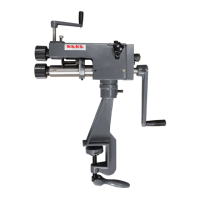
The KAKA Industrial RM-08 Rotary Machine is a hand-operated tool designed for forming sheet metal. It is constructed from cast iron and steel to ensure minimal deflection during forming operations, providing durability and precision. The machine comes with six interchangeable die sets, allowing for a variety of operations including large and small turning, burring, wiring, ogee beading, and crimping.

Function Description:

The primary function of the KAKA RM-08 Rotary Machine is to shape and form sheet metal. By utilizing different die sets, users can create various profiles and edges on metal workpieces. The hand-operated crank allows for controlled rotation of the dies, while adjustable components enable precise manipulation of the metal. The machine is suitable for both professional and hobbyist use in metalworking applications.

Important Technical Specifications:

  • Capacity: 22 Gauge (0.8mm) mild steel or equivalent.
  • Throat depth: 7 inches (177 mm).
  • Packing size: 20"x18"x7" (50x45x16 cm).
  • Net Weight/Gross Weight: 48/53 lbs (22/24 kg).
  • Construction: Cast iron and steel body for rigidity and durability.
  • Die Sets Included: Six sets for large turning, small turning, burring, wiring, ogee beading, and crimping.
  • Operation: Hand-operated with a crank handle.

Equivalency Chart for Material Capacity:

The machine's maximum capacity is 22 gauge (0.030") mild steel. For other materials, the equivalent maximum thickness is as follows:

  • Mild steel: 0.030"
  • Stainless steel: 0.020"
  • SAE 1050 cold rolled steel: 0.024"
  • Aluminum: 0.055"
  • Soft brass: 0.046"
  • ½ Hard brass: 0.030"
  • Annealed phosphor bronze: 0.034"
  • Soft copper: 0.046"
  • Hard copper: 0.034"

Usage Features:

  • Unpacking and Inspection: Upon receipt, users should thoroughly inspect the product for any damage during transit and account for all parts. Shipping damage claims are the user's responsibility.
  • Coating Removal: The machine and dies are coated with a protectant that must be removed before use. This can be done with mild solvents (like mineral spirits) and a soft cloth. Care should be taken to avoid getting solvents on painted, rubber, or plastic parts, which can be cleaned with soap and water. After cleaning, all exposed surfaces should be lightly oiled.
  • Assembly: The machine comes partially assembled with one die set attached. The base assembly, crank handle assembly, and adjusting handle assembly need to be mounted.
    • Mount Base Assembly: Secure the base assembly to a workbench with a mounting surface thickness not exceeding 2 inches, using the clamp handle.
    • Mount Rotary Machine to Base: Attach the rotary machine body to the base using a hex head bolt.
    • Mount Handle to Machine: Mount the crank assembly to the driving shaft and secure it with a hex head bolt. Mount the adjusting handle assembly into the top of the body.
  • Work Area Setup: The machine should be installed on a level surface with proper lighting and bench-mounted. Ensure adequate clearance for crank arm rotation and keep the area clear of scraps, oil, or dirt. Applying non-skid material to the floor is recommended.
  • Die Set Selection and Installation: Users select the appropriate die set for the desired operation. Spacers, dies, and retaining nuts are placed onto the driving and driven shafts and tightened with a wrench. Some die sets require two spacers per shaft.
  • Adjustments:
    • Vertical Adjustment: The position of the upper die is adjusted according to the workpiece thickness using the adjusting handle.
    • Horizontal Adjustment: The horizontal position of the upper die is adjusted by rotating the adjusting nut.
    • Stop Gauge/Plate Adjustment: The stop gauge (for sheets) or stop plate (for cylinders) is adjusted to control the distance the form will be from the metal's edge. Fine adjustments can be made using the thumb nuts.
  • Operation Procedure: Insert the metal between the dies and slowly rotate the crank arm. The workpiece should be checked, and adjustments (steps 3 and 4) fine-tuned as necessary until the correct form is achieved.
  • Safety Precautions:
    • Always follow proper operating procedures.
    • Wear proper apparel (no loose clothing, gloves, neckties, rings, bracelets, or jewelry).
    • Wear protective hair covering.
    • Wear safety shoes with non-slip soles.
    • Wear safety glasses (ANSI Z87.1 compliant).
    • Be alert; do not operate when tired, intoxicated, or on drowsy medications.
    • Keep the work area clean and well-lit.
    • Keep visitors at a safe distance.
    • Keep children out of the workplace and childproof the workshop.
    • Assemble only according to instructions.
    • Store tools in a dry, secure place out of reach of children when not in use.
    • Maintain product labels and nameplates.
    • Keep hands clear of forming dies.
    • Do not exceed the machine's maximum capacity (22 gauge mild steel or equivalent).
    • Bolt the machine to a sturdy stand that is bolted to the floor to prevent sliding or tipping.
    • Never use highly volatile solvents; non-flammable solvents are recommended to avoid fire hazards.

Maintenance Features:

  • General Maintenance: Consult the manual for specific maintenance and adjusting procedures. Keep the tool lubricated and clean for safe operation.
  • Adjusting Tools: Always remove adjusting tools before using the machine.
  • Working Order Check: Regularly check all parts to ensure they operate properly and perform their intended function. This includes guards and other components.
  • Damaged Parts: Inspect for damaged parts, alignment of moving parts, binding, breakage, and mounting issues. Any damaged guard or part should be properly repaired or replaced; do not perform makeshift repairs.
  • Lubrication:
    • Coat all exposed iron surfaces with light oil to prevent rusting.
    • Grease the adjusting block (#35) with a multi-purpose or bearing grease.
    • Oil the driving shaft (#53) through the oil ports (#17 and #62) monthly.

Troubleshooting:

The manual provides a troubleshooting chart to address common issues:

  • Dies cut through metal: Possible cause is dies being too close together. Corrective action is to adjust die position using the adjusting handle (#60).
  • Dies do not make the form correctly: Possible causes include improperly adjusted dies, a loose thumb screw (#36), or workpiece material being too thick. Corrective actions include adjusting die position using the adjusting nut (#27), tightening the thumb screw, and ensuring the machine capacity (0.030" mild steel or equivalent) is not exceeded.
  • Crank arm difficult to turn: Possible causes are the adjusting block (#35) being loose or not in the proper position, or improper lubrication. Corrective actions involve adjusting set screws (#21), securing lock nuts (#20), loosening knob (#22), adjusting the adjusting block position by turning adjusting bolts (#33), retightening knob (#22), and ensuring proper lubrication as per maintenance instructions.

KAKA Industrial RM-08 Specifications

General IconGeneral
BrandKAKA Industrial
ModelRM-08
CategoryIndustrial Equipment
LanguageEnglish

Related product manuals