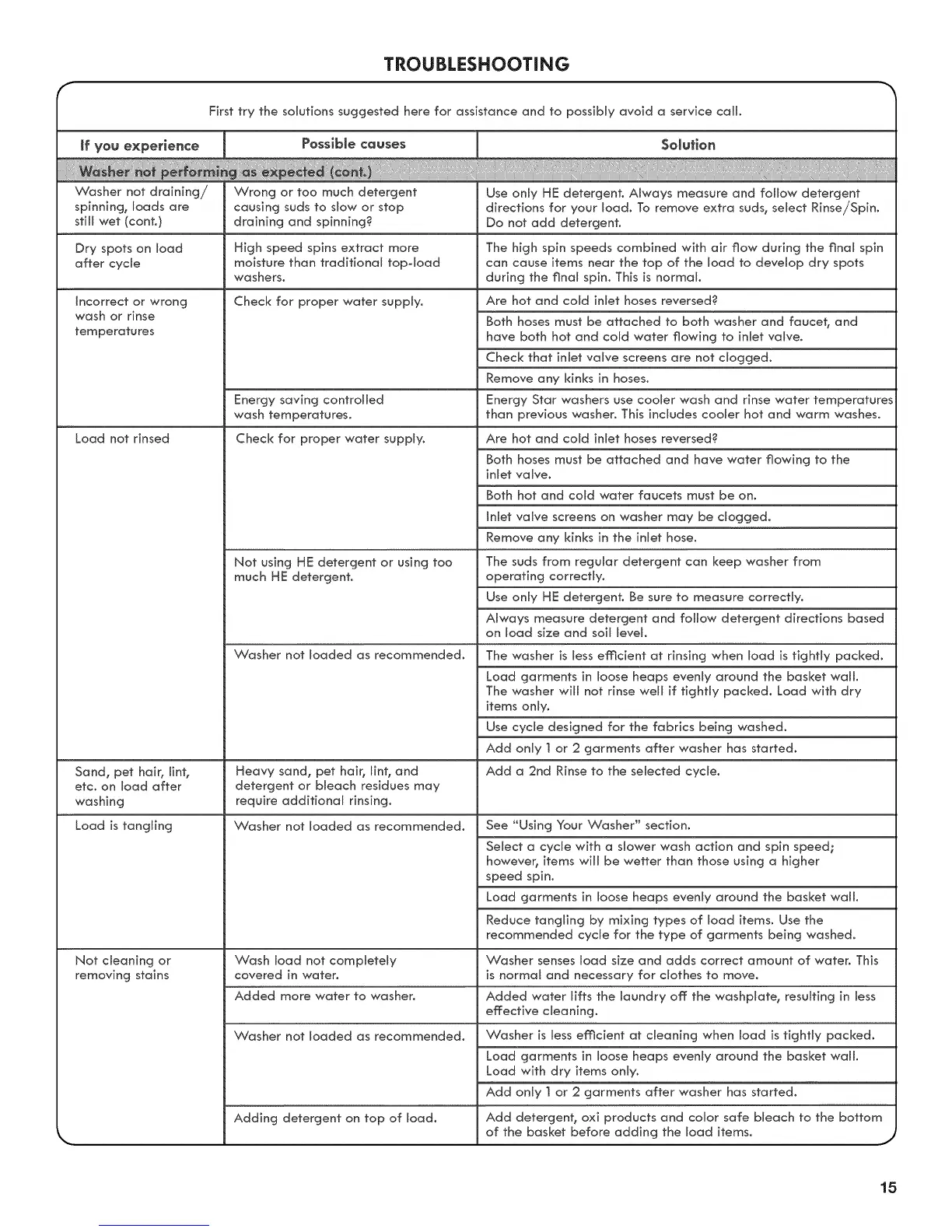
TROUBLESHOOTING
First try the sobtions suggested here for assistance and to possibRy avoid a service call.
Jf you experience Possible causes Solution
Washer not draining/ Wrong or too much detergent
spinning, Roads are causing suds to slow or stop
still wet (cont.) draining and spinning?
Dry spots on Road High speed spins extract more
after cycle moisture than traditional top4oad
washers.
Check for proper water supply,Incorrect or wrong
wash or rinse
temperatures
Energy saving controlled
wash temperatures.
Load not rinsed Check for proper water supply.
Sand, pet hair, lint,
etc. on load after
washing
Load is tangling
Not using HE detergent or using too
much HE detergent.
Washer not loaded as recommended.
Heavy sand, pet hair, lint, and
detergent or bleach residues may
require additional rinsing.
Washer not loaded as recommended.
Not cleaning or Wash load not completely
removing stains covered in water.
Added more water to washer.
Washer not loaded as recommended.
Adding detergent on top of load.
Use only HE detergent. Always measure and follow detergent
directions for your load. To remove extra suds, select Rinse/Spin.
Do not add detergent.
The high spin speeds combined with air flow during the final spin
can cause items near the top of the load to develop dry spots
during the final spin. This is normal.
Are hot and cold inlet hoses reversedg.
Both hoses must be attached to both washer and faucet, and
have both hot and cold water flowing to inlet valve.
Check that inlet valve screens are not clogged.
Remove any kinks in hoses.
Energy Star washers use cooler wash and rinse water temperatures
than previous washer. This includes cooler hot and warm washes.
Are hot and cold inlet hoses reversedg.
Both hoses must be attached and have water flowing to the
inlet valve.
"Both hot and cold water faucets must be on.
inlet valve screens on washer may be clogged.
Remove any kinks in the inlet hose.
The suds from regular detergent can keep washer from
operating correctly.
Use only HE detergent. Be sure to measure correctly.
Always measure detergent and follow detergent directions based
on load size and soil level.
The washer is less efficient at rinsing when load is tightly packed.
Load garments in loose heaps evenly around the basket wall.
The washer will not rinse well if tightly packed. Load with dry
items only.
Use cycle designed for the fabrics being washed.
Add only I or 2 garments after washer has started.
Add a 2nd Rinse to the selected cycle.
See "Using Your Washer" section.
Select a cycle with a slower wash action and spin speed;
however, items will be wetter than those using a higher
speed spin.
Load garments in loose heaps evenly around the basket wall.
Reduce tangling by mixing types of load items. Use the
recommended cycle for the type of garments being washed.
Washer senses load size and adds correct amount of water. This
is normal and necessary for clothes to move.
Added water lifts the laundry off: the washplate, resulting in less
effective cleaning.
Washer is less efficient at cleaning when load is tightly packed.
Load garments in loose heaps evenly around the basket wall.
Load with dry items only.
Add only 1 or 2 garments after washer has started.
Add detergent, oxi products and color safe bleach to the bottom
of the basket before adding the load items.
J
15



 To Next Page