CARE OF YOUR SOFTENER
SECTION 3
14
3A. SALT¼REFILLING STORAGE TANK/BREAKING A SALT BRIDGE
WHEN TO REFILL WITH SALT: Check the salt
level a few weeks after you install the softener
and every week after that. Refill when the
storage tank is about 1/3 full. Never let the
softener use all the salt before refilling. Without
salt, you will soon have hard water.
IMPORTANT:
You will have a loss in softening capacity and
may get partly hard water if less than 10inches
of salt is in the storage tank.
PLEASE SEE PAGE 8 FOR SALT FILLING DIRECTIONS.
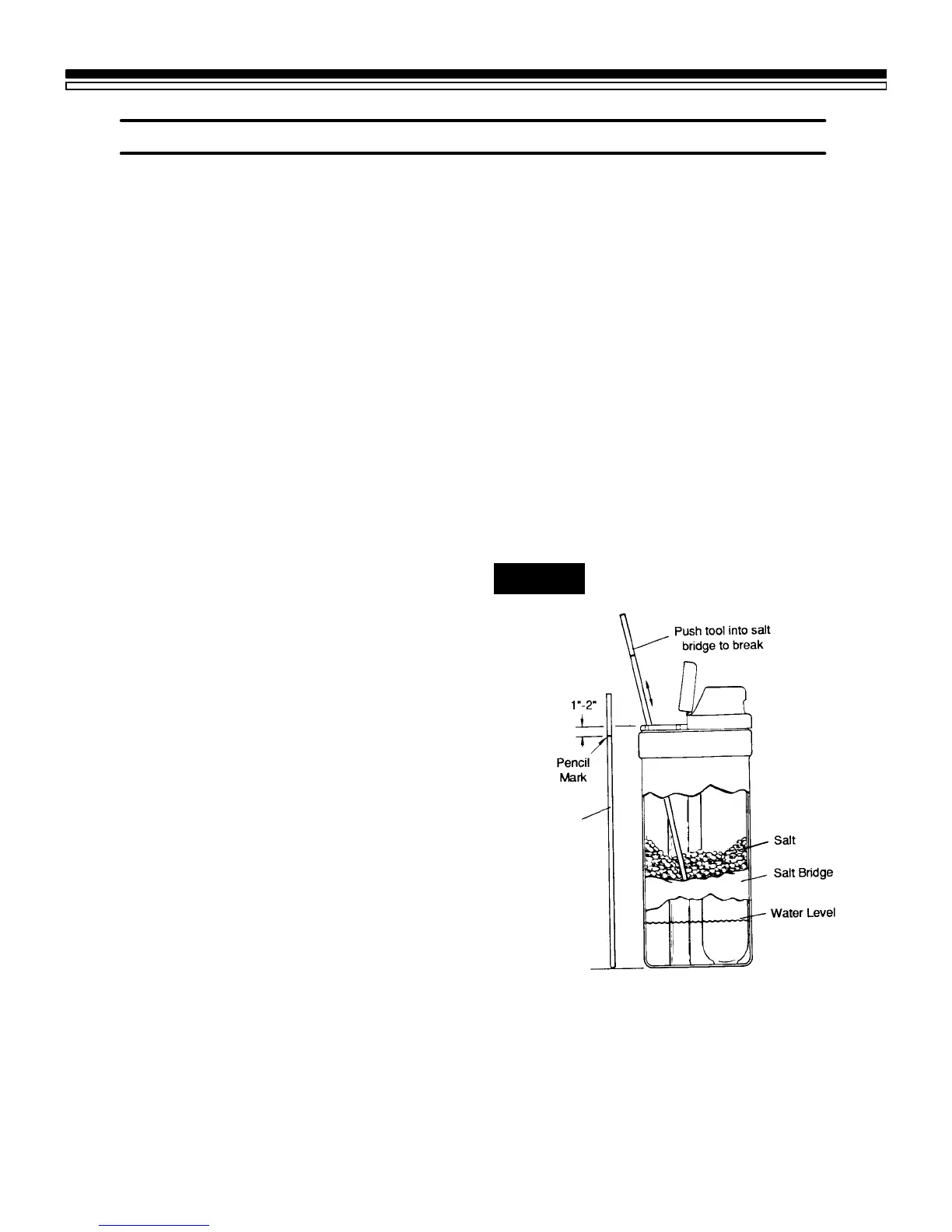
SALT BRIDGE
Sometimes, a hard crust or salt bridge forms in
thesaltstoragetank.Itisusuallycausedbyhigh
humidityorthewrongkindofsalt.Whenthesalt
bridges, an empty space forms between the
waterandsalt.Then,saltwillnotdissolve(melt)
in the water to make brine. Without brine, the
resinbed does notregenerateand you will have
hard water.
Ifthestoragetankisfullofsalt, itishardtotellif
youhaveasaltbridge.Saltislooseontop,butthe
bridge is under it. The following is the best way
to check for a salt bridge.
Salt should be loose all the way to the bottom of
thetank.Holdabroomhandle,orliketool,upto
the softener as shown in FIG. 12. Make a pencil
markonthehandle,1,or2,belowthe top height
of the rim.Then,carefullypushit straight down
into the salt. If a hard object is felt before the
pencil mark gets to the top of the tank, it’s most
likely a salt bridge. Carefully push into the
bridge in a few places to break it. Do not try to
break the salt bridge by pounding on the
outside of the salt tank. You may damage it.
Ifthewrongkind of saltmade the bridge, takeit
out. Then fill the tank with nugget or pellet salt
only.
FIG. 12 A SALT BRIDGE
Broom Handle




 To Next Page