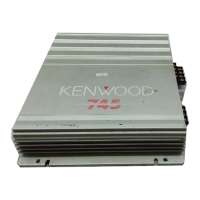
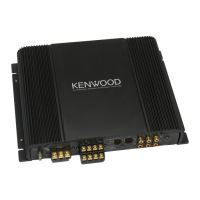
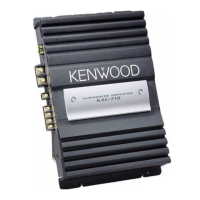
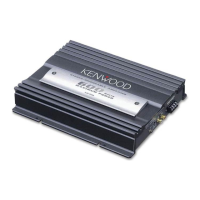
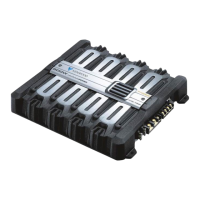
This document serves as an instruction manual for the Kenwood KAC-848 and KAC-748 4-channel power amplifiers. It provides detailed information on installation, controls, connections, system examples, troubleshooting, and technical specifications.
Function Description:
The Kenwood KAC-848 and KAC-748 are 4-channel power amplifiers designed to enhance the audio system in a vehicle. Each unit incorporates two stereo amplifiers, referred to as Amplifier A and Amplifier B, allowing for versatile system configurations. These amplifiers are compatible with a wide variety of systems, supporting both stereo and bridged (monaural) connections for different power output requirements. The units are equipped with a protection function to safeguard against various accidents or problems, such as short-circuited speaker wires, speaker output contacting ground, excessive internal temperature (above 120°C / 248°F), or improper grounding of the center unit. When the protection function is activated, the Power indicator turns off, and the amplifier ceases operation.
Important Technical Specifications:
The specifications are subject to change without notice.
Audio Section:
- Max Power Output (4 Ω):
- KAC-848: 4 Channel Mode: 100 W x 4; 3 Channel Mode: 100 W x 2 + 300 W x 1; 2 Channel Mode: 300 W x 2
- KAC-748: 4 Channel Mode: 70 W x 4; 3 Channel Mode: 70 W x 2 + 200 W x 1; 2 Channel Mode: 200 W x 2
- Rated Power Output (4 Ω):
- KAC-848: 4 Channel Mode (20 Hz ~ 20 kHz, less than 0.08% THD): 50 W x 4; 3 Channel Mode (1 kHz, 0.08% THD) + (1 kHz, 0.8% THD): 50 W x 2 + 150 W x 1; 2 Channel Mode (1 kHz, 0.8% THD): 150 W x 2
- KAC-748: 4 Channel Mode (20 Hz ~ 20 kHz, less than 0.08% THD): 35 W x 4; 3 Channel Mode (1 kHz, 0.08% THD) + (1 kHz, 0.8% THD): 35 W x 2 + 100 W x 1; 2 Channel Mode (1 kHz, 0.8% THD): 100 W x 2
- Rated Power Output (2 Ω):
- KAC-848: 4 Channel Mode (1 kHz, 0.8% THD): 75 W x 4
- KAC-748: 4 Channel Mode (1 kHz, 0.8% THD): 50 W x 4
- Frequency Response (+0, -1 dB): 5 Hz ~ 50 kHz
- Signal to Noise Ratio: 100 dB
- Sensitivity (MAX) (rated output): 0.15 V
- Sensitivity (MIN) (rated output): 4.0 V
- Input Impedance: 10 kΩ
- Low Pass Filter Frequency (12 dB/oct.) (Variable): 50 ~ 200 Hz
- High Pass Filter Frequency (12 dB/oct.) (Variable): 50 ~ 200 Hz
General:
- Operating Voltage: 11 ~ 16 V (allowable)
- Current Consumption (1 kHz, 10% THD):
- KAC-848: 38 A
- KAC-748: 28 A
- Dimensions (W x H x D):
- KAC-848: 290 x 56 x 280 mm (11-7/16 x 2-3/16 x 11 in.)
- KAC-748: 290 x 56 x 230 mm (11-7/16 x 2-3/16 x 9-1/16 in.)
- Weight:
- KAC-848: 4.3 kg (9.4 lb)
- KAC-748: 3.7 kg (8.1 lb)
Usage Features:
- Installation Flexibility: The power amplifier can be installed in locations away from the driver's seat, such as inside the trunk, as it does not require direct operation. It is crucial to install the unit in a location that allows for easy heat dissipation and to avoid placing any objects on top of it.
- Speaker Connections: Supports both stereo and bridged connections. For stereo, speakers should have an impedance of 2Ω or greater (combined impedance if multiple speakers are used). For bridged connections, speakers should have an impedance of 4Ω or greater. The rated input power of speakers must be greater than the amplifier's maximum output power to prevent damage.
- Input Sensitivity Control: Allows adjustment of the amplifier's input sensitivity to match the pre-output level of the connected center unit or the maximum power output of the car stereo.
- Filter Control: Features a FILTER switch (HPF for High-Pass Filter, LPF for Low-Pass Filter) and a FREQUENCY control to adjust the threshold frequency, enabling precise sound customization.
- Operation Switch: Selects the amplification method for signals input to amplifiers A and B. Options include STEREO (for stereo amplification), L+R (combines left and right signals for subwoofer or monaural sound), and MONO (Lch) (amplifies only the left channel signal, suitable for high-power monaural bridged connections).
- Input Selector Switch: Determines whether signals are amplified by both amplifiers A and B (A+B position) or only by amplifier A (A position), with both A and B amplifying the signal from A.
- RCA Cable Ground Lead Terminal: Used when an RCA cable with a ground lead is attached. This terminal should not be used for power source grounding.
- Speaker Level Input Connection (KAC-748 only): Allows connection between the car stereo and speakers using speaker level inputs.
- System Examples: The manual provides diagrams for various system configurations, including:
- Full-range 4-channel + Subwoofer system
- High-pass (100 Hz) + Subwoofer (100 Hz) system
- High-power 2-channel system
- Tri-mode system, which explains the principle of frequency band division using coils and capacitors for 6dB/oct. slope.
Maintenance Features:
- Cleaning: The front panel can be cleaned with a dry silicon cloth or soft cloth. Avoid using hard cloths or volatile solvents like paint thinner and alcohol, as they can scratch the surface or cause indicator letters to peel off.
- Fuse Replacement: If a fuse blows, check for shorts in the wiring and replace the fuse with one of the same prescribed rating. Always disconnect the wiring harness before replacing a fuse.
- Troubleshooting Guide: A comprehensive guide helps diagnose common issues such as no sound, sound from only one side, incorrect output level, or distorted sound. It suggests checking input/output wires, protection circuit activation, fuse condition, input sensitivity settings, speaker wire polarity, and switch settings.
- Wiring Precautions: Emphasizes the importance of using automotive-grade wires for power connections, preventing short circuits, and connecting a fusible link or breaker near the battery's positive terminal to prevent fire. It also advises against direct contact of cords with sharp metal edges and ensures proper grounding to the car chassis.
- Protection Function: The built-in protection function automatically shuts down the amplifier in case of issues like speaker wire short circuits, speaker output contacting ground, overheating, or improper grounding, preventing damage to the unit and speakers.

 Need help?

 To Next Page
 General