Need help?
Do you have a question about the Kenwood KAC-9106D and is the answer not in the manual?
Warnings for safe installation, including wire gauge, avoiding metallic objects, smoke, and hot surfaces.
Details on the amplifier's protection modes triggered by speaker shorts, ground contact, DC signals, or overheating.
Instructions for connecting battery, ground, and other wires, including fuse placement and wire gauge recommendations.
Advice on matching speaker impedance to amplifier output and calculating combined impedance for multiple speakers.
Lists the parts provided with the amplifier, such as screws, wrench, and input cables.
Provides a detailed sequence for mounting and connecting the amplifier in the vehicle.
Advises against installing in wet, dusty, or hot locations and emphasizes heat dissipation.
Details on connecting power, ground, control, and speaker wires for optimal performance and safety.
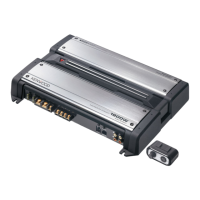
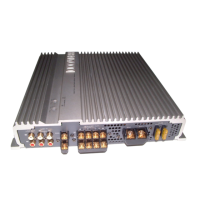
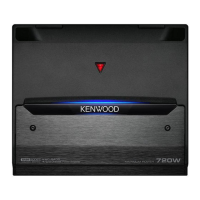
The Kenwood KAC-9106D is a Class D Mono Power Amplifier designed to enhance the audio system in a vehicle. Its primary function is to amplify audio signals, specifically for subwoofers, delivering powerful and clear bass.
This power amplifier takes low-level audio signals from a head unit (like a CD receiver) and amplifies them to drive subwoofers. It is a mono amplifier, meaning it is optimized for single-channel output, typically used for a single subwoofer or multiple subwoofers wired in parallel or series for a combined mono output. The Class D design ensures high efficiency, which translates to less heat generation and lower power consumption compared to other amplifier classes, making it suitable for automotive applications where power resources are limited.
The unit incorporates a protection function to safeguard itself and connected speakers from various issues. This protection activates in situations such as a short-circuited speaker wire, a speaker output contacting ground, a DC signal being sent to the speaker output due to malfunction, or when the internal temperature of the unit becomes excessively high. When activated, the power indicator turns off, and the amplifier ceases operation, preventing potential damage.
For optimal performance and safety, specific usage features and precautions are highlighted. The amplifier requires a 12V DC power supply with a negative ground connection. Proper wiring is crucial, with the battery wire needing to be connected directly to the vehicle's battery using automotive-grade wires of sufficient gauge (5 mm² or AWG 10 or more) to prevent deterioration and damage. A protective fuse, with a capacity equal to or slightly larger than the unit's fuse capacity, must be installed in the power cord near the battery to prevent fire from short circuits.
The power control wire connects to the head unit to turn the amplifier on and off in sync with the audio system. Grounding the unit to a metal part of the car chassis that provides a good electrical ground is essential. If buzzing noise is heard from the speakers when the engine is running, a line noise filter (optional) can be connected to the battery wire to mitigate this.
Speaker selection is a critical aspect of usage. Users must ensure that the speakers (subwoofers) have an impedance of 2Ω or greater. Using speakers with input ratings lower than the amplifier's output power can lead to smoke generation or equipment failure. When connecting multiple subwoofers, the combined impedance must be calculated to ensure compatibility with the amplifier. The manual provides an example of wiring two 4Ω subwoofers to achieve a combined 2Ω impedance, or two 4Ω subwoofers to achieve a combined 8Ω impedance, depending on the wiring configuration.
Installation should be performed in a location that allows for easy heat dissipation, avoiding direct sunlight, excessive heat, humidity, dust, or areas where it might interfere with driving. It should not be installed under carpets, as this can lead to heat buildup and potential damage. Once installed, no objects should be placed on top of the unit. The amplifier's surface can become hot during use, so it should be placed where it won't come into contact with people, resins, or other heat-sensitive substances. When drilling holes for installation, care must be taken to avoid damaging critical vehicle components like gasoline tanks, brake pipes, or wiring harnesses. The unit must be securely fastened to prevent it from dislodging during shocks, which could cause injury or accidents. After installation, it's important to verify that other electrical equipment in the vehicle, such as brake lamps, turn signal lamps, and windshield wipers, operate normally.
The amplifier includes a dressing cover for aesthetic purposes, which needs to be removed during installation and reattached afterward. The unit also features speaker level input cables, allowing connection to head units without RCA pre-outs.
Maintenance primarily involves keeping the unit clean and addressing issues promptly. For cleaning the front panel, it should be wiped with a dry silicon cloth or soft cloth after turning off the power. Harsh cleaning agents like paint thinner or alcohol, or hard cloths, should be avoided as they can scratch the surface or cause indicator letters to peel off.
In case of a blown fuse, users should first check for short circuits in the wiring before replacing the fuse with a new one of the same prescribed rating. To prevent short circuits during fuse replacement, the wiring harness should be disconnected first. If the unit malfunctions or does not seem to be working correctly, or if smoke or strange smells are emitted, the power should be turned off immediately, and a Kenwood dealer should be consulted. Users are advised not to open the top or bottom covers of the unit.
To prevent battery drain, especially when the vehicle engine is off, the amplifier should only be used when the engine is running. If the unit is used in the ACC ON position without the engine running, it will deplete the battery.
 General
| Amplifier Class | D |
|---|---|
| Number of Channels | 1 |
| RMS Power at 4 Ohms | 600 W |
| Peak Power Output | 1800 W |
| Signal to Noise Ratio | 100 dB |
| Speaker Level Inputs | Yes |
| Input Sensitivity | 0.2 V - 6 V |
| Weight | 8.6 lbs |
| Low Pass Filter | 50 Hz - 200 Hz, 24 dB/oct. |
| Subsonic Filter | 15 Hz / 24 dB/oct. |
| RMS Power at 2 Ohms | 900 Watts x 1 Channel @ 14.4V |


 To Next Page