EasyManua.ls Logo

Kenwood TR-751A - CIRCUIT DESCRIPTION; FREQUENCY CONFIGURATION

Kenwood TR-751A
83 pages
Print Icon
To Next Page IconTo Next Page
To Previous Page IconTo Previous Page
Loading...
TR-751A/E
CIRCUIT
DESCRIPTION
MODEL
UNIT
TR-751A
(K,
M1,
M2)
TR-751E
(W,
T)
FINAL
UNIT
X45-1490-11
X45-1490-11
CONTROL
UNIT
X53-1460-11
(K,
M1)
X53-1460-21
(M2)
X53-1460-51
(T)
-_X53-1460-61
(W)
COMPOSITE
UNIT
X60-1310-11
X60-1310-
(PLL,
TX)
3
00:5319;0)
COMPOSITE
UNIT
a
X60-1320-11
X60-1320-00
|
Table
1
TR-751A/E
PC
board
chort
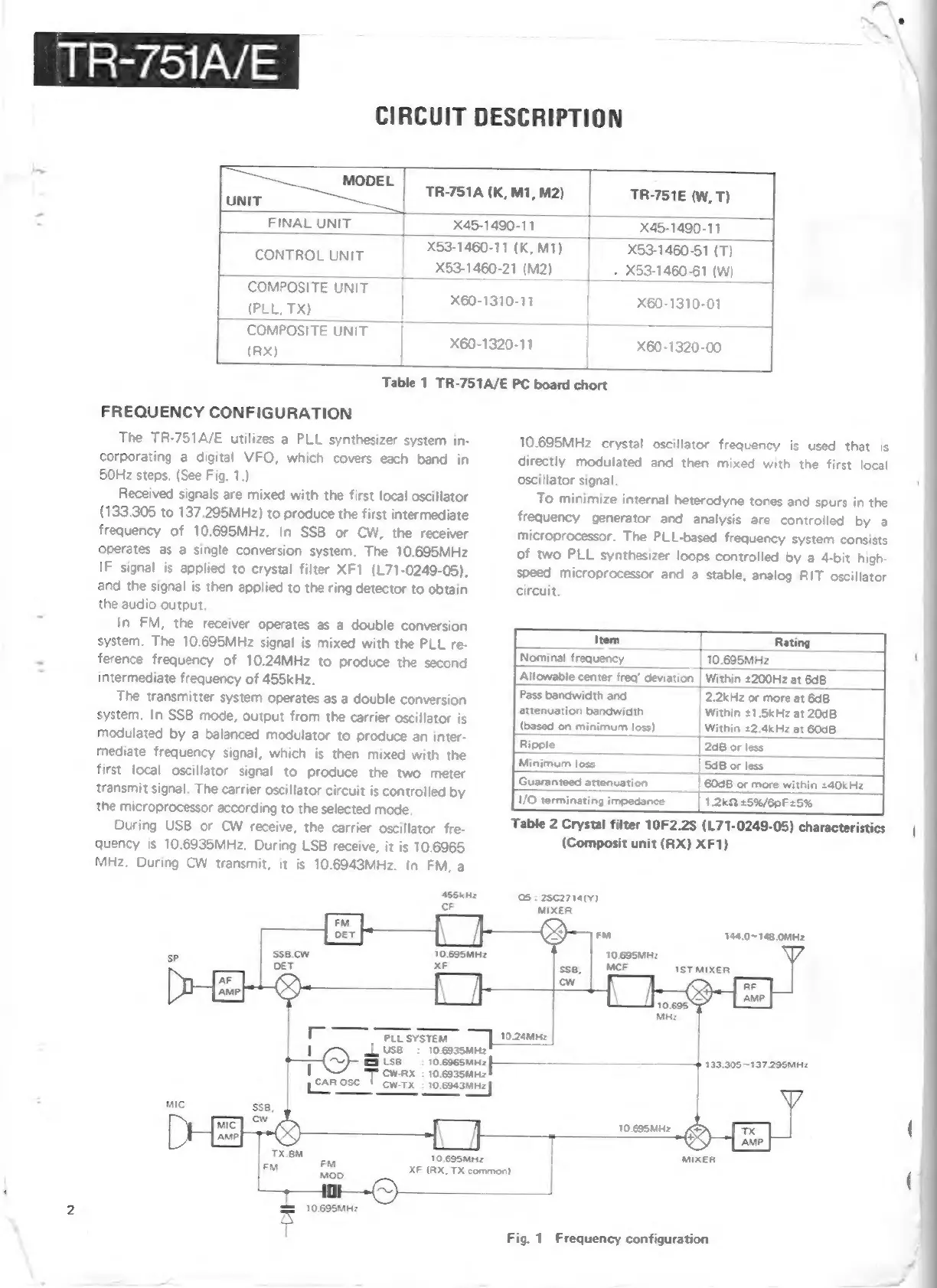
FREQUENCY
CONFIGURATION
The
TR-751A/E
utilizes
a
PLL
synthesizer
system
in-
corporating
a
digital
VFO,
which
covers
each
band
in
50Hz
steps.
(See
Fig.
1.)
Received
signals
are
mixed
with
the
first
local
oscillator
(133.305
to
137.295MHz)
to
produce
the
first
intermediate
frequency
of
10.695MHz.
In
SSB
or
CW,
the
receiver
operates
as
a
single
conversion
system.
The
10.695MHz
IF
signal
is
applied
to
crystal
filter
XF1
(L71-0249-05),
and
the
signal
is
then
applied
to
the
ring
detector
to
obtain
the
audio
output.
In
FM,
the
receiver
operates
as
a
double
conversion
system.
The
10.695MHz
signal
is
mixed
with
the
PLL
re-
ference
frequency
of
10.24MHz
to
produce
the
second
intermediate
frequency
of
455kHz.
The
transmitter
system
operates
as
a
double
conversion
system.
In
SSB
mode,
output
from
the
carrier
oscillator
is
modulated
by
a
balanced
modulator
to
produce
an
inter-
mediate
frequency
signal,
which
is
then
mixed
with
the
first
local
oscillator
signal
to
produce
the
two
meter
transmit
signal.
The
carrier
oscillator
circuit
is
controlled
by
the
microprocessor
according
to
the
selected
mode.
During
USB
or
CW
receive,
the
carrier
oscillator
fre-
quency
is
10.6935MHz.
During
LSB
receive,
it
is
10.6965
MHz.
During
CW
transmit,
it
is
10.6943MHz.
In
FM,
a
455kHz
10.695MHz
crystal
oscillator
frequency
is
used
that
is
directly
modulated
and
then
mixed
with
the
first
local
oscillator
signal.
To
minimize
internal
heterodyne
tones
and
spurs
in
the
frequency
generator
and
analysis
are
controlled
by
a
microprocessor.
The
PLL-based
frequency
system
consists
of
two
PLL
synthesizer
loops
controlled
by
a
4-bit
high-
speed
microprocessor
and
a
stable,
analog
RIT
oscillator
circuit.
Item
Nominal
frequency
10.695MHz_
Within
2200Hz
at
6d8_
|'2.2kH2
or
more
at
6d8
|
Witt
+1.5kHz
at
20dB
Within
#2.4kHz
at
608
Allowable
center
freq’
deviation
Pass
bandwidth
and
attenuation
bandwidth
(based
on
minimum
loss).
Ripple
7
248
or
less
Minimum
loss
|
SdB
or
less
Guaranteed
attenuation
4
60dB
or
more
within
t40kHz
1/0
terminating
impedance
1.2k225%/60F
25%
Table
2
Crystal
filter
10F2.2S
(L71-0249-05)
characteristics
(Composit
unit
(RX)
XF1)
5
:
2sc2714(¥)
MIXER
Qn
1as0~te6
ome
10.6935MHz
10.6965MHz
L
PLL
SYSTEM
]
10.24Mtz
é
T
oWax
:
10.c035mHe
"AR
OSC
;
iz
l
CW-TX
=
10.69¢3MH2
J
133.305~137.295MHz
10.695MHz
XF
(RX,
TX
common)
10.695MHz
rl
+
|
MIXER
Fig.
1
Frequency
configuration

Other manuals for Kenwood TR-751A

Related product manuals