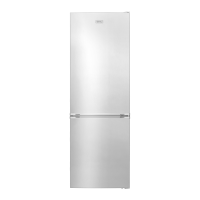
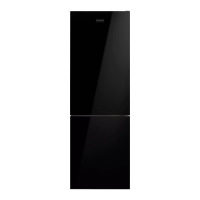
This document serves as the user manual for the Kernau KFSB 17191 NF X / KFSB 17191 NF B refrigerator, providing comprehensive information on its operation, maintenance, and safety.
Function Description
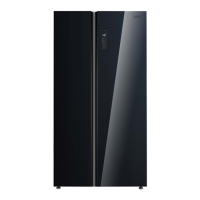
The Kernau KFSB 17191 NF X / KFSB 17191 NF B is a household refrigerator designed for storing a variety of foods. It features both a refrigerating chamber and a freezing chamber. The refrigerating chamber is suitable for short-term storage of fruits, vegetables, and beverages, while the freezing chamber is intended for long-term storage of frozen foods, meat, fish, rice balls, and for making ice. The appliance incorporates LED lighting in both compartments for improved visibility.
Important Technical Specifications
The refrigerator is a side-by-side model with two doors. Its dimensions are approximately 1440mm in width, 740mm in depth, and 1045mm in height (including a 125° door opening angle). The appliance is designed for home use and is not intended for commercial or medical purposes such as storing blood, drugs, or biological products.
Temperature Control:
- Refrigerating Chamber: Temperature can be adjusted between 2°C and 8°C, changing by 1°C with each press of the adjustment button.
- Freezing Chamber: Temperature can be adjusted between -16°C and -24°C, changing by 1°C with each press of the adjustment button.
Safety Warnings:
The manual highlights several critical safety warnings:
- Flammable Materials: The appliance uses flammable blowing gas and refrigerant. It must be disposed of according to local regulations and kept away from fire sources when scrapped.
- Electrical Safety: Do not use extension cords or ungrounded adapters. The supply cord, if damaged, must be replaced by the manufacturer or a qualified service agent. The power plug must be firmly connected to a grounded socket. In case of gas leakage, turn off the gas valve, open doors and windows, and do not unplug the refrigerator to avoid sparks.
- Ventilation: Keep ventilation openings clear of obstruction.
- Refrigerant Circuit: Do not damage the refrigerant circuit.
- Mechanical Devices: Do not use mechanical devices or other means to accelerate defrosting, other than those recommended by the manufacturer.
- Children Safety: Children should be supervised and prevented from playing with the appliance. To avoid entrapment, remove doors and leave shelves in place when disposing of an old refrigerator. Keys for locked appliances should be kept out of reach of children.
- Placement: Avoid placing the refrigerator in moist or watery places, near heat sources, or in direct sunlight. Ensure adequate space (at least 30cm above, 10cm on sides and back) for heat dissipation.
- Items Storage: Do not store flammable, explosive, volatile, or highly corrosive items. Avoid placing bottled or sealed containers of fluid (like beers) in the freezer to prevent bursts. Do not place heavy objects on top of the refrigerator.
Fault Indications:
The display panel can show error codes indicating specific faults:
- E1: Temperature sensor failure of refrigerating chamber.
- E2: Temperature sensor failure of freezing chamber.
- E5: Freezing defrost sensor detection circuit error.
- E6: Communication error.
- E7: Ambient temperature sensor error.
In case of these faults, users should contact a maintenance specialist.
Usage Features
Control Panel:
The refrigerator features a display panel with several indicators and buttons:
- Indicators: Refrigerating compartment temperature, OFF icon, Super Cool icon, Super Freeze icon, Freezer compartment temperature, Lock/Unlock icon, Vacation icon.
- Buttons: Refrigerating compartment temperature adjustment, Freezer compartment temperature adjustment, Mode function, Vacation setting, Lock/Unlock control.
Operation Modes:
- Lock/Unlock: Long press the LOCK/UNLOCK button for 3 seconds to lock or unlock the display panel. When locked, the icon lights up, and button operations are disabled.
- Vacation Mode: Press the VACATION button to activate. The VACATION icon lights up, and the mode starts after locking.
- Super Cool Mode: Press the SUPER COOL button to activate. The icon lights up, and the mode starts after locking.
- Super Freeze Mode: Press the SUPER/SUPER FRZ. button to activate. The icon lights up, and the mode starts after locking.
Initial Use:
- Before initial start, let the refrigerator stand still for half an hour.
- Run the refrigerator for 2-3 hours (or 4+ hours in summer) before placing any fresh or frozen foods.
- Ensure enough space for convenient door and drawer opening.
Levelling:
The appliance has adjustable levelling feet and doors.
- Levelling Feet: Turn clockwise to raise, counter-clockwise to lower. Adjust to achieve a horizontal level.
- Levelling Door: Use a wrench (M10) to loosen the locking nut. Rotate the adjusting nut anti-clockwise to raise the door or clockwise to lower it. Tighten the locking nut once doors are aligned.
Energy Saving Tips:
- Locate the appliance in the coolest area of the room, away from heat sources and direct sunlight.
- Allow hot foods to cool to room temperature before placing them in the appliance.
- Wrap foods properly and wipe containers dry to reduce frost build-up.
- Avoid lining storage bins with foil, wax paper, or paper toweling as this interferes with cold air circulation.
- Organize and label food to minimize door openings and search times.
Maintenance Features
Cleaning:
- General: Timely clean dust behind the refrigerator and on the ground to improve cooling and energy efficiency.
- Interior: Turn off power, remove all food, drinks, shelves, and drawers. Use a soft cloth or sponge with two tablespoons of baking soda and a quart of warm water. Rinse with water and wipe clean. Allow to air dry before turning on power.
- Hard-to-reach Areas: Use a soft rag, soft brush, or auxiliary tools (like thin sticks) to clean narrow spaces and corners to prevent contaminant accumulation.
- Door Gasket: Clean regularly with a soft cloth dampened with soapy water or diluted detergent.
- Bottle Frame, Shelves, Drawers: Clean with a soft cloth dampened with soapy water or diluted detergent. Dry with a soft cloth or naturally.
- Exterior: Wipe with a soft cloth dampened with soapy water or detergent, then wipe dry.
- Prohibited Cleaners: Do not use soap, scrub powder, spray cleaner, hard brushes, steel balls, wire brushes, abrasives (e.g., toothpastes), organic solvents (e.g., alcohol, acetone, banana oil), boiling water, acid, or alkaline items, as these can damage surfaces and plastic parts.
- Water Rinse: Do not rinse directly with water or other liquids to avoid short circuits or affecting electrical insulation.
- Unplug: Always unplug the refrigerator before defrosting and cleaning.
Cleaning of Door Tray:
Squeeze the tray with both hands and push it upward to remove. After washing, adjust its height as needed.
Cleaning of Glass Shelf:
Raise the shelves upward to clear the backstop, then pull them out. Adjust or clean as required.
Defrost:
The refrigerator requires manual defrosting.
- Disconnect the plug, open the door, and remove all food to a cool place.
- Remove frost with a plastic scraper or allow it to melt naturally.
- Wipe away remaining ice and water, then plug in the freezer.
- Do not use mechanical devices or other means to accelerate defrosting, other than those recommended by the manufacturer.
Stop Using:
- Power Failure: Foods can be preserved for a few hours. Reduce door openings and avoid adding fresh foods.
- Long-time Non-use: Unplug, clean, and leave the door open to prevent odors.
- Moving: Do not turn upside down or vibrate the refrigerator. The carrying angle should not exceed 45°. Do not hold the door or hinge when moving.
- Continuous Operation: Continuous operation is recommended once started to avoid affecting service life.
Disposal:
The product and its batteries (if any) are subject to selective collection for recycling according to EU directives (2012/19/EU and 2006/66/EC). Do not dispose of with household waste. Return to designated collection points. Remove locks for safety before disposal. The appliance may contain insulation material and CFC refrigerant, requiring careful disposal to prevent environmental pollution.


 To Next Page
 General