RECOMMENDED ENCLOSURES
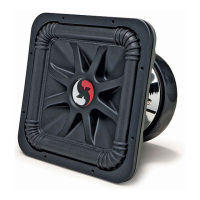
Your Solo-Baric subwoofers are designed for massive sub-bass performance when
installed in a simple sealed enclosure. Sealed boxes are known for extended low frequency
capability with a smooth gradual roll off characteristic - elaborate hard-to-build boxes
aren’t needed to get the best bass response.
Because of the Solo-Baric's high moving mass, it is essential that the enclosure size
recommendations be followed exactly. Failure to use the correct box size can result in
poor sound quality or premature woofer failure.
DO NOT USE SOLO-BARIC WOOFERS IN THE FOLLOWING ENCLOSURE DESIGNS:
Vented or ported enclosures
Freeair or infinite baffle mounting
Double vented "7th Order" bandpass enclosure
Passive radiator designs
The cardboard support inside your Solo-Baric’s shipping carton can be used as a
template for cutting the speaker mounting hole in the enclosure you build. Since the
cardboard cut-out is the same size as the basket of the L7, when you make the cut
along the line drawn through the template, make sure to cut right on the line to get the
correct opening size.
These enclosure volume recommendations are for the airspace inside the enclosure
and include the displacement of the woofer. Do not make the airspace any greater than
recommended.
Enclosure Volume Recommendations
Model Minimum Enclosure Volume Maximum Enclosure Volume
S8L7 .33 cubic feet (9.3 L) .4 cubic feet (11.3 L)
S10L7 .66 cubic feet (18.7 L) .8 cubic feet (22.7 L)
S12L7 .88 cubic feet (24.9 L) 1.1 cubic feet (31.2 L)
S15L7 1.5 cubic feet (42.5 L) 1.8 cubic feet (51.0 L)
A Note on Power Handling Capability
Solo-Baric subwoofers will handle their full rated power in any of the recommended
enclosures, minimum or maximum. The smaller enclosures are best for use in limited
space applications. The larger (maximum) recommended enclosures will yield slightly
more bass at the lowest frequencies.The power ratings given are assuming that both
voice coils are used. You should never hook up a dual voice coil woofer using only one
coil.
2




 To Next Page