This document provides instructions for use of a KitchenAid gas hob, designed for cooking food in household settings. It covers product description, symbols, usage, installation, maintenance, and troubleshooting.
Function Description:
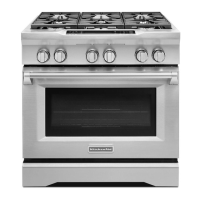
The KitchenAid gas hob is a cooking appliance featuring multiple gas burners for various cooking needs. It includes an auxiliary burner, two semi-fast burners, and a professional wok burner. Each burner is controlled by a dedicated knob, allowing for flame adjustment from minimum to maximum. The hob incorporates safety features such as thermocouples that cut off the gas supply if the flame is accidentally lost. It is designed to be built into a worktop and can be paired with KitchenAid ovens.
Important Technical Specifications:
The hob is a Category II2H3+ appliance, indicating its compatibility with specific gas types.
- Burner Types and Heat Flow:
- Auxiliary burner: 1 kWh nominal heat flow.
- Semi-fast burner: 1.65 kWh nominal heat flow (two of these).
- Professional wok burner: 4.20 kWh (Natural Gas G20), 3.80 kWh (Liquid Petroleum Gas G30/G31).
- Gas Types and Pressures:
- Natural Gas (Methane) G20: 20 mbar nominal pressure.
- Liquid Petroleum Gas (Butane) G30: 28-30 mbar nominal pressure.
- Liquid Petroleum Gas (Propane) G31: 37 mbar nominal pressure.
- Overall Nominal Heat Flow (4 burners):
- G20 20 mbar: 8.50 kW
- G30 28-30 mbar: 8.10 kW
- G31 37 mbar: 8.10 kW
- Electrical Connection: 230 V - 50 Hz. The appliance must be earthed and protected by a 3mm bi-polar switch.
- Dimensions (Hob): 730 mm (width) x 510 mm (depth). Cut-out dimensions are 560 mm x 490 mm.
- Pan Diameter Recommendations:
- Wok burner: 24 to 26 cm.
- Semi-fast burner: 16 to 24 cm.
- Auxiliary burner: 8 to 14 cm.
- Clearances: Minimum 750 mm from the hob surface to the bottom of a hood, and 50 mm from the hob surface to the bottom of adjacent cabinetry. If the distance between wall cupboards is between 600mm and 730mm, the height to the bottom of the cupboard must be at least 530mm. If the distance is greater than the width of the hob, the height must be at least 400mm.
Usage Features:
- Ignition: To turn on a burner, rotate the corresponding control knob anticlockwise to the maximum flame symbol and press it for about 5 seconds to engage the safety thermocouple. If the burner does not ignite within 15 seconds, switch it off, check the burner cap and plate fitting, wait at least 1 minute, and try again. If the burner goes out when the knob is released, the thermocouple did not engage; wait 1 minute before retrying.
- Flame Adjustment: Control knobs allow adjustment between maximum and minimum flame settings.
- Pan Support Positioning: Pan supports are positioned by inserting locating pins at the rear of the hob into corresponding slots. The wok burner has a specific fitting order for its components: burner ring, decorative covering ring, external burner cap, and internal burner cap, ensuring correct pin alignment.
- Gas Type Adaption: The hob can be adapted to different gas types by replacing injectors and adjusting primary air for the wok burner. This process requires contacting the Customer Care Centre or a qualified electrician.
- Minimum Flow Level Regulation: The minimum flame level of the gas taps can be regulated by adjusting screws found under the control knobs. Tightening reduces flame height, while slackening increases it. This should be done with the tap at the lowest position. For liquid petroleum gas (G30/G31), the bypass screw must be screwed in fully.
Maintenance Features:
- General Cleaning: Always disconnect the hob from the electrical supply and allow it to cool before cleaning. Enamelled parts and glass surfaces should be cleaned with lukewarm water and a mild detergent. Stainless steel surfaces should be cleaned with lukewarm water, mild detergent, and a soft cloth, or stainless steel specific cleaning products. Avoid harsh, corrosive, chloride-based, or inflammable products, scourers, and steam cleaning. Do not leave acidic or alkaline products on the hob surface.
- Burner Cleaning: Pan supports and burners are removable for easier cleaning. Wash them carefully in hot water with a mild detergent, ensuring all dirt is removed and burner openings are not blocked. The internal brass burner cap (D) will naturally burnish with heat and should be cleaned with a product specifically designed for brass. The wok burner external cap (C) should be cleaned with hot water and mild detergent. Rinse and dry all parts carefully before refitting.
- Electronic Ignition and Thermocouples: The ends of igniters and thermocouples should be cleaned regularly with a damp cloth to ensure proper operation. Ingrained food should be removed carefully with a toothpick.
- Safety: Ensure pan supports are correctly in place with all rubber feet before operating the hob to avoid damaging the electronic ignition.
Troubleshooting Guide:
- Burner does not ignite or flame is unsteady: Check gas/electricity supply, control knob position, gas supply level, burner openings, electronic igniter cleanliness, and proper positioning of burner parts.
- Flame doesn't stay on: Ensure the control button was pushed in properly for the required time to activate the thermocouple, check burner openings relative to the thermocouple, and ensure the thermocouple end is clean.
- Pans are not stable: Check if the pot bottom is flat, the pot is centred on the burner, and pan supports are correctly positioned with all rubber feet in place.
For persistent problems, contact the Customer Care Centre with a description of the fault, hob type/model, service number, address, and telephone number.

 Need help?
 General



 To Next Page
