EasyManua.ls Logo

KitchenAid KEBS207D - Page 17

KitchenAid KEBS207D
50 pages
Print Icon
To Next Page IconTo Next Page
To Previous Page IconTo Previous Page
Loading...
*Ii$ing
Your
Oven
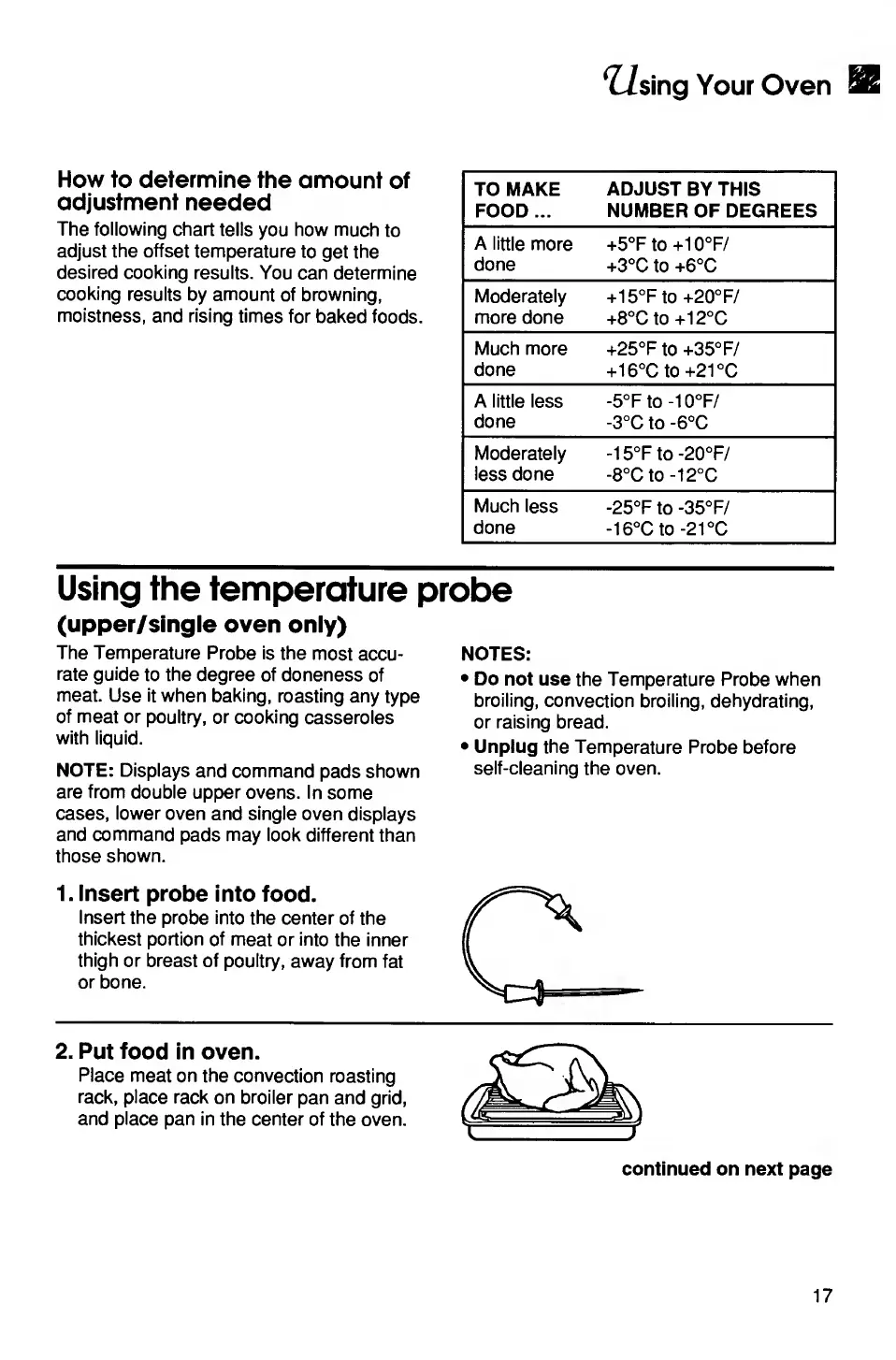
How
to
determine
the
amount
of
adjustment
needed
The
following
chart
tells
you
how
much
to
adjust
the
offset
temperature
to
get
the
desired
cooking
results.
You
can
determine
cooking
results
by
amount
of
browning,
moistness,
and
rising
times
for
baked
foods.
TO
MAKE
FOOD
...
ADJUST
BY
THIS
NUMBER
OF
DEGREES
A
little
more
done
+5°F
to
+10°F/
+3°C
to
+6°C
Moderately
more
done
+15°F
to
+20°F/
+8°C
to
+12°C
Much
more
done
+25°F
to
+35°F/
+16°C
to
+21
°C
A
little
less
done
-5°F
to
-10°F/
-3°C
to
-6°C
Moderately
less
done
-15°F
to
-20°F/
-8°C
to
-12°C
Much
less
done
-25°F
to
-35°F/
-16°C
to
-21
°C
Using
the
temperature
probe
(upper/single
oven
only)
The
Temperature
Probe
is
the
most
accu¬
rate
guide
to
the
degree
of
doneness
of
meat.
Use
it
when
baking,
roasting
any
type
of
meat
or
poultry,
or
cooking
casseroles
with
liquid.
NOTE:
Displays
and
command
pads
shown
are
from
double
upper
ovens.
In
some
cases,
lower
oven
and
single
oven
displays
and
command
pads
may
look
different
than
those
shown.
1.
Insert
probe
into
food.
Insert
the
probe
into
the
center
of
the
thickest
portion
of
meat
or
into
the
inner
thigh
or
breast
of
poultry,
away
from
fat
or
bone.
NOTES:
Do
not
use
the
Temperature
Probe
when
broiling,
convection
broiling,
dehydrating,
or
raising
bread.
Unplug
the
Temperature
Probe
before
self-cleaning
the
oven.
2.
Put
food
in
oven.
Place
meat
on
the
convection
roasting
rack,
place
rack
on
broiler
pan
and
grid,
and
place
pan
in
the
center
of
the
oven.
continued
on
next
page
17

Related product manuals