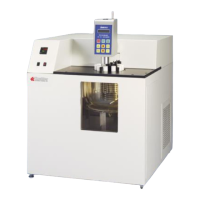
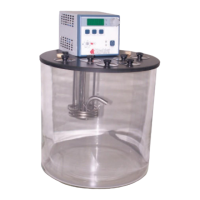
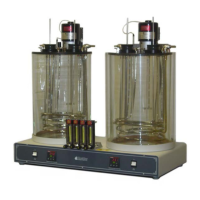
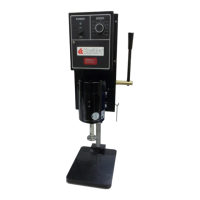
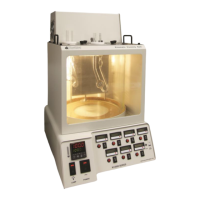
SV3000, SV4000 Saybolt Viscosity Bath
Operation and Instruction Manual
- 8 -
b. Press the Menu/OK key two times until PCt is displayed in the upper white display. Press the DOWN key. CAL will display
on upper white display. If there is a value observed in the upper white display, add it to the calculated difference obtained
in the previous step. This is the offset value.
c. Press the Menu/OK Key. The lower green display will flash. Use the up or down keys to adjust to the new calibration
offset value on the lower green display calculated in the previous step. When the value has been entered, the controller
will display OK on the lower display and store the value. The lower green display will stop flashing. If further adjustments
are necessary, press the Menu/OK key, then the up or down Keys again. Resume regular operations by pressing the
Back key two times. Verify if the new calibration is correct by observing the upper white display and comparing the value
with the calibrated reference device.
Auto Tune. The below procedure allows the digital temperature control to automatically learn the optimal heating P-I-D parameters
needed at a specific setpoint temperature. This operation should be performed to provide optimal bath temperature stability
when initially installing a new unit, after replacing or changing the bath medium type, or utilizing a different temperature set
point that is 20% different from the previously used set point temperature.
a. Set the operating temperature to the desired setting.
Press the up and down arrow buttons simultaneously for about 5 seconds. When Auto Tune is active, the lower green display will
scroll “Autotuning Active”. Auto Tune will automatically terminate when the tuning process is complete. Auto tune can be
terminated by pressing the up & down buttons simultaneously again.
4.3. Preparation of Apparatus (As Per ASTM D88)
1. Use a Universal orifice or tip for lubricants and distillates with efflux times greater than 32 seconds to give the desired
accuracy. Liquids with efflux times greater than 1000 seconds are not conveniently tested with this orifice.
2. Use a Furol orifice or tip for residual materials with efflux times greater than 25 seconds to give the desired accuracy.
The Saybolt Furol viscosity is approximately one tenth the Saybolt Universal viscosity and is recommended for
characterization of petroleum products such as fuel oils and residual materials having Saybolt Universal viscosities greater
than 1000 seconds.
3. Clean the viscometer thoroughly with an appropriate solvent of low toxicity; then remove all solvent from the viscometer
and its gallery. Clean the receiving flask in the same manner.
NOTE: The plunger commonly supplied with the viscometer should never be used for cleaning; its use might damage the
overflow rim and walls of the viscometer.
4. Set up the viscometer and bath in an area where they will not be exposed to drafts or rapid changes in air temperature,
and dust or vapors that might contaminate a sample.
5. Place the receiving flask beneath the viscometer so that the graduation mark on the flask is from 100-130 mm (4 to 5
inches) below the bottom of the viscometer tube and so that the stream of oil will jus strike the neck of the flask.
6. Fill the bath to at least 6 mm (1/4 inch) above the overflow rim of the viscometer with an appropriate bath medium.
7. Provide adequate stirring and thermal control for the bath so that the temperature of a test sample in the viscometer will
not vary more than +/- 0.03°C (+/- 0.05°F) after reaching the selected test temperature.
8. Do not make viscosity measurements at temperatures below the dew point of the room’s atmosphere.
9. For calibration and referee tests, keep the room temperature between 20 and 30°C (68 and 86°F) and record the actual
temperature. However room temperatures up to 38°C (100°F) will not introduce errors in excess of 1%.


 To Next Page