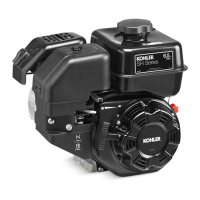
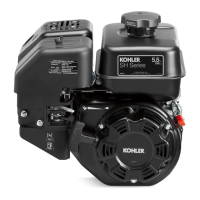
This document is an owner's manual for the KOHLER SH Series engines, specifically models SH255 and SH265. It provides essential information for safe operation, maintenance, and troubleshooting of these engines.
Function Description:
The KOHLER SH Series engines (SH255, SH265) are internal combustion engines designed to power various equipment. The manual emphasizes the importance of reading all safety precautions and instructions carefully before operation, and refers users to the operating instructions of the equipment powered by the engine. It also highlights the necessity of ensuring the engine is stopped and level before any maintenance or service.
Important Technical Specifications:
- Models: SH255, SH265
- Bore: 2.7 in. (68 mm)
- Stroke: 2.1 in. (54 mm)
- Displacement: 12 cu. in. (196 cc)
- Oil Capacity (Refill): 0.63 qt. (0.60 L)
- Spark Plug Gap: 0.030 in. (0.76 mm)
- Maximum Angle of Operation (@ full oil level): 25° (Exceeding this angle may cause engine damage from insufficient lubrication).
- High Altitude Operation: A high altitude carburetor kit is required for operation at 4000 ft. (1219 meters) or above. Operating with the wrong configuration at a given altitude may increase emissions, decrease fuel efficiency, and damage the engine.
- Fuel Requirements: Clean, fresh, unleaded gasoline with an octane rating of 87 (R+M)/2 or higher (Research Octane Number (RON) 90 minimum). Gasoline up to 10% ethyl alcohol and 90% unleaded is acceptable. Methyl Tertiary Butyl Ether (MTBE) and unleaded gasoline blend (max 15% MTBE by volume) are approved. E15, E20, and E85 are NOT approved. Do not use gasoline older than 30 days.
- Emission Control System: The exhaust emission control system for models SH255, SH265 is designated EM for U.S. EPA, California, and Europe. Tampering with the engine and its emission control system voids relevant certifications.
Usage Features:
- Starting:
- Pre-Start Checklist: Includes checking oil and fuel levels, cleaning cooling and air intake areas, ensuring air cleaner components and shrouds are in place, and checking the spark arrestor.
- Fuel Shut-Off Valve: Turn to ON position (if equipped).
- Engine On/Off Switch: Turn to ON position (if equipped).
- Cold Engine Start: Place throttle control midway between SLOW and FAST, place choke control into ON.
- Warm Engine Start: Place throttle control midway between SLOW and FAST, return choke to OFF as soon as engine starts. A warm engine usually does not require choke.
- Retractable Start: Pull starter handle slowly until past compression-STOP, then firmly pull straight out.
- Electric Start: Activate starter switch and release as soon as engine starts.
- Cold Weather Starting Hints: Use proper oil, disengage external loads, use fresh winter grade fuel.
- Stopping:
- Remove load by disengaging PTO driven attachments (if possible).
- Move throttle control to slow or idle position; stop engine (if equipped).
- Close fuel shut-off valve (if equipped).
- Angle of Operation: Do not operate the engine exceeding the maximum angle of operation to prevent damage from insufficient lubrication.
- Engine Speed: Do not tamper with governor settings to increase maximum engine speed, as overspeed is hazardous and voids warranty.
- Oil Sentry™ (if equipped): This switch prevents the engine from starting in low or no oil conditions. It may not shut down a running engine before damage occurs and may activate a warning signal.
Maintenance Features:
- Maintenance Schedule:
- After first 5 Hours: Change oil.
- Every 50 Hours or Annually: Service/replace dual-element precleaner.
- Every 100 Hours or Annually¹: Clean low-profile air cleaner element, replace dual-element air cleaner element, change oil, clean cooling areas, clean spark arrestor (if equipped), replace fuel filter (if equipped).
- Every 100 Hours²: Check and adjust valve clearance when engine is cold.
- Every 125 Hours or Annually¹: Replace spark plug and set gap.
- Every 200 Hours²: Replace fuel line.
- Every 300 Hours: Replace low-profile air cleaner element.
- ¹ Perform these procedures more frequently under severe, dusty, dirty conditions.
- ² Have a Kohler authorized dealer perform this service.
- Oil Recommendations: Kohler oils are recommended, or other high-quality detergent oils (including synthetic) of API service class SJ or higher. Viscosity selection is based on air temperature.
- Check Oil Level: Ensure engine is cool. Clean oil fill/dipstick areas. Remove, wipe, and reinsert dipstick (resting on oil fill neck, not threaded) to check level. Level should be at the top of the indicator on the dipstick or up to the point of overflowing the filler neck.
- Change Oil: Change oil while the engine is warm. Drain completely, reinstall drain plug (torque to 13 ft. lb. / 17.6 N·m), fill crankcase with new oil to the point of overflowing the filler neck, and reinstall the cap/dipstick. Dispose of used oil according to local ordinances.
- Add Fuel: Ensure engine is cool. Clean around the fuel cap, remove, fill to the base of the filler neck (do not overfill), and reinstall securely.
- Spark Plugs: Clean recess, remove, check gap (adjust per specification table), install into cylinder head, and torque to 20 ft. lb. (27 N·m).
- Air Cleaner:
- Dual-Element: Service precleaner (wash in warm water with detergent, rinse, air dry) and replace paper element.
- Low-Profile: Remove screw and cover, remove foam element, wash in warm water with detergent, rinse, air dry, lightly oil with new engine oil, squeeze out excess, reinstall.
- Operating with loose or damaged components can cause premature wear. Paper elements cannot be blown out with compressed air.
- Breather Tube: Ensure both ends are properly connected.
- Air Cooling: Proper cooling is essential. Clean screens, cooling fins, and external surfaces to prevent overheating. Avoid spraying water at wiring harness or electrical components.
- Repairs/Service Parts: Kohler recommends using an authorized dealer for maintenance, service, and replacement parts.
- Storage: For storage of 2 months or more: Add Kohler PRO Series fuel treatment (or equivalent) to the fuel tank and run the engine for 2-3 minutes. Change oil while warm. Remove spark plug(s), pour about 1 oz. of engine oil into cylinder(s), replace spark plug(s), and crank engine slowly. Disconnect the negative (-) battery cable. Store in a clean, dry place.
The manual includes a troubleshooting section with common problems and possible causes, such as "Will Not Start," "Hard Starting," "Lacks Power," and "Overheats," linking them to issues like improper fuel, dirty fuel line, incorrect oil level, or a faulty spark plug. It explicitly states that major engine components or items requiring special timing/adjustment should be serviced by a Kohler authorized dealer.
Warranty information is available on KohlerEngines.com, and users are encouraged to record engine information (model, specification, serial number, purchase date) for future reference when ordering parts or obtaining warranty coverage.

 Need help?


 To Next Page
 General