Why is the date and time incorrect on my Konica Minolta Digital Camera?
- EEric HancockSep 13, 2025
If the date and time are incorrect on your Konica Minolta Digital Camera, it might be because it was left without a battery for over 24 hours.

Why is the date and time incorrect on my Konica Minolta Digital Camera?
If the date and time are incorrect on your Konica Minolta Digital Camera, it might be because it was left without a battery for over 24 hours.
| Brand | Konica Minolta |
|---|---|
| Model | DiMAGE G400 |
| Category | Digital Camera |
| Language | English |
Advises users to read the manual, perform test shots, and be aware of copyright.
Explains the meaning of warning and caution symbols used in the manual.
Covers critical warnings related to product handling, electrical safety, and usage.
Details safety advice for operating the camera, including electrical precautions and environmental factors.
Provides cautions for battery care, cleaning, and avoiding hazardous environments for safe operation.
Addresses battery fluid, LCD monitor care, and specific product warnings like lead exposure.
Lists all the accessories included in the camera package for user reference.
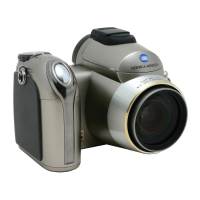
Identifies and labels the external components of the camera body for user familiarity.
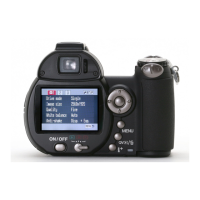
Details the location and function of the camera's main buttons and controls for easy operation.
Provides step-by-step instructions on how to attach the camera strap securely.
Guides users on the correct procedure for charging the camera's battery pack before first use.
Explains the process of correctly inserting the battery pack into the camera for power.
Provides instructions on how to connect the AC adapter for continuous power supply to the camera.
Guides users on the proper method for inserting SD, MultiMedia, or Memory Stick cards into the camera.
Explains the procedure for safely removing memory cards from the camera to prevent data loss.
Provides guidance on how to hold the camera correctly for stable shooting.
Explains the meaning of the green LED status in the viewfinder during operation.
Guides users on choosing the appropriate shooting mode (Auto, Scene Select, Movie, Manual, Setup) for different scenarios.
Details the basic steps for taking still images using the LCD monitor in AUTO mode.
Explains how to take pictures using the camera's viewfinder, noting lower battery consumption.
Details how to lock focus on a subject not in the center for precise photography.
Guides users on how to record movies with sound using the camera.
Describes the automatic flash mode and its shooting distances.
Explains how to use the fill-in flash mode for subjects with shadows or against light.
Details using the flash off mode where flash photography is prohibited.
Guides users on shooting close-up subjects and explains shooting distances for macro modes.
Explains how to play back recorded still images on the LCD monitor and navigate through them.
Guides users on how to play back recorded movie clips on the camera.
Explains how to erase single, multiple, or all unwanted still pictures, movie images, or voice memos.
Details the process of selecting specific images for deletion using the 'SELECT' option.
Explains the menu options available when the camera is set to AUTO mode.
Describes how to apply different color effects (Standard, B&W, Sepia, Warm, Cold) to photos.
Explains the different continuous shooting modes (Single, Continuous, Super Continuous) for capturing sequences.
Guides users on choosing image resolutions (4M, 2M, VGA) based on quality and memory needs.
Explains how to set priority when using two memory cards simultaneously in the camera.
Details how to use the self-timer function for delayed shots, with 3-second or 10-second options.
Introduces the Scene Select mode and its available options for different photographic scenes.
Guides users on choosing the best scene mode for optimal results based on the shooting environment.
Introduces the Movie/Voice mode for shooting movies, adding voice comments, or recording messages.
Explains how to add voice comments to still images after they have been taken.
Explains how to adjust exposure levels to brighten or darken images for better exposure control.
Guides users on setting the correct white balance for different light sources to ensure accurate color reproduction.
Introduces the Manual mode, allowing users to control shutter speed and aperture for creative control.
Explains the Program mode, where the camera automatically sets exposure based on brightness.
Details how to use AF (focus) lock and AE (exposure) lock for precise shooting control.
Explains Aperture Priority mode, where users set aperture and the camera adjusts shutter speed.
Guides users on setting both shutter speed and aperture manually for complete creative control.
Explains how to use Auto Bracket Exposure or Focus to capture multiple shots with staggered settings.
Details how to adjust the camera's ISO sensitivity for different lighting conditions.
Explains how to set a fixed focus distance for specific shooting scenarios.
Guides users on enabling and configuring custom image quality settings for preferred results.
Explains how to adjust the intensity of the flash for optimal lighting in different shooting situations.
Details how to adjust color clearness and vibrancy in images for desired visual effects.
Explains how to adjust the gap between bright and dark areas in images to achieve sharp or soft results.
Guides users on adjusting the sharpness of image outlines to make them sharper or softer.
Explains how to adjust the intensity of red, green, and blue colors to emphasize specific tones.
Details how to adjust shutter speed for slow shutter effects, especially in dark conditions.
Explains how to view up to nine images simultaneously on the LCD for quick access or deletion.
Guides users on how to zoom in on images during playback to view details.
Guides users on playing back recorded voice memos stored in the camera.
Explains the procedure for copying or moving images to other media like memory cards.
Guides users on selecting images and specifying print quantities for DPOF compatible printing services.
Explains how to protect important images from accidental deletion or cancel existing protection.
Details how to reduce image file sizes for email attachments or smaller storage.
Guides users on how to automatically play back images as a continuous slide show.
Introduces the Set-up menu for customizing various camera preferences and settings.
Explains the process of formatting a memory card to restore it to its initial state.
Guides users on adjusting LCD monitor settings like Quick View, Information display, and Monitor operation mode.
Covers settings for Quick View display and hiding image information on the LCD monitor.
Details changing LCD monitor operation mode and controlling the blue LED indicator.
Explains how to adjust the brightness and color tones of the LCD monitor for optimal viewing.
Guides users on setting options like Red Eye Reduction and Digital Zoom for shooting modes.
Details how to use red-eye reduction and digital zoom features for improved photography.
Explains how to change the file numbering system for images on the memory card.
Covers changing between center-weighted and spot metering for exposure control.
Details how to change the camera's focus metering system between exo-AF sensor ON and OFF.
Explains how to turn camera sounds (warning tones, shutter sound) ON or OFF.
Guides users on setting basic camera configurations like Date/Time, Language, Auto Power Off, Custom, and Default settings.
Explains how to reset the date and time if they are lost due to battery removal.
Guides users on changing the language displayed on the camera's LCD monitor.
Details how to adjust the time interval before the camera automatically powers off.
Explains how to enable or disable custom settings for various shooting modes.
Guides users on how to reset all camera settings back to their factory defaults.
Lists the required operating system and hardware specifications for Windows and Macintosh to connect the camera.
Provides step-by-step instructions for connecting the camera to a PC using a USB cable.
Guides users through the process of installing the necessary USB driver software from the CD-ROM.
Explains the procedure for transferring images from the camera to a PC via USB.
Details the requirements and process for installing QuickTime for movie playback on Windows.
Explains how to access instruction manuals and install Adobe Acrobat Reader from the CD-ROM.
Provides guidance on using the AC adapter and charger overseas, noting voltage compatibility.
Discusses managing image data, potential data loss, and care for the LCD monitor.
Provides information on spare parts availability and contacting service facilities for repairs.