2 Introduction
Kontron User's Guide ETX CD 9
2.2 ETX® Documentation
This product manual serves as one of three principal references for an ETX® design. It documents the
specifications and features of ETX®-CD. The other two references, which are available from the Kontron
Embedded Modules Web site, include:
®
The ETX® Specification defines the ETX® module form factor, pinout, and signals.
®
The ETX® Design Guide serves as a general guide for baseboard design, with a focus
on maximum flexibility to accommodate a wide range of ETX® modules.
Note: Some of the information contained within this product manual applies only to certain product revisions (CE:
xxx). If certain information applies to specific product revisions (CE: xxx) it will be stated. Please check the
product revision of your module to see if this information is applicable.
2.3 ETX® Benefits
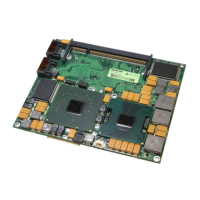
Embedded technology extended (ETX) modules are very compact (114 x 95 mm), highly integrated
computers. All ETX® modules feature a standardized form factor and a standardized connector layout
that carry a specified set of signals. This standardization allows designers to create a single-system
baseboard that can accept present and future ETX® modules.
ETX® modules include common personal computer (PC) peripheral functions such as:
®
Graphics
®
Parallel, Serial, and USB ports
®
Keyboard/mouse
®
Ethernet
®
Sound
®
IDE (and SATA)
The baseboard designer can optimize exactly how each of these functions implements physically.
Designers can place connectors precisely where needed for the application on a baseboard designed to
optimally fit a system’s packaging.
Peripheral PCI or ISA buses can be implemented directly on the baseboard rather than on mechanically
unwieldy expansion cards. The ability to build a system on a single baseboard using the computer as one
plug-in component simplifies packaging, eliminates cabling, and significantly reduces system-level cost.
A single baseboard design can use a range of ETX® modules. This flexibility can differentiate products at
various price/performance points, or to design future proof systems that have a builtin upgrade path.
The modularity of an ETX® solution also ensures against obsolescence as computer technology evolves.
A properly designed ETX® baseboard can work with several successive generations of ETX® modules.
An ETX® baseboard design has many advantages of a custom, computer-board design but delivers better
obsolescence protection, greatly reduced engineering effort, and faster time to market.


 To Next Page