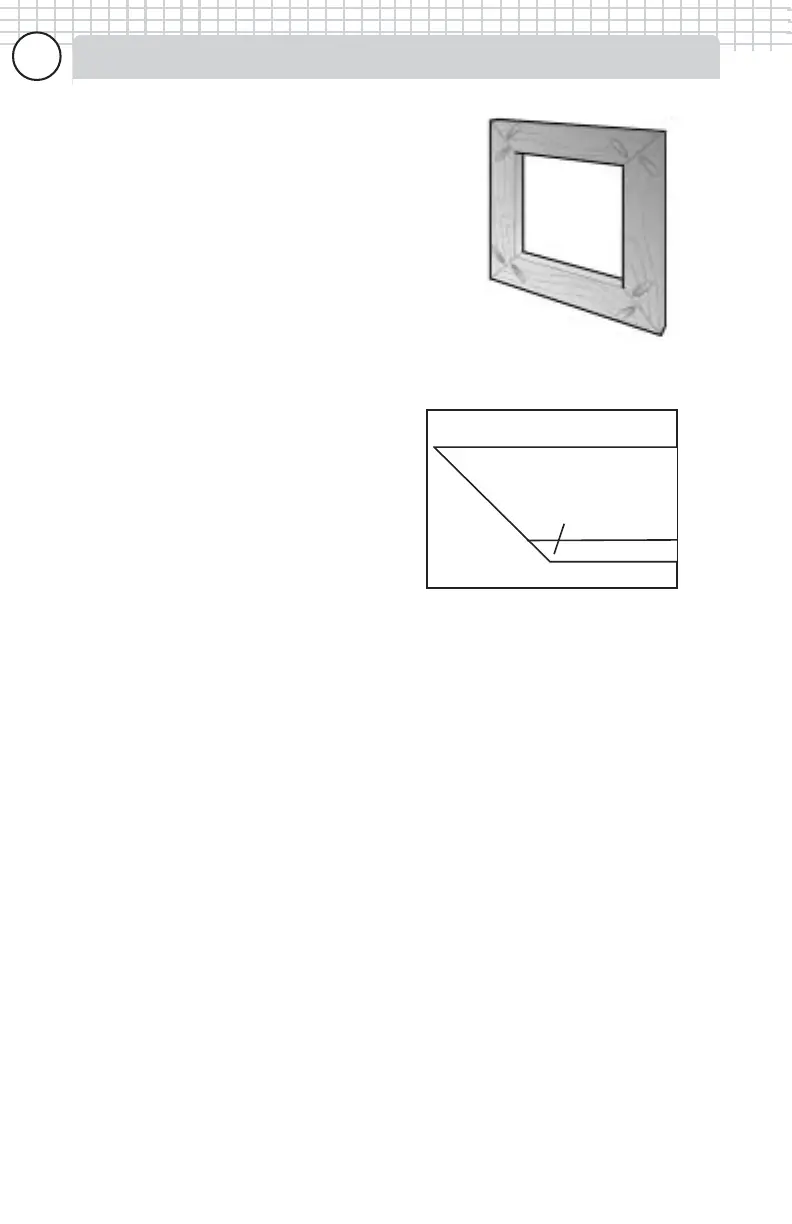
Mitered Joints
2323
2323
23
This section relates to mitered joints that are
assembled in a flat plane such as a picture frame.
This is probably one of the most challenging
types of joints to produce with pocket hole
joinery. Understanding how the orientation of
the pocket hole and the width of the stock being
joined varies will allow you to join frames more
easily.
Miter Components
A. Miter toe – The outside point of a
mitered workpiece.
B. Miter heel – The inside corner of a
mitered workpiece.
C. Rabbet – This is typically a 3/8”
wide by 1/2” deep L-shaped groove set
into the edge of the frame that allows
the backing material to be inserted.
Standard Miter Dimensions
A miter cut refers to anything other than a 90 degree cut. Two 45 degree
miter cuts when assembled create a 90 degree joint, while two 30 degree
angles will produce a 60 degree joint. To calculate the angles needed to
make a hexagon, octagon, etc. simply take 360 degrees and divide it by the
number of sides multiplied by two (ie. For an octagon take 360 / (8 * 2) =
22.5 degrees
Triangle 60 degrees Heptagon 25.7 degrees
Square 45 degrees Octagon 22.5 degrees
Pentagon 36 degrees Nonagon 20 degrees
Hexagon 30 degrees Decagon 18 degrees
Frames are typically made from 3/4” thick stock. Material width of frame
members can range from 1-1/2” wide to 5” wide and beyond. One thing to
keep in mind with pocket hole joinery is that the wider the frame members,
the easier they are to join. Many frames also incorporate a standard 3/8”
wide by 1/2” deep rabbet into the inside edge of the frame that serves to
allow the glass, picture and backing material to be secured.
3/8" Rabbet
Miter Heel
Miter Toe



 To Next Page