This document is an instruction and maintenance manual for a KROFtools hydraulic scissor lift, model REF 9817, with a 3-ton capacity.
Function Description
The KROFtools hydraulic scissor lift is a lifting equipment designed for professional use, primarily for raising vehicles to facilitate maintenance and repair work. It operates hydraulically, utilizing a power unit to extend and retract scissor arms, thereby lifting and lowering the platforms. The lift is designed to provide a stable and secure platform for vehicles, ensuring safety during operations. It incorporates safety locks to prevent accidental lowering and is controlled via an external power unit with UP and DOWN buttons.
Important Technical Specifications
- Lifting Capacity: 3000 kg (3 tons)
- Max. Lifting Height: 1000 mm
- Min. Height: 110 mm
- Overall Width: 1760 mm
- Platform Length: 1400-2004 mm (adjustable/extendable)
- Space between Platforms: 700 mm
- Lifting Time: 60 seconds
- Noise Level: 70 dB (A) at 1 meter
- Operating Temperature: 10°C to +50°C
- Work Environment: Closed room
- Power Supply:
- 2.2 KW
- 200-240V 50/60Hz 1 Phase
- 380-415V 50/60Hz 3 Phase
- Gross Weight: 576 kg
- Net Weight: 522 kg
- Shipping Weight (Lift): 520 kg
- Shipping Weight (Hydraulic Pump): 80 kg
- Recommended Hydraulic Oil: 30# hydraulic oil
Usage Features
The lift is designed for ease of operation and safety.
- Control System: The lift is operated using a control unit with "UP" and "DOWN" buttons for raising and lowering the platforms.
- Safety Locks: The system includes safety locks to secure the lift at various heights, preventing unintended descent. The manual explicitly states, "DO NOT PUT ANYTHING ON THE SAFETY LOCK."
- Vehicle Direction: An arrow on the platform indicates the "Vehicle direction" (Direção veículo / Dirección del vehículo / Direction du véhicule) for proper vehicle positioning.
- Ramp and Extension: The lift features ramps and extensions, suggesting adaptability for different vehicle lengths or for easier loading.
- Hydraulic Cylinders: The lifting mechanism relies on hydraulic cylinders, powered by a hydraulic pump station.
- Installation Requirements: The manual specifies that the machine should be installed on a floor that is not broken or uneven to ensure stability and free movement of the platform. It also recommends a minimum working space of 3200x2000mm around the machine. If installed outdoors, it must be protected by some form of roofing against rain.
- Safety Precautions: Operators are warned against wearing loose clothing or having long hair unprotected. Crucially, no personnel are allowed to be in the lift or the car when the lift is working, as this could result in severe injury or death.
Maintenance Features
The manual outlines a comprehensive maintenance schedule to ensure the lift's longevity and safe operation.
- Regular Maintenance:
- Monthly: Check the power unit oil level and add oil if necessary.
- Every 6 Months: Check the contamination or aging level of the hydraulic oil. Contaminated oil can cause malfunctions and reduce the service life of the gear pumps. Grease all moving parts. Check that the locking system works properly.
- Every 12 Months: Perform a general visual inspection of all structural parts and mechanisms for problems or abnormalities. Skilled electricians should test the electric plant, including the motor of the power unit and the control box.
- Hydraulic Oil Management:
- Filling: Hydraulic oil (30#) is filled through an inlet after removing the motor box and turning the oil cap anti-clockwise. It's crucial not to overfill the tank to prevent overflow when the oil warms up.
- Replacement: The oil should be replaced by lowering the lift to its minimum height, disconnecting power, draining the old oil from the reservoir, and then refilling with new, filtered, recommended oil. After refilling, perform two or three up-down cycles (20-30 cm) to circulate the oil.
- Contamination Check: After the first 40 hours of operation, check for oil contamination. Clean the filter and replace the oil if contamination is high.
- Hydraulic Circuit: Regularly check for oil leaks in the circuit between the power unit, cylinder, and in the cylinder itself. Replace gaskets if necessary.
- Hydraulic Pump: Under normal conditions, check for changes in motor and gear pump noise and ensure all relative bolts are properly tightened.
- Safety Systems: Regularly check the operating condition and efficiency of safety devices. Use a torque wrench to ensure anchor bolts and connection bolts are properly tightened.
- Moving Parts: Clean and lubricate carriage side runners and guides. Check that all screws are tightened.
- Oil Cylinder Maintenance: It is explicitly stated that "IT IS PROHIBITED TO PERFORM MAINTENANCE ON THE OIL CYLINDER. IT SHOULD BE REPLACED WHEN DAMAGED."
- Storage: For long-term storage, lower the platforms, remove any heavy objects, and disconnect the machine from all power sources. It's also recommended to empty the hydraulic oil tank and wrap the machine in protective plastic to prevent dust. Before re-use, refill oil and restore electrical connections.
- Documentation: The manual emphasizes the importance of using original spare parts, following the maintenance schedule, and consulting the provided wiring diagrams and hydraulic diagrams for correct maintenance procedures.

 Need help?
 General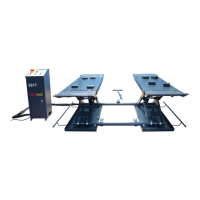

 To Next Page