EasyManua.ls Logo

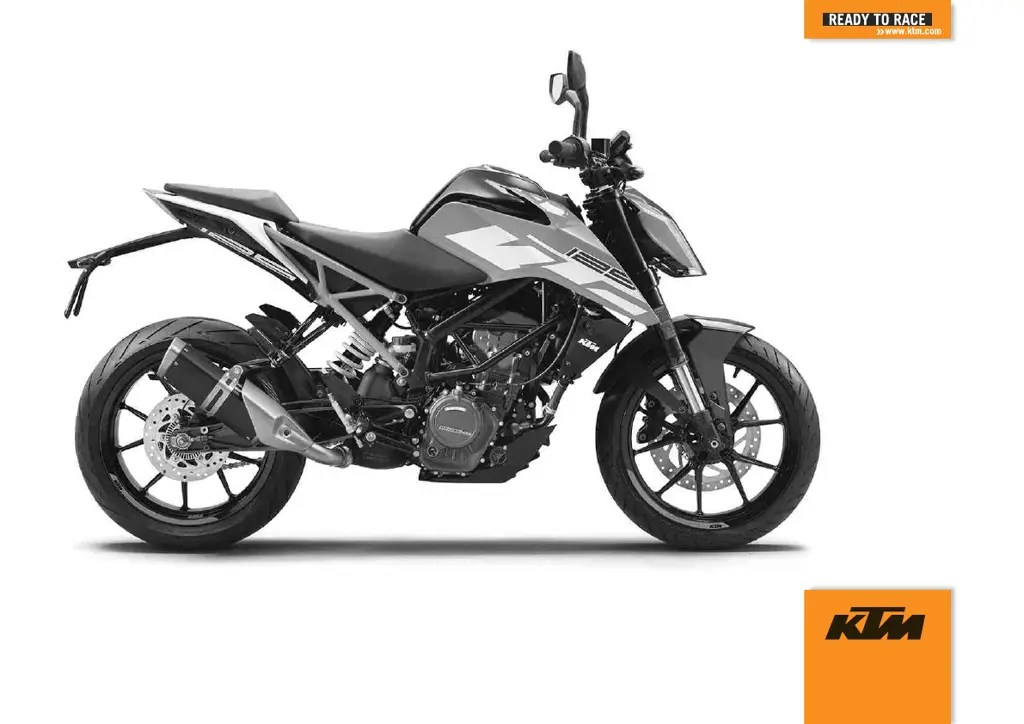
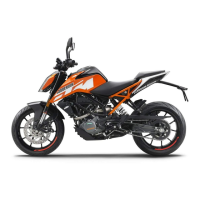
KTM 125 Duke 2017 - User Manual

KTM 125 Duke 2017
202 pages
Print Icon
To Next Page IconTo Next Page
Loading...
OWNER'S MANUAL 2017
125 Duke
Art. no. 3213561en

Table of Contents

Questions and Answers

  • S
    Shannon CooperAug 18, 2025
    How to troubleshoot a KTM Motorcycle that won't crank?
    • K
      Kelly SimmonsAug 18, 2025
      If the engine of your KTM Motorcycle does not crank when you press the electric starter button, it could be due to several reasons. First, ensure you are following the correct start procedure. Alternatively, the battery might be discharged, requiring a recharge. Check fuses 1, 3, 4, and 7, and replace any that are blown. Finally, verify the ground connection is properly established.
  • S
    Suzanne SmithAug 20, 2025
    What to do if KTM 125 Duke 2017 Motorcycle engine turns over but won't start?
    • S
      Steve AveryAug 21, 2025
      If the engine of your KTM Motorcycle turns but does not start, this could be due to an operating error (carry out the start procedure) or a fault in the fuel injection system (read out the fault memory using the KTM diagnostics tool).
  • D
    Dorothy GomezAug 23, 2025
    What to do if my KTM Motorcycle engine dies while riding?
    • W
      williamyoungAug 23, 2025
      If your KTM Motorcycle engine dies during a trip, the possible causes are lack of fuel, in which case you should refuel, or a blown fuse (1, 3, 4, or 7), which requires replacing the affected fuse.
  • C
    Charles WilliamsAug 26, 2025
    Why is the ABS light on my KTM 125 Duke 2017 illuminated?
    • M
      Mary GriffinAug 26, 2025
      If the ABS indicator lamp lights up on your KTM Motorcycle, it could be due to a blown ABS fuse, a large difference in wheel speeds, or a malfunction in the ABS. Replace the ABS fuses if they are blown. If the issue is due to wheel speed differences, stop the motorcycle, switch off the ignition, and start it again. For an ABS malfunction, use the KTM diagnostics tool to read the ABS fault memory.
  • R
    rdayAug 27, 2025
    Why does my KTM 125 Duke 2017 Motorcycle have low power?
    • R
      randallbarrettAug 28, 2025
      If your KTM Motorcycle engine has too little power, the possible causes are: a very dirty air filter (replace it), a very dirty fuel filter (check the fuel pressure), a fault in the fuel injection system (read out the fault memory using the KTM diagnostics tool), too little coolant in the cooling system (check for leakage and the coolant level), radiator fins very dirty (clean them), foam formation in the cooling system (drain and refill the coolant), a defective thermostat (check it), or a blown fuse 5 (replace it).
  • J
    Jeffery WilliamsonAug 30, 2025
    What causes high oil consumption in a KTM 125 Duke 2017?
    • J
      James DavisAug 30, 2025
      If your KTM Motorcycle has high oil consumption, check the following: ensure the engine vent hose is not bent, and correct its routing or replace it if needed; verify that the engine oil level is not too high; and ensure that the engine oil is not too thin, and replace it if needed.
  • J
    Jacqueline ManningSep 1, 2025
    What does it mean when the malfunction indicator lamp is yellow on my KTM Motorcycle?
    • C
      Christopher SandovalSep 1, 2025
      If the malfunction indicator lamp lights up yellow on your KTM Motorcycle, it indicates a fault in the fuel injection system. To address this, read out the fault memory using the KTM diagnostics tool.
  • G
    Gabriel CarterSep 4, 2025
    Why does my KTM 125 Duke 2017 only start with the clutch in?
    • D
      Dawn CobbSep 4, 2025
      If the engine of your KTM Motorcycle only turns when the clutch lever is drawn, it's likely because the vehicle is in gear. Shift the gear to neutral.
  • Z
    zdavisSep 6, 2025
    Why aren't the headlight and parking light working on my KTM 125 Duke 2017?
    • P
      Patrick WongSep 6, 2025
      If the headlight and parking light are not functioning on your KTM Motorcycle, it is likely due to a blown fuse 6. Replace the fuse.
  • B
    Bryan WebbSep 8, 2025
    Why are the turn signals, brake light, and horn not working on my KTM 125 Duke 2017 Motorcycle?
    • E
      Eric RichardsonSep 8, 2025
      If the turn signal, brake light, and horn are not functional on your KTM Motorcycle, it is likely due to a blown fuse 4 or 6. Replace the fuse.

Summary

Safety Advice

Misuse

Explains what constitutes misuse of the vehicle and the potential dangers involved.

Safety Advice

Emphasizes reading safety instructions and the presence of warning labels for safe operation.

Degrees of Risk and Symbols

Defines danger, warning, caution, and note symbols and their associated risk levels.

Tampering Warning

Warns against tampering with the noise control system and lists prohibited acts.

Safe Operation

Details safe operating practices, including rider fitness and adherence to regulations.

Protective Clothing

Recommends wearing appropriate protective clothing for rider safety and legal compliance.

Owners Manual

Stresses the importance of reading the manual for operation, handling, and maintenance.

Important Notes

Service

Highlights the importance of proper service for operation and preventing premature wear.

Serial Numbers

Chassis Number

Explains where the chassis number is stamped on the vehicle's steering head.

Engine Number

Explains where the engine number is stamped on the engine under the engine sprocket.

Controls

Ignition;Steering Lock

Explains the functions and positions of the ignition and steering lock.

Locking the Steering

Details the procedure for locking the steering for security and preventing theft.

Unlocking the Steering

Details the procedure for unlocking the steering to allow normal operation.

Side Stand

Explains the function and safety coupling of the side stand for parking and starting.

Combination Instrument

Warning Notes

Explains how warning notes are displayed, their colors, and how they are cleared.

Indicator Lamps

Explains the meaning and function of various indicator lamps on the instrument panel.

Shift Warning Light

Explains the function, activation, and settings of the shift warning light.

Menu

Explains how to navigate the instrument's menu system using the control buttons.

Warning

Explains how to view stored warning messages and their meanings.

ABS

Explains how to check and switch the ABS system on/off for different conditions.

Shift Light

Explains how to configure the shift warning light and its display indicators.

Preparing for Use

Advice on First Use

Provides essential advice for the initial operation and familiarization with the motorcycle.

Running in the Engine

Details the procedure and guidelines for the engine's running-in phase for optimal performance.

Loading the Vehicle

Provides warnings and guidelines for loading the vehicle safely, considering weight and balance.

Riding Instructions

Checks and Maintenance When Preparing for Use

Lists essential pre-ride checks for safety, roadworthiness, and proper operation.

Starting

Details the procedure for starting the motorcycle engine safely.

Starting Off

Explains the procedure for starting off smoothly from a standstill.

Shifting, Riding

Provides instructions and warnings for shifting gears and general riding techniques.

Applying the Brakes

Explains the correct application of brakes and related warnings for effective stopping.

Stopping, Parking

Details the procedure for safely stopping and parking the motorcycle.

Refueling

Explains the refueling procedure, safety precautions, and fuel specifications.

Service Schedule

Required Work

Lists scheduled maintenance tasks and their corresponding intervals.

Tuning the Chassis

Service Work on the Chassis

Checking the Chain Tension

Explains how to check and adjust the chain tension for proper operation.

Adjusting the Chain Tension

Details the procedure for adjusting the chain tension to the specified value.

Checking the Chain, Rear Sprocket, and Engine Sprocket

Explains how to check the chain and sprockets for wear and damage.

Brake System

Antilock Braking System (ABS)

Explains the ABS system, its components, operation, and safety warnings.

Checking the Brake Discs

Details how to check brake disc thickness, for wear, damage, and deformation.

Checking the Brake Fluid Level of the Front Brake

Explains how to check the front brake fluid level and identify potential issues.

Adding Front Brake Fluid

Details how to add front brake fluid and safety precautions.

Checking the Front Brake Linings

Explains how to check the front brake linings for minimum thickness and damage.

Checking the Rear Brake Fluid Level

Explains how to check the rear brake fluid level and identify potential issues.

Adding Rear Brake Fluid

Details how to add rear brake fluid and safety precautions.

Checking the Brake Linings of the Rear Brake

Explains how to check the rear brake linings for minimum thickness and damage.

Wheels, Tires

Removing the Front Wheel

Details the procedure for safely removing the front wheel.

Installing the Front Wheel

Details the procedure for safely installing the front wheel.

Removing the Rear Wheel

Details the procedure for safely removing the rear wheel.

Installing the Rear Wheel

Details the procedure for safely installing the rear wheel.

Checking the Tire Condition

Details how to check tires for damage, cuts, tread depth, and age.

Checking the Tire Air Pressure

Explains how to check and set tire air pressure for solo and passenger loads.

Electrical System

Removing the Battery

Details the procedure for safely removing the motorcycle battery.

Installing the Battery

Details the procedure for safely installing the motorcycle battery.

Recharging the Battery

Provides instructions and warnings for recharging the motorcycle battery.

Changing the ABS Fuses

Details how to change the fuses for the ABS hydraulic unit and return pump.

Changing the Fuses of Individual Power Consumers

Details how to change fuses for various vehicle components and lists fuse assignments.

Cooling System

Checking the Antifreeze and Coolant Level

Provides instructions and warnings for checking coolant and antifreeze levels.

Checking the Coolant Level

Explains how to check coolant levels in the compensating tank and radiator.

Draining the Coolant

Details the procedure and safety warnings for draining the cooling system.

Tuning the Engine

Service Work on the Engine

Checking the Engine Oil Level

Explains how to check the engine oil level correctly after the engine has cooled.

Changing the Engine Oil and Oil Filter, Cleaning the Oil Screen

Details the process for changing engine oil, filter, and cleaning the oil screen.

Adding Engine Oil

Explains how to add engine oil, recommended types, and quantities.

Troubleshooting

Technical Data

Substances

KTM 125 Duke 2017 Specifications

General IconGeneral
Displacement124.7 cc
Bore x Stroke58 mm x 47.2 mm
Compression Ratio12.6:1
Power15 hp (11 kW) @ 10, 000 rpm
Transmission6-speed
Fuel SystemElectronic Fuel Injection
Rear SuspensionWP monoshock
Seat Height830 mm
Ground Clearance185 mm
Dry Weight137 kg
Engine TypeSingle cylinder, 4-stroke
Torque12 Nm @ 8, 000 rpm
FrameSteel trellis frame, powder coated
Front SuspensionWP upside-down Ø 43 mm
Front BrakeFour-piston radial fixed caliper, brake disc
Rear BrakeSingle-piston floating calliper, brake disc
Front Tire110/70 x 17
Rear Tire150/60 x 17
ABSBosch 9MB Two Channel ABS

Related product manuals