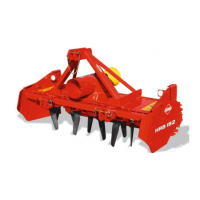
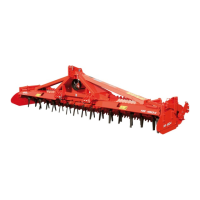
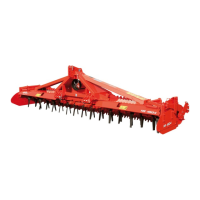
This document is an operator's manual for KUHN Power Harrows, specifically models HR3503D, HR4003D, and HR4503D. It provides comprehensive information on the machine's function, technical specifications, usage, and maintenance.
Function Description
The KUHN Power Harrow is designed for seedbed preparation on ploughed or min-tilled ground, with or without simultaneous seeding. It is an implement for secondary tillage, excellent for preparing seedbeds after conventional ploughing, chisel ploughing, or soil loosening. Its primary functions include:
- Seedbed preparation: Creating an optimal seedbed by crumbling and breaking up clods.
- Soil packing: Evenly packing the soil behind the rotors.
- Levelling: Improving seedbed levelling.
- Track eradication: Reducing tractor wheel marks in the seedbed using optional track eradicators.
The machine can be coupled to a tractor via a 3-point hitch linkage (category 2 or 3) and is driven by the tractor's PTO shaft. Optional hydraulic lift linkages are available to reduce the combination's overhang when fitting additional machines.
Important Technical Specifications
The manual details the specifications for the HR3503D, HR4003D, and HR4503D models:
General Specifications:
- Coupling device: 3-point linkage category 2 and 3.
- PTO speed: 1000 min⁻¹. The power harrow can also be used with tractors having a PTO speed of 540 min⁻¹ or 750 min⁻¹, driving the rotors at intermediate speeds. However, 540 min⁻¹ PTO speed is recommended only for light conditions or lower power requirements (below 73 kW / 100 hp).
- Maximum allowable DIN engine power: 184 kW (250 hp).
Model-Specific Specifications:
| Specification |
HR3503D |
HR4003D |
HR4503D |
| Number of rotors |
12 |
14 |
16 |
| Number of blades R/L |
12/12 |
14/14 |
16/16 |
| Working width |
3.50 m (11'6") |
4.00 m (13'1") |
4.50 m (14'9") |
| Working depth |
30 to 250 mm (1.2" - 9.8") for all models |
|
|
| Overall width |
3.66 m (12') |
4.10 m (13'5") |
4.55 m (14'1") |
| Power requirement |
66 kW (90 hp) |
73 kW (100 hp) |
81 kW (110 hp) |
Weight (approximate, depending on roller type):
| Roller Type |
HR3503D |
HR4003D |
HR4503D |
| Maxicrumbler roller |
1400 kg (3086 lb) |
1580 kg (3483 lb) |
1730 kg (3814 lb) |
| PK2 Packer roller |
1635 kg (3604 lb) |
1850 kg (4078 lb) |
2020 kg (4453 lb) |
| Maxipacker roller |
1685 kg (3714 lb) |
1900 kg (4188 lb) |
2075 kg (4574 lb) |
| Packliner roller |
- |
2145 kg (4728 lb) |
2320 kg (5114 lb) |
Sound Levels (Weighted equivalent continuous acoustic pressure level at the driver's seat (closed cabin) L (A) eq):
| Model |
Tractor only |
Tractor + machine |
| HR3503D |
78.4 dB(A) |
81 dB(A) |
| HR4003D |
78 dB(A) |
81.6 dB(A) |
| HR4503D |
79.1 dB(A) |
82.7 dB(A) |
Usage Features
- Rotor Speed Adjustment: The rotor speed can be adjusted by inverting standard gearwheels or using optional gearwheel sets (27/38 teeth or 25/40 teeth) to adapt to different soil conditions and desired clod sizes.
- Working Depth Adjustment: The roller controls and sets the working depth. An adjustment pin is used to select one of the adjusting plate holes to achieve the desired depth.
- Side Deflector Adjustment: The vertical position of the side deflectors can be adjusted based on working depth and blade wear. The longitudinal position of the anti-ridging plate is adapted to the roller position and type, ensuring it is near the roller without interference.
- Levelling Bar (Optional): Can be fitted at the front or rear.
- Front position: Levels irregular ground and helps break up dry clods.
- Rear position: Increases crumbling in dry soils and improves roller efficiency in sandy soils. Not recommended for wet, sticky, or stony soils, as it increases horsepower requirements.
- Track Eradicators (Optional): Reduce tractor wheel marks. Available with traction bolt overload mechanism (for less difficult ground) or spring overload mechanism (recommended for difficult or stony ground). The working depth of track eradicators should not exceed 100 mm (4").
- Hydraulic Lift Linkage (Optional): Allows for coupling additional machines and reducing the combination's overhang. Stroke limiters are available to prevent damage to the PTO transmission shaft when lifting PTO-driven implements.
- Semi-Automatic Front Linkage (Optional): Available in Category 2 or 3. Not recommended when the power harrow is used with a seed drill.
- Adaptation Parts (Optional): Specific kits are available for integrating VENTA LC, VENTA AL, VENTA TI, and INTEGRA seed drills, with options for floating or rigid adaptation.
- Lengthened Coupling Yokes (Optional): Provide more space between the tractor and machine for fitting certain equipment.
Maintenance Features
- Frequency Chart: Provides a schedule for oil changes (gearbox) and greasing (roller bearing housings).
- After first 10 hours: Oil change (gearbox), grease (roller bearing housings).
- Every 20 hours: Grease (roller bearing housings).
- Every 100 hours: Oil change (gearbox), grease (roller bearing housings).
- Cleaning: Regular cleaning of the machine, especially side deflectors, roller, and scraper bar, is crucial to prevent clogging and premature wear.
- Lubrication:
- Grease: Use SHELL multi-purpose grease grade NLGI 2 for pivot points and roller bearing housings.
- Primary PTO shaft: U-joints should be greased every 250 hours or at the end of the season. Transmission tubes should be greased each time the half-PTO shafts are split. For intensive use, grease at closer intervals (100-150 hours).
- Trough: Lubricated for life with NLGI 0 SHELL ALVANIA WRO semi-fluid grease (extreme pressure). Quantities vary by model (HR3503D: 27 kg, HR4003D: 31 kg, HR4503D: 34 kg).
- Gearbox Oil:
- Type: 6 L (1.58 US gal) of SHELL SPIRAX A extreme-pressure gear oil with viscosity grade 80W90 and API grade GL5.
- Draining: Operate the machine for a few minutes to warm up the oil before draining.
- Refilling: Mineral base oil (SAE 80W90 or 85W140, API GL5) for normal use, or synthetic base oil (PAO type, equivalent to SAE 80W90 or 85W140, API GL5) for intensive use.
- Level Check: Place the machine on level ground; oil level must reach the lower edge of the level hole.
- Blade and Mounting Hardware Check: Regularly check for wear, damage, or distortion. Replace blades when wear reaches 150 mm (6"). Ensure no foreign objects are wrapped around blade holders.
- Blade Replacement: Instructions are provided for safely removing and replacing blades, including the use of an unlocking key for the lynch pin.
- Oil Seal Replacement: Detailed steps for removing and fitting new oil seals, including marking the initial direction of the blade holder and using a special tool.
- Storage: At the end of each season, clean the machine, check and replace worn parts, touch up paintwork, store in a dry place, and service the PTO shaft. At the start of each season, re-read the manual, check nuts/bolts, and ensure all protection devices are in place.

 Need help?
 General

 To Next Page