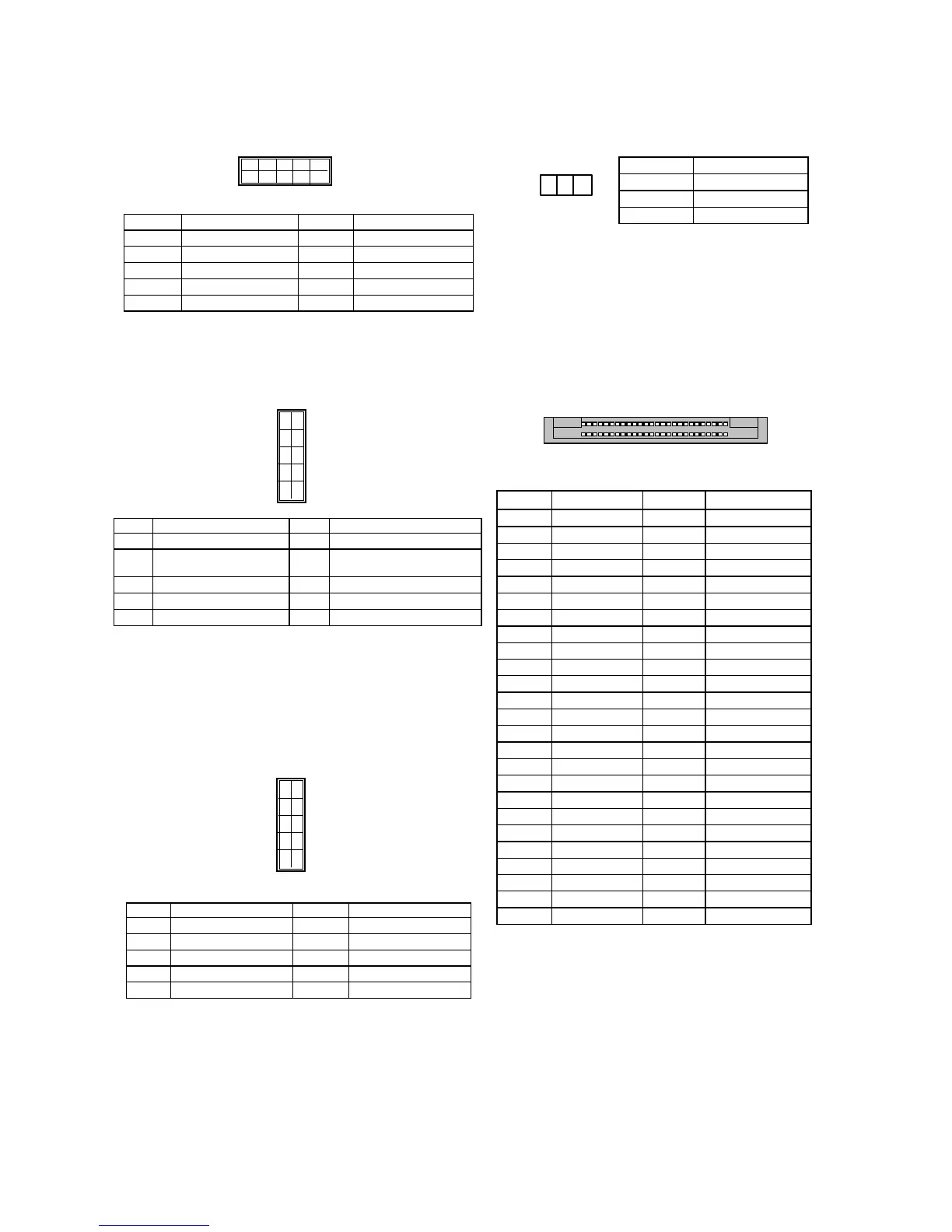
GPIO Output Pin (GPIO1): Theses pins can be used
to write to an internal register to control the GPIO
output pin state.
SPI-ROM Update Connector (SPIROM1): It is for
updating the SPI Flash soldered on board for service
and repair purposes.
LPC I/O bus (It can also be called Port 80) (LPC1):
It is a proprietary connector for connecting
a checkpoint device to output checkpoints
throughout booting and Power-On Self Test
(POST) to indicate the task the system is currently
executing.
2
1
10
9
Pin No. Signal Pin No. Signal
1 SIO_GP20 2 SIO_GP21
3 SIO_GP46 4 SIO_GP47
5 SIO_GP53 6 SIO_GP54
7 SIO_GP56 8 SIO_GP57
9 P5V 10 GND
Pin No. Signal Pin No. Signal
1 SPI_HOLD0_L 2 NC
3 PMU_AVN_SPI_R_
CS0
4 V_3P3_SPI
5 PMU_AVN_SPI_MISO 6 NC
7 NC 8 PMU_AVN_SPI_R_CLK
9 GND 10 PMU_AVN_SPI_R_MOSI
Pin No. Signal Pin No. Signal
1 CLK_33M_P80 2 LPC_AD1
3 PLTRST_PORT80_N 4 LPC_AD0
5 LPC_FRAME_N 6 P3V3
7 LPC_AD3 8 Key ping
9 LPC_AD2 10 GND
1
2
9
10
1
2
9
10
Clear CMOS jumper (JBAT1): It is for clearing the
CMOS memory and system setup parameters
by erasing the data stored such as the system
passwords in the CMOS RAM.
CompactFlash Connector (CF1): It is for connecting a
Compact Flash card to be served as your system’s
storage. The connector is a CF Type II slot which
could fit both CF Type I or CF Type II cards.
Pin No. Signal
1 VBAT
2 PCH_RTCRST_N
3 GND



 To Next Page