Need help?
Do you have a question about the LAPORTE EASYTRAP 75 and is the answer not in the manual?
Covers safety, installation, operation; prohibits reproduction without authorization.
Provides company name, address, phone, and website details.
Highlights Laporte's 70 years, Olympic supply, and industry endorsements.
Focuses on simple use, minimal parts, easy maintenance, and durable steel chassis.
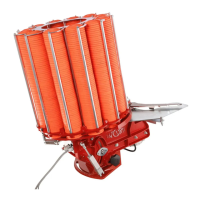
Describes the magazine capacity, target compatibility, and simplified electronics.
Details the safety guard, throwing arm bearing, and its functions.
Covers projection distance, re-arming time, voltage, and weight of the machine.
Explains target release options, voltage, and trajectory adjustment capabilities.
States the manual's intent for correct operation and servicing, with product modification rights.
Warns of serious injuries and stresses reading instructions before installation/operation.
Outlines essential checks before operation, including power, lubrication, and magazine loading.
Advises against leaving the trap cocked, operating alone, and lifting by the arm.
Recommends safety glasses, keeping children/animals away, and safe positioning.
Ensures the machine is in a safe, uncocked state and disconnected from power before approach.
Details the steps to safely unarm the machine using the ON-OFF-UNCOCK switch.
Guides on securing the machine, installing the safety guard, and making electrical connections.
Covers loading clays, initial arming/uncocking, and test firing for trajectory setup.
Details the final steps for safe shutdown and completion of the start-up process.
Diagnoses common causes like power loss, blown fuses, or motor defects.
Addresses issues with jammed arms, broken chains, or gearbox malfunctions.
Identifies problems like no power, broken shafts, or faulty release systems.
Covers arms blocked by clays, bent/broken arms, and associated safety risks.
Explains issues with micro-switches, relays, stuck buttons, or radio interference.
Addresses loose bolts, spring tension, worn bearings, and target quality issues.
Discusses causes of clay breakage, damaged plates, or dirt affecting performance.
Details issues from loading, mixed clay sizes, or incorrect plate adjustment.
Covers problems with multiple clays falling at once or magazine feeding issues.
Addresses targets stuck in the magazine or issues with magazine rods.
Emphasizes accessing the machine from behind when armed and maintaining safe distances.
Recommends sheltering walls, wearing safety glasses, and securing the machine properly.
Provides detailed steps and part references for attaching the safety guard.
Explains the ON-OFF-UNCOCK switch and its respective positions for machine control.
Details the process of adjusting the throwing plate for optimal clay trajectory using screws.
Guides on inserting the threaded rod and hand-tightening the spring assembly.
Explains how to modify spring tension using the rear adjustment nut.
Instructions for adjusting rods outwards for 110mm standard clays.
Instructions for adjusting rods inwards for 90mm Midi clays.
Details adjusting the clay holder to achieve a 2mm gap for correct clay retention.
Presents the schematic of the control box, showing power, motor, and switch connections.
Lists parts for the magazine support, plates, and rods.
Details magazine rollers, left/right plates, and associated fasteners.
Lists components for the main spring assembly, including the spring, plug, screws, and washers.
Details parts like thrust washers, spacers, keys, screws, and the main spindle.
Illustrates the assembly of the throwing arm axis components.
Lists main body parts, motor, pinions, chain, and bearings.
Details washers, screws, nuts, springs, and plates used in the body assembly.
Shows exploded view of the base plate, its support, and associated hardware.
Lists magazine support, bearings, clay holders, and centering square.
 General
| Response Time | Instantaneous |
|---|---|
| Operating Temperature | 0°C to 50°C |
| Storage Temperature | -20°C to 60°C |
| Type | Electronic refrigerant leak detector |
| Detection Principle | Heated Diode |
| Refrigerant Compatibility | CFCs, HCFCs, HFCs |
| Sensitivity | 3 g/year |


 To Next Page