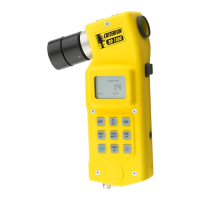
The device described in this manual is the Criterion RD 1000, the first electronic BAF-scope/dendrometer, manufactured by Laser Technology, Inc. It is a sophisticated instrument designed for forestry professionals to accurately measure and calculate various parameters related to trees and plots.
Function Description
The Criterion RD 1000 is a versatile electronic BAF-scope/dendrometer that integrates a laser range finder with an inclinometer and an in-scope LED display. Its primary function is to provide real-time results for calculations that are essential for forest inventory and management. The device allows users to perform several types of measurements:
- BAF Mode (Basal Area Factor): This mode is used to visually estimate if trees fall "In" or "Out" of a given plot, based on a specified Basal Area Factor. The Magnifier has no application in this mode.
- In/Out Mode: This mode is used to internally stored plot radius factors to determine the status of a "borderline" tree.
- Diameter Mode: This mode determines the diameter of a tree at any given height. Results may be downloaded to an external data collector.
- Height/Diameter Mode: This mode verifies the height at which a specified diameter is reached. Results may be downloaded to an external data collector.
- Raw Inclination: This mode displays the Percent Slope. Results may be downloaded to an external data collector.
The device is capable of automatically downloading measurement data from an LTI laser range finder, or users can manually enter values. It incorporates a tilt sensor that measures vertical angles, allowing the RD 1000 to determine slope-reduced measured distance and to calculate height. The tilt sensor is capable of taking +/- 90° measurements (360° full circle).
Important Technical Specifications
- Dimensions: 2.75" x 2.00" x 6.5" (7 cm x 5 cm x16.5 cm)
- Weight: 1.1 pounds (500 grams)
- Data Communications: RS232, NMEA 0183, Proprietary Record Data Format. The device uses RS232 voltage levels and transfers information in an ASCII, hexadecimal format. It has two serial port connectors.
- Power: 3.0 volts DC nominal.
- Battery Type: AA (2) or CRV3 (1).
- Operation Duration: AA: Approximately 20 hours. CRV3: Approximately 40 hours.
- Environmental: Water and dust resistant. NEMA 3, IP54.
- Operating Temperature: -22° F to +140° F (-30° C to +60° C).
- Optics: Normal: 1X. Magnified: 2.00 - 2.99 (value listed on the Magnifier).
- Displays: External LCD and In-scope LED.
- Units: Imperial and Metric.
- Monopod/Tripod Mount: ¼" - 20.
- Measurement Range:
- BAF: 1 to 127 Ft²/Acre (0.2 to 29.1 M²/Hectar).
- Diameter: 2" to 100" (5 cm to 254 cm) under typical field conditions.
- Inclination Accuracy: +/- 90° (360° full circle).
- Diameter Accuracy: +/- ¼" (6 mm) up to 80 feet (24 m) away under typical field conditions. Maximum diameter achievable is 1400" based on the maximum allowable distance entry, but accuracy will be limited to 1% of measurement.
- Inclination: +/- 0.1° typical.
Usage Features
The Criterion RD 1000 is designed for ease of use in the field, with several features enhancing its functionality:
- In-scope LED Display: The in-scope LED display illuminates brightness levels and projects a measurement bar scale that represents a subtended horizontal angle. This allows the RD 1000 to use this angular measurement and the horizontal distance to the target tree to calculate the diameter of the tree stem. The horizontal distance is the level distance between the eyepiece and the point of measurement on the face of the tree.
- Attachable Magnifier: A magnifier can be used when measuring diameters in situations that require maximum measurement resolution. It is attached by grasping the magnifier by the front, outside edges opposite the threads, positioning the magnifier front of the RD 1000, and turning the magnifier clockwise to secure it. Removing the magnifier involves grasping it by the front, outside edges and turning it counter-clockwise.
- Ergonomic Design: The device is ergonomically designed for handheld use, rugged, water and dust resistant, and is small enough to carry in a vest pocket.
- Mounting Options: It can be mounted on a tripod or monopod for increased precision.
- External Laser Range Finder Compatibility: Works seamlessly with an LTI laser range finder and an external data collector.
- User Interface: The RD 1000 has 11 buttons. Nine of these buttons are located on the keypad below the external LCD. The TRIGGER button is located at your index finger on the front of the unit, and the Scale Adjust button is located at your thumb on the back of the unit.
- Keypad Functions:
- EDIT: Activates the edit function for manually entering numeric values.
- UP/DOWN Arrows: Used to toggle between Metric and Imperial Measurement Units, increase/decrease values, and move between menu items.
- HUD: Activates the Heads Up Display (HUD) in-scope LED and displays brightness values. Long press toggles the illuminated in-scope LED Measurement Bar Scale from Solid to Gap or Gap to Solid.
- BACK: Moves to the previous menu item.
- ENTER: Confirms function, selects value, and accepts new BAF values.
- FWD: Moves to the next menu item.
- MODE: Moves through operating modes.
- POWER: Turns the unit ON/OFF.
- Display Backlight: The external LCD display backlight can be toggled ON or OFF using a short press of the POWER button.
- Display Indicator Test: Allows users to verify that all display indicators are working properly by pressing and holding the POWER button.
- Measurement Bar Scale: The device supports two Measurement Bar Scale modes: Solid and Gap. The Measurement Bar Scale mode is stored in memory, and the last mode used is maintained when the unit is powered on.
- Displaying Percent Slope: The RD 1000's tilt sensor allows you to view inclination values. Values are displayed in the in-scope LED and appear as whole units of percent slope.
- Selecting Measurement Units: Users can choose between Metric and Imperial measurement units.
- Aligning the Tilt Sensor: The tilt sensor can be aligned to ensure accurate measurements.
Maintenance Features
- Temperature Range: The instrument components are rated for a temperature range of -22° F to +140° F (-30° C to +60° C). Do not expose the RD 1000 to temperatures outside this range.
- Protection from Moisture and Dust: The RD 1000 is sealed to provide protection from normally expected field conditions. It is protected from dust and rain, but will not withstand submersion.
- Protection from Shock: The RD 1000 is a precision instrument and should be handled with care. It will withstand a reasonable drop shock. If the unit suffers from a severe drop shock, users may need to align the tilt sensor.
- Transporting: When transporting the RD 1000 in a vehicle, the unit should be secured in the provided carrying case. The provided neck strap can be used when carrying the RD 1000 in the field.
- Cleaning: Clean the RD 1000 after each use, before returning it to its carrying case. Check all of the following items:
- Excess moisture: Towel off excess moisture, and air dry the instrument at room temperature with the batteries removed and the battery compartment open.
- Exterior dirt: Wipe exterior surfaces clean to prevent grit buildup in the carrying case. Isopropanol may be used to remove dirt and fingerprints from the exterior.
- Sighting Scope Lenses: Use the provided lens cloth to wipe the sighting scope's lenses and the external LCD. Failure to keep the lenses clean may damage them. A damaged scope lens can make it difficult to see a target.
- Testing the Display Segments: Periodically check the external LCD to make certain that all display segments are working properly.
- Storing: If the device won't be used soon, remove the batteries before storing the instrument.
- Battery Replacement: The RD 1000 uses two AA batteries or one CRV3 battery. To remove batteries, insert a coin into the slot on the battery door and turn the screw counter-clockwise. The door will raise as the screw is released. Once the screw is released, lift the battery door to remove. To install, insert the batteries as shown in Figure #2 (lower battery negative end first, upper battery positive end first). If using one CRV3 battery, the battery compartment is designed so the battery will only fit one way. To replace the battery door, insert the tab into the slot, align the screw with the hole, and turn the screw clockwise. Do not over-tighten.
- Low Battery Warning: When the voltage drops below 2.2V, the External LCD main display flashes "LobAt" every 5 seconds, alternating with the normally displayed information. When the voltage drops below 2.0V, the "LobAt" message stops flashing and is displayed steady. At this point, system operation is locked. Users must replace the batteries to return to normal system operation.
- Firmware Revision Number: The firmware revision number provides manufacturing information about the RD 1000. Each time the RD 1000 is powered ON, the external LCD displays the firmware revision number, "r 1.xx" (where 'xx' is a value from 00 to 99).

 Need help?
 General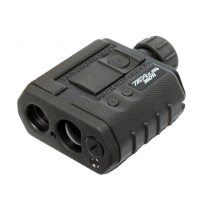


 To Next Page