
 Need help?
Do you have a question about the Laser Technology UltraLyte and is the answer not in the manual?
The UltraLyte is designed to meet FDA eye safety requirements and is classified as eye-safe to Class 1 limits.
Looking at sun through the scope may permanently damage your eyes.
Exposing the lens system to direct sunlight, even for a brief period, may permanently damage the laser transmitter.
UltraLyte components are rated for a temperature range of -30° C (-22° F) to +60° C (+140° F).
Instructions for powering the instrument on and off.
Procedures for measuring horizontal, slope, and vertical distances.
Instructions for measuring vehicle speed.
How to adjust the display backlight.
Adjusts the brightness of the in-scope display.
Restricts the minimum or maximum range of the instrument.
Sets the data download format (e.g., 20.20.Cr, UL100, UL200).
Enables continuous speed measurement while trigger is held.
Instructions for verifying received items and checking for damage upon delivery.
Lists the standard components included in the basic package.
Lists optional accessories that may have been ordered.
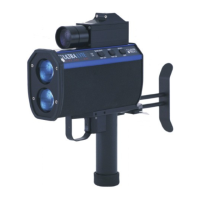
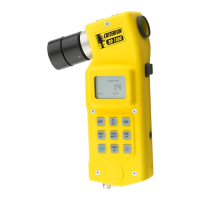
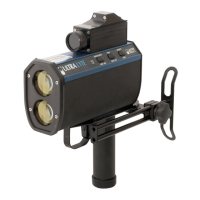
Describes the UltraLyte models and their key features.
Explains the function of the front panel lenses and internal circuitry.
Describes the physical components of the LCD screen.
Details the serial port and the sighting scope features.
Step-by-step guide to orient the stock for left-handed use.
Step-by-step guide to orient the stock for right-handed use.
Instructions for adjusting the stock's length and angle.
Procedure for folding the stock back for storage.
Instructions for turning the instrument on and off.
How to test the screen display segments at power-on.
How to check the instrument's model number and software revision.
Procedure to reset instrument options to factory defaults.
Step-by-step procedure for measuring vehicle velocity.
Discusses target visibility needs and angle effects on speed measurement.
Explains the JAM indicator and its meaning.
Step-by-step guide to manually enter the reference distance.
Describes two methods for measuring the distance between reference points.
Procedure for measuring speeds using established reference points.
Provides tips and important considerations for using Time Over Distance.
Step-by-step guide to perform a survey measurement.
Explains the in-scope display during survey mode.
Explains the "Group" feature for combining sensor readings.
Lists and explains possible error codes (Exx) encountered by the instrument.
Discusses radio frequency interference and its impact.
Procedure for setting short and long gate values.
Instructions on how to disable a currently set gate.
Guidelines for choosing a suitable target for scope alignment.
Details the location and use of scope adjustment screws.
Step-by-step procedure to realign the instrument's scope.
Information about realigning the tilt sensor (factory service).
Describes the specific data formats: UL, 20/20, and Criterion.
Details the serial port parameters like baud rate, data bits, etc.
Explains version queries and data return format for UL format.
Defines the general format for speed and range data downloads in UL format.
 General
| Acquisition Time | 0.3 seconds |
|---|---|
| Weight | 0.8 kg (1.75 lbs) |
| Operating Temperature | -30° C to +60° C (-22° F to +140° F) |
| Battery Life | >8 hours |
| Display | LCD |
| Range | Up to 4, 000 feet (1, 200 meters) |
| Accuracy (Speed) | ±2 km/h (±1 mph) |
| Speed Range | 0 to 320 km/h (0 to 200 mph) |


 To Next Page