Need help?
Do you have a question about the Leadshine STEPPERONLINE DM320T and is the answer not in the manual?
Lists key features of the DM320T stepper drive, including anti-resonance, auto-identification, and protections.
Details the industries and specific applications where the DM320T stepper drive is suitable, like CNC and automation.
Provides detailed electrical parameters including output current, supply voltage, logic signal current, and pulse frequency.
Specifies operating and storage conditions, including ambient temperature, humidity, vibration, and cooling requirements.
Details the physical dimensions of the DM320T stepper drive, shown in millimeters with inch equivalents.
Offers recommendations for managing heat dissipation, including optimal mounting and cooling methods.
Details the pin functions and configurations for Connector P1, used for control signal connections.
Describes the pin functions and configurations for Connector P2, used for power and motor connections.
Explains the meaning of the GREEN (power) and RED (protection) LEDs on the DM320T drive.
Provides instructions for connecting 4-lead stepper motors to the DM320T drive.
Details the half coil and full coil configurations for connecting 6-lead stepper motors.
Explains series and parallel connection methods for 8-lead stepper motors.
Discusses the pros and cons of using regulated versus unregulated power supplies for the drive.
Advises on sharing a single power supply across multiple DM320T drives to reduce cost and avoid interference.
Guides on choosing the optimal supply voltage (18-30VDC), recommending 24VDC for stability.
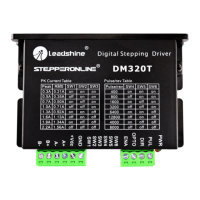
Explains how to set microstep resolution using DIP switches SW4, SW5, and SW6.
Details how to set the dynamic motor current using DIP switches SW1, SW2, and SW3.
Describes the automatic motor matching and self-configuration feature upon power-on.
 General
| Control Mode | Pulse/Direction |
|---|---|
| Pulse Input Frequency | 0-200 kHz |
| Logic Input Current | 7-16 mA |
| Input Voltage | 20-50VDC |
| Operating Temperature | 0 - 50℃ |
| Humidity | 90%RH (non-condensing) |
| Protection Features | Over-voltage, Over-current, Short-circuit |
| Microstep Resolution | 200-51200 steps/rev |

 To Next Page