Need help?
Do you have a question about the Leadshine CS3E-E Series and is the answer not in the manual?
Explanation of EtherCAT technology and its role in automation.
Crucial safety and usage guidelines for the product.
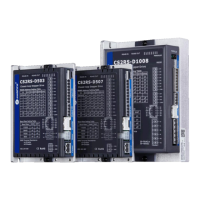
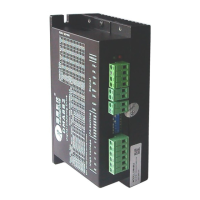
Overview of the newly released CS3E-E series EtherCAT stepper drives.
Highlights of the CS3E-E series drives, including operation modes and protections.
Guidance on checking the product upon arrival and understanding nameplate information.
Recommended conditions for storing and installing the drive.
Physical dimensions and mounting guidelines for the drive.
Detailed specifications for EtherCAT communication interface and protocol.
Electrical parameters, supply voltage, output current, and matched motors.
Wire diameter and type recommendations for power, I/O, and communication cables.
Definition and pinouts for all drive connectors, including power, motor, I/O, EtherCAT, USB, and encoder.
Wiring diagram and notes for digital input signals.
Wiring diagram and notes for digital output signals.
Wiring diagram for connecting the motor brake output.
Parameters and objects related to EtherCAT communication and device information.
Drive-specific parameters for peak current, microstepping, filtering, and control modes.
Configuration of input and output ports, including function, filter time, and polarity settings.
Objects related to motion control, including error codes, control words, status words, and operation modes.
Information on EtherCAT Slave Information files required for master station connection.
List of error codes and their corresponding troubleshooting steps.
Explanation of ALM/ERR LEDs and procedures to clear alarms.
Procedures for saving drive parameters to EEPROM and resetting to factory defaults.
Explanation of synchronous and asynchronous motion modes and their control words.
Using input signals to capture and record motor position with touch probe functionality.
Details homing methods that utilize Z signal and stalling signal for position detection.
Explains homing using Z signal with negative or positive limit switches.
Covers homing procedures involving Z signal and home switch inputs.
Describes homing sequences using home switch and positive or negative limit switches.
Details homing procedures that rely solely on the home switch input.
Explains homing where the current position is set as the zero reference.
Reference for communication objects, vendor ID, product code, and PDO mapping.
Details TXPDO/RXPDO assignment and related administrative parameters.
Reference for drive-specific parameters like peak current, microstepping, and alarm selection.
Parameters for current/speed/position loops, JOG functions, and slave ID configuration.
Parameters for limit mode, quick stop, operation modes, and touch probe functions.
Parameters for synchronization interface, ESC ID, and homing setup.
Settings for synchronization periods, special functions, and quick stop selection.
Parameters for operation modes, velocity, acceleration, and deceleration profiles.
Parameters for encoder resolution, touch probe functions, and digital I/O status.
Information on connectors for motor, encoder, I/O, and power supply, including models and specifications.
Troubleshooting common communication issues and drive enablement problems.
Addressing alarms, motor not turning, and homing errors.

 To Next Page
 General