The passenger oxygen masks (Figure 17-9) are
stowed in compartments in the convenience
panels above the passenger seats. The
compartments may contain as many as three
masks, depending on the airplane seating
configuration. There will be at least one more
mask than passenger seats available.
The passenger mask storage compartment doors
are held closed by latches. When oxygen is
admitted into the passenger distribution system,
the oxygen pressure causes the door latches
(plungers) to open each compartment door.
When the doors open, the passenger masks fall
free and are available for passenger use. As the
passenger pulls down on his mask to don it, an
attached lanyard withdraws a pin from the
supply valve which releases oxygen into the
mask breather bag at a restricted, constant-flow
rate. The breather bag may seem to inflate
slowly, but this is normal.
NOTE
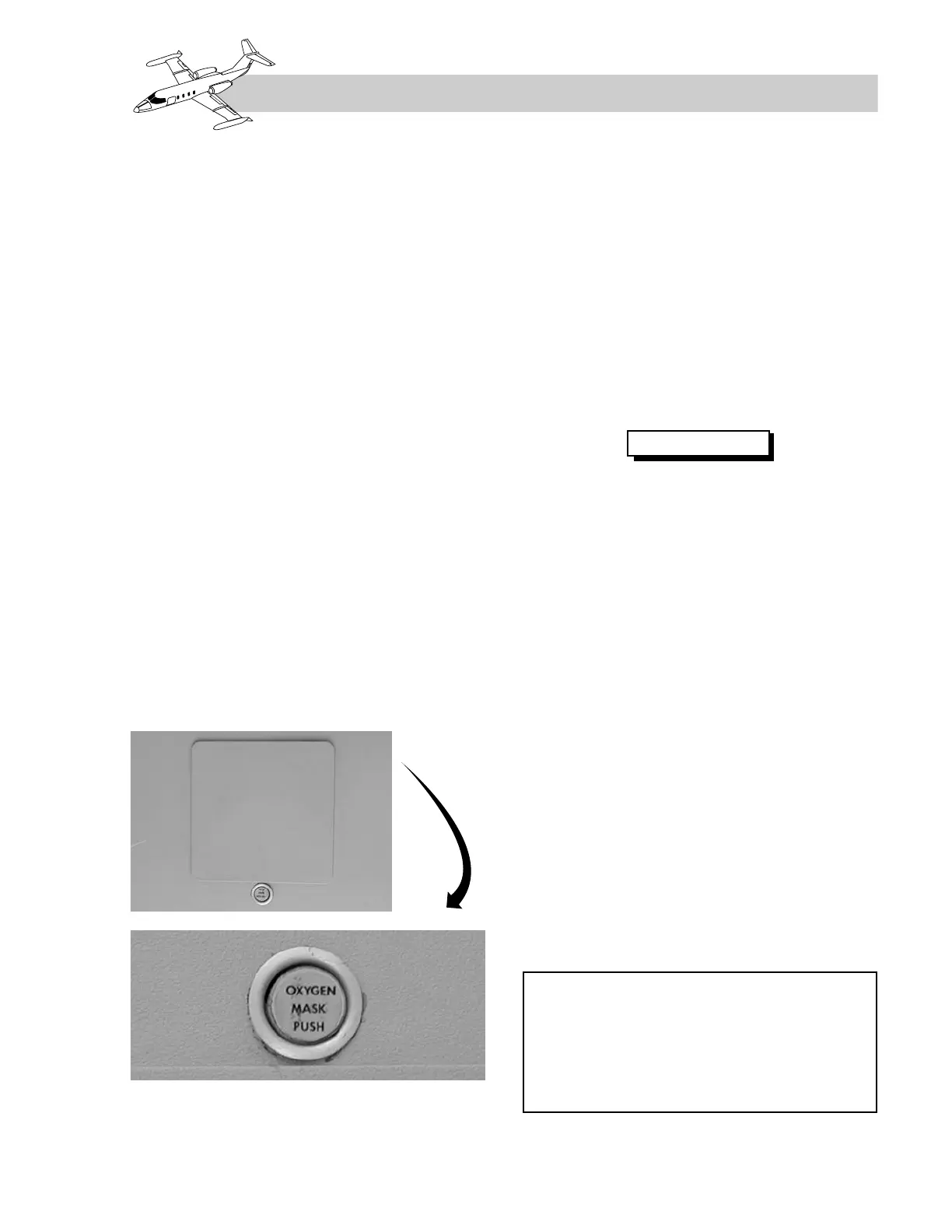
The individual compartment doors can
be opened manually (Figure 17-10) if
selected use is required, but pulling the
mask lanyard will not start oxygen
flow until the PASS MASK valve is
turned to MAN.
Should the doors be inadvertently opened from
the cockpit, oxygen pressure must be bled from
the passenger distribution system before the
masks can be restowed. This is accomplished by
pulling one of the passenger mask lanyards after
ensuring that the PASS MASK valve is closed
(AUTO). If the doors open due to malfunction of
the solenoid-operated valve, the PASS OXY
valve must be turned off to permit stowage of the
passenger masks.
The compartment doors can be opened manually
for mask cleaning and servicing.
No smoking when oxygen is being used.
OXYGEN DURATION
Before an overwater flight is made, the pilot
should plan oxygen requirements to provide a
sufficient quantity for all occupants in case of a
pressurization failure. It may be necessary to
carry additional oxygen on board to ensure that
both oxygen duration and fuel requirements
are met.
The pilot should also remember that
unpressurized flight above 30,000 feet, even
though oxygen is being used, can result in
unconsciousness. Therefore, if a pressurization
problem is encountered at a high altitude, a
descent should be initiated immediately. Table
17-1 lists the average time of useful con-
sciousness at various altitudes.
Figure 17-10. Passenger Oxygen
Compartment Door Manual
Release
15,000 to 18,000 feet . . . . . . . . . . 30 minutes or more
22,000 feet . . . . . . . . . . . . . . . . . . . . . . 5 to 10 minutes
25,000 feet . . . . . . . . . . . . . . . . . . . . . . . 3 to 5 minutes
28,000 feet . . . . . . . . . . . . . . . . . . . . 2 1/2 to 3 minutes
30,000 feet . . . . . . . . . . . . . . . . . . . . . . . 1 to 2 minutes
35,000 feet . . . . . . . . . . . . . . . . . . . . 30 to 60 seconds
40,000 feet . . . . . . . . . . . . . . . . . . . . 15 to 20 seconds
45,000 feet . . . . . . . . . . . . . . . . . . . . . 9 to 15 seconds
Table 17-1. AVERAGE TIME OF
USEFUL CONSCIOUSNESS



 To Next Page