under CAR 3) as two-pilot transport category
aircraft. They are certified for operation to an
altitude of 41,000, 45,000, or 51,000 feet, de-
pending on serial number and equipment in-
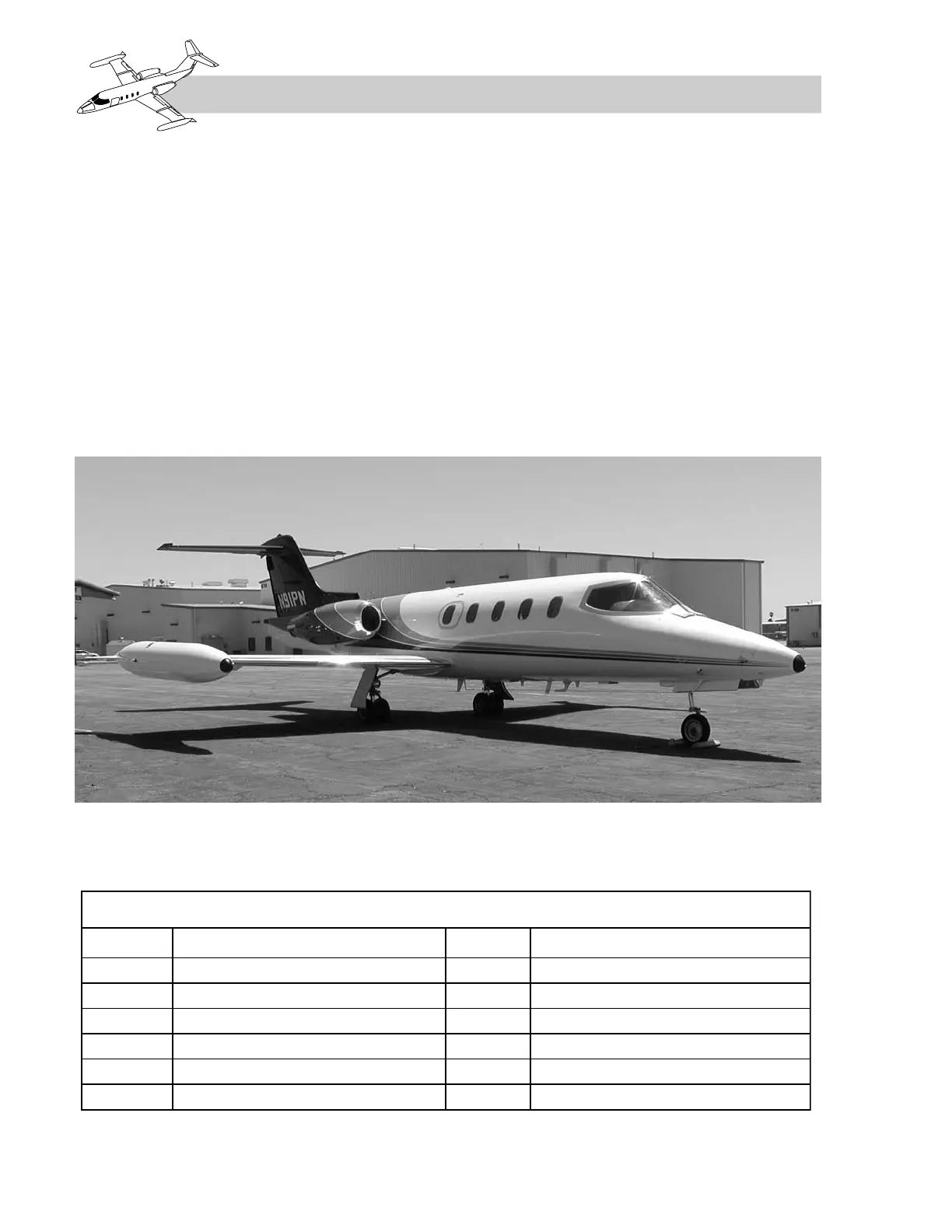
stallation. Figure 1-1 shows a Learjet 25.
The terms “early” and “late” are frequently
used in the chapters of this training manual
with reference to airplane models. This is to
simplify explanations for the two basic groups
of airplanes. Table 1-1 lists the early- and
late-model groups by airplane serial number
for reference.
STRUCTURES
GENERAL
Most of the airplane structures are fabricated of
high-strength aluminum alloy, with steel, glass
fiber, and other materials used as needed. During
testing, all load-bearing members and surfaces
demonstrated the capability to carry 90% of the
“G” forces with an adjacent structural compo-
nent failed. The airplane structure consists of
fuselage, wings, and empennage. The discussion
on the fuselage includes the doors and windows.
General dimensions are shown in Figure 1-2.
1-2
FOR TRAINING PURPOSES ONLY



 To Next Page