www.lectrosonics.com 9
PH (phantom power supply)
The transmitter input jack can provide phantom power for the attached mi‑
crophone if needed, with voltages at 5, 15 or 48 or be turned off. Use the UP
and DOWN arrow buttons to select the desired setting. Phantom power will
consume a slight amount of battery power.
About the Phantom Power Supply
Three phantom voltages are selectable from the control panel.
The voltages are:
• 5 Volts for lavaliere microphones,
• 15 Volts for some professional mics requiring high current and for many
common stage mics that will operate over a wide phantom Voltage range of
12 to 48 Volts. With the proper adapter, this position can also be used with
T power microphones. See our web site for details on finding or making the
proper adapter.
• 48 Volts for microphones that do in fact require a supply greater than 18
Volts. (See below for a discussion of why 42 and not a “true” 48 Volts.)
For longest battery life use the minimum phantom voltage necessary for the
microphone. Many stage microphones regulate the 48 Volts down to 10 Volts
internally anyway, so you might as well use the 15 Volt setting and save some
battery power. If you are not using a microphone for the input device, or are
using a microphone that does not require phantom power, turn the phantom
power off.
Phantom power should only be used with a fully floating, balanced device
such as most microphones with a 3‑pin XLR connector. If you use the phan‑
tom power with an unbalanced device or if pins 2 or 3 are DC connected to
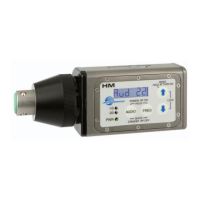
ground, then you will draw maximum current from the power supply. The HM
is fully protected against such shorts but the batteries will be drained at twice
the normal rate.
The transmitter can supply 4 mA at 42 Volts, 8 mA at 15 Volts, and 8 mA at 5
Volts. The 42 Volts setting actually supplies the same voltage to a 48 Volt mi‑
crophone as the DIN standard arrangement due to a dynamic biasing scheme
that does not have as much voltage drop as the DIN standard. The 48 Volt
DIN standard arrangement protects against shorts and high fault current with
high resistance in the power supply feeds to pins 2 and 3. This provides pro‑
tection if the supply current is accidentally shorted to ground and also keeps
the microphone from being attenuated by the power supply.
The HMa improves on those functions and is able to use less power from
the battery by using constant current sources and current limiters. With this
dynamic arrangement the HMa can also supply more than twice the current
of competing 48 Volt plug on units and provide four times the current for some
very high end 15 Volt microphones.


 To Next Page