Need help?
Do you have a question about the Leica LINO L2P5G and is the answer not in the manual?
Details components and available L2P5/L2P5G types.
Safety instructions and manual should be read carefully before first use.
Explanation of locking the pendulum for transport or tilting beyond self-levelling range.
Using a laser receiver to detect laser lines over long distances or in poor lighting.
Instructions for charging the Li-Ion battery before first use.
Guide for inserting Li-Ion or alkaline batteries into the device.
Instructions for turning the device on, off, and enabling auto power-off feature.
Explains how to activate different laser line combinations (vertical, horizontal, points).
Steps for attaching the device to an adapter and aligning laser lines.
Demonstrates various methods for fixing the device using adapters.
Procedure to check the self-levelling accuracy of the instrument.
Methods for checking horizontal and vertical line accuracy.
Checks for the accuracy of upper and lower vertical plumb points.
Verifying the perpendicularity of laser points to walls.
Guidelines for cleaning the device, optics, and adapters to ensure proper function.
Details on the two-year warranty and how to register for an additional year.
Recommendations for regular device checks and how to obtain service.
Defines responsibilities and outlines the intended use of the instrument.
Lists prohibited actions and potential hazards during operation.
Instructions for safe disposal and transport of the instrument and battery.
Information regarding EMC compliance, FCC, and ISED statements.
Details on laser class, wavelength, output power, and safety warnings.
Explanation of labels and markings on the instrument.
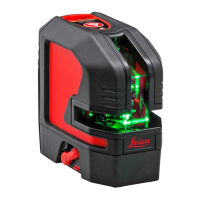
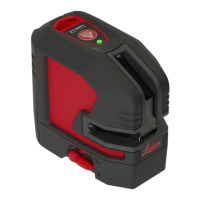
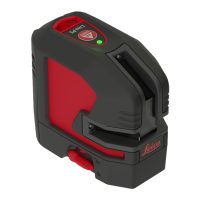
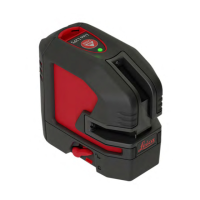
The Leica Lino L2P5/L2P5G is a versatile, self-levelling laser tool designed for various construction and surveying tasks. It integrates the functionalities of both a cross-line laser and a point laser into a single device, offering precision for levelling, plumbing, transferring points, and setting out right angles. The device projects two crossing vertical and horizontal lines, along with five points—four points and one intersection point located in front of the device—all precisely arranged at 90° to each other. Two different types are available: the L2P5, which uses a red laser, and the L2P5G, which uses a green laser.
The primary function of the Leica Lino L2P5/L2P5G is to project accurate laser lines and points for various applications. When the levelling lock is in the "Unlocked" position, the instrument automatically levels itself within its specified inclination range. This self-levelling capability ensures that the projected lines and points are always accurate without manual adjustment. The device can project vertical lines and dots, horizontal lines and dots, or a combination of both, depending on the user's needs.
For tasks requiring the device to be tilted beyond its self-levelling range or for transport, the levelling lock can be engaged. When locked, the pendulum is fixed, and the self-levelling function is deactivated. In this mode, the laser blinks every 5 seconds to indicate that it is operating without self-levelling. This feature is particularly useful for setting out slopes or for safe transportation of the instrument.
The Lino L2P5/L2P5G also features an auto power-off function to conserve battery life. This can be activated by placing the lock switch to the unlocked position and holding the On button for 5 seconds at startup. The status LED will blink three times in green to confirm activation. To deactivate this function, the user repeats the same steps, and the status LED will blink three times in red.
The Leica Lino L2P5/L2P5G is designed for ease of use on the job site. It can be powered by a Li-Ion battery pack or high-quality alkaline batteries. The Li-Ion battery should be charged before first use, and while charging, the instrument may heat up, which is normal and does not affect its lifespan or performance. The Li-Ion status LED indicates the charging status: green for charging and off when charging is complete.
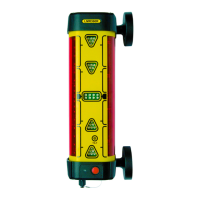
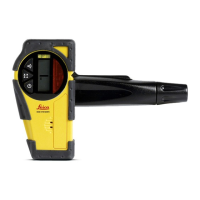
To extend the detection range of the laser lines or to work in unfavourable lighting conditions, a laser receiver such as the Leica RGR200 can be used. The Lino is equipped with XRANGE technology, allowing it to be automatically detected by compatible receivers.
The device is compatible with smart adapters that enhance its versatility. The Twist 360 adapter allows the device to be snapped on, enabling a full 360° rotation around the plumb point for adjusting vertical lines. The UAL 130 adapter features an adjustment knob for fine-tuning the horizontal line to the desired reference level, offering a range of 130 mm (5.12 inches). These adapters provide different fixing applications, allowing the device to be mounted in various ways to suit specific job requirements.
Proper care and maintenance are crucial for ensuring the longevity and accuracy of the Leica Lino L2P5/L2P5G. The device should never be immersed in water. For cleaning, a damp soft cloth should be used, avoiding aggressive cleaning agents or solvents. The instrument should be handled with care, similar to binoculars or a camera, to prevent damage from dropping or violent shaking. Regular checks for any damage are recommended before use.
The levelling accuracy of the instrument should be checked regularly, especially before important measuring tasks and after any abnormal use. The manual provides detailed instructions for checking the accuracy of horizontal and vertical lines, as well as plumb points. If the device falls outside the specified tolerance, it is recommended to contact a local dealer or an authorised Leica Geosystems distributor for service.
To maintain optimal precision and visibility, the optics of the device should be cleaned regularly. This involves blowing off dust from the glasses without touching them. If necessary, a damp soft cloth with a little pure alcohol can be used. The adapters should also be cleaned regularly to ensure easy rotation and to prevent wrong measurements. The interface between the adapter and the device should always be clean. For magnetic surfaces, compressed air or modelling clay can be used for cleaning. If the equipment gets wet, it should always be dried at a maximum of 70°C (158°F) before repacking it into its case.
For Li-Ion batteries, specific precautions are necessary during transport, shipping, or disposal to prevent fire hazards from mechanical influences. Batteries should be discharged by running the product until they are flat before shipping or disposing of them. Users must ensure compliance with applicable national and international rules for battery transport and shipping, contacting local passenger or freight transport companies if needed. The device comes with an International Limited Warranty, and registration on the Leica Geosystems website within eight weeks of purchase can extend the warranty period. Regular calibration and repair service, at least once a year, are recommended to ensure the device's function and reliability. Users are advised not to attempt repairs themselves and to contact a certified Leica Geosystems distributor for service.
 General
| Type | Line/Point level |
|---|---|
| Product color | Black, Red |
| Tripod thread | 1/4, 5/8 \ |
| Tripod mounting supported | Yes |
| International Protection (IP) code | IP54 |
| Maximum range | 35 m |
| Beam direction | Horizontal/Vertical |
| Color of laser beam | Green |
| Fan angle (vertical) | 170 ° |
| Number of laser lines | 2 |
| Fan angle (horizontal) | 180 ° |
| Leveling accuracy (±) | 0.2 mm/m |
| Number of laser points | 4 |
| Self-leveling range (±) | 4 ° |
| Maximum range (with receiver) | 80 m |
| Operating time | 28 h |
| Battery capacity | 5200 Ah |
| Storage temperature (T-T) | -25 - 70 °C |
| Operating temperature (T-T) | -10 - 50 °C |
 Weight and Dimensions
| Depth | 60 mm |
|---|---|
| Width | 110 mm |
| Height | 100 mm |
| Weight | 530 g |

 To Next Page