Need help?
Do you have a question about the Leica LINO L2G and is the answer not in the manual?
Describes the mechanism for locking the pendulum.
Explains the function of the levelling lock when unlocked and locked.
Details charging the Li-Ion battery and storage recommendations.
Instructions on how to insert the Li-Ion battery pack.
Instructions on inserting alkaline batteries into the battery pack.
Instructions on inserting the battery pack into the instrument.
Instructions on checking the levelling accuracy of the instrument.
Instructions for checking the accuracy of vertical and horizontal lines.
Lists actions that are not allowed with the product.
Warns about potential risks and damage from misuse or modification.
Explains the laser classification and associated warnings.
Safety advice for Class 2 laser products regarding eye protection.
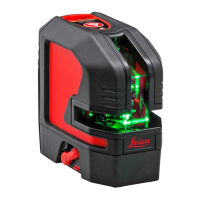
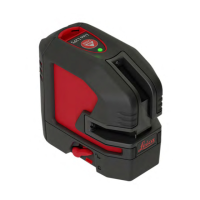
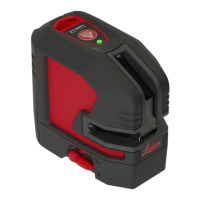
The Leica Lino L2/L2G is a self-levelling cross-line laser designed for a variety of tasks including levelling, transferring, and setting out right angles. It projects two crossing laser lines, one vertical and one horizontal, to assist with precision work on job sites. The device is available in two versions: the L2, which emits a red laser, and the L2G, which emits a green laser.
The primary function of the Leica Lino L2/L2G is to project accurate horizontal and vertical laser lines. It features a self-levelling system that automatically adjusts the laser lines to ensure they are perfectly level within a range of ±4°. This automatic pendulum lockable system ensures reliable precision for various applications. The device also includes an out-of-level warning, where the laser lines blink every 5 seconds if the instrument is outside its self-levelling range, indicating that manual adjustment is needed to bring it back into the operational range.
The instrument can be operated in different modes to suit specific needs. Users can activate either the horizontal line, the vertical line, or both simultaneously. A levelling lock mechanism allows the pendulum to be fixed, which is useful for transporting the instrument or for projecting lines at an angle when self-levelling is not required. When the levelling lock is activated, the instrument can be used for working without self-levelling, and the status LED will blink green. If the levelling lock is activated but the instrument has low power, the status LED will blink red.
The Leica Lino L2/L2G is powered by a Li-Ion battery pack, but can also use alkaline batteries as an alternative power source. The Li-Ion battery pack has a status LED that indicates charging (green light) or a full charge (light off). The device also features an auto power-off function, which can be activated to turn off the instrument after 30 minutes of operation, conserving battery life. This feature is activated by pressing and holding the On button for 5 seconds at startup, indicated by the status LED blinking green three times. To deactivate it, the same steps are repeated, and the status LED will blink red three times.
The Leica Lino L2/L2G is designed for ease of use with its intuitive keypad for operations. The laser key serves as the ON/OFF switch and also controls the activation of the laser lines. The device can be mounted on a tripod using its 1/4" thread, providing stability for precise measurements.
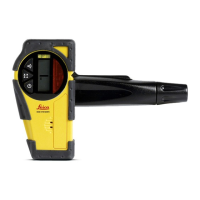
For extended range or challenging lighting conditions, the Leica RGR200 laser receiver is recommended. The Lino device, incorporating XRANGE technology, automatically detects this receiver, enhancing its versatility.
Smart adapters are available to expand the functionality and ease of setup. The Twist 250 adapter allows the device to be snapped on and rotated 250° for fine adjustment of vertical laser lines. The UAL130 adapter features an adjustment knob for fine-tuning the horizontal line to a desired reference level, offering a vertical adjustment range of 130 mm (5.12"). These adapters facilitate various fixing applications, including mounting on tripods with 5/8" or 1/4" threads, or securing to different surfaces using magnetic or clamp attachments.
Regular maintenance is crucial for ensuring the best precision and visibility of the Leica Lino L2/L2G. The device should never be immersed in water. For cleaning, a damp soft cloth should be used to wipe off dirt, avoiding aggressive cleaning agents or solvents. The optics should be cleaned regularly by blowing off dust without touching the lenses, and if necessary, a damp soft cloth with a small amount of pure alcohol can be used.
The levelling accuracy of the instrument should be checked regularly, especially before important measuring tasks or if the instrument has been subjected to abnormal use, such as being dropped or misused. If the device is found to be outside the specified tolerance (e.g., horizontal line deviation exceeding 3 mm over 5 m, or vertical line deviation exceeding 2 mm over 1.5 m), it is recommended to contact a local dealer or an authorised Leica Geosystems distributor for service.
The adapters also require regular cleaning to prevent wrong measurements and ensure easy rotation, particularly the interface between the adapter and the device. Compressed air or modelling clay can be used to clean magnetic surfaces. If the equipment gets wet, it should be thoroughly dried (at a maximum of 70°C/158°F) before being repacked into its case.
For battery maintenance, the Li-Ion battery should be charged before first use. While charging, the instrument may heat up, which is normal and does not affect its lifespan or performance. Batteries with a 50% to 100% charge can be stored for up to one year at recommended temperatures (-20°C to +30°C / -4°F to +86°F), after which they must be recharged. Only Leica-approved chargers, batteries, and cables should be used to avoid damage or explosion. When transporting or disposing of batteries, they should be discharged by running the product until they are flat, and applicable national and international rules must be observed.
The instrument should always be set to the "Locked" position when transported to protect the internal pendulum. Using the original case or equivalent packaging is recommended for transport and shipping. The manufacturer recommends checking the device within regular intervals (at least once per year) to ensure its function and reliability meet standards. Users should never attempt to repair the device themselves; any damage requires contacting a local dealer or certified distributor.
 General
| Type | Line level |
|---|---|
| Product color | Black, Red |
| Tripod thread | 1/4, 5/8 \ |
| Tripod mounting supported | Yes |
| International Protection (IP) code | IP54 |
| Maximum range | 35 m |
| Beam direction | Horizontal/Vertical |
| Color of laser beam | Green |
| Fan angle (vertical) | 170 ° |
| Number of laser lines | 2 |
| Fan angle (horizontal) | 180 ° |
| Leveling accuracy (±) | 0.2 mm/m |
| Self-leveling range (±) | 4 ° |
| Maximum range (with receiver) | 80 m |
| Operating time | 28 h |
| Battery capacity | 5200 Ah |
| Storage temperature (T-T) | -25 - 70 °C |
| Operating temperature (T-T) | -10 - 50 °C |
 Weight and Dimensions
| Depth | 60 mm |
|---|---|
| Width | 110 mm |
| Height | 100 mm |
| Weight | 530 g |

 To Next Page