Need help?
Do you have a question about the Leica Lino L4P1 and is the answer not in the manual?
Instructions for turning the Leica Lino L4P1 on and off.
Describes the procedure to check the levelling accuracy of the instrument.
Details how to check the accuracy of horizontal and vertical laser lines.
Explains how to verify the accuracy of the upper and lower plumb points.
Warns about potential dangers from instrument defects, misuse, or modification.
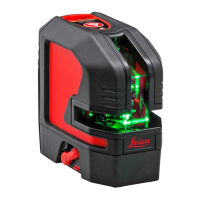
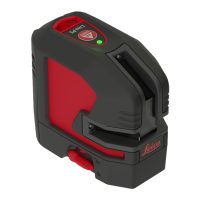
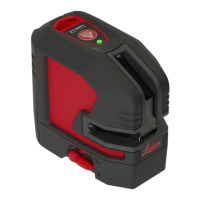
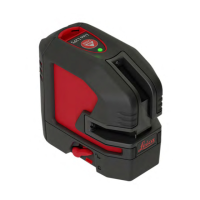
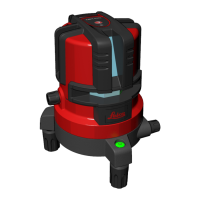
The Leica Lino L4P1 is a versatile laser leveling instrument designed for a variety of construction and surveying tasks, offering precise horizontal, vertical, and plumb point projections. It operates with a Class 2 laser, ensuring safety while providing clear and visible laser lines. The instrument is built for ease of use and reliability, featuring both self-leveling capabilities and a locking mechanism for tilted applications or transport.
For basic operation, the device is switched on and off via a dedicated laser key on the keypad. A short press activates the laser, cycling through different line configurations with subsequent presses. A longer press (3 seconds) turns the device off. The instrument's self-leveling function is crucial for accurate measurements. When the leveling lock is in the "unlocked" position, the Lino L4P1 automatically levels itself within a specified inclination range. This ensures that the projected laser lines are perfectly horizontal or vertical. If the instrument is outside its self-leveling range, the laser will blink, indicating that it needs to be repositioned. For applications requiring tilted lines or for safe transport, the leveling lock can be engaged, fixing the pendulum and deactivating the self-leveling function. In this locked mode, the laser blinks every 3 seconds as a visual reminder.
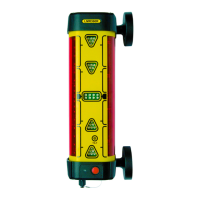
The Lino L4P1 offers fine adjustment for vertical laser lines, allowing users to precisely align the lines to specific points or references. This is achieved by turning an adjustment knob, providing granular control over the vertical alignment. For extended range or in challenging lighting conditions, the instrument can be used with a laser receiver, such as the recommended Leica RVL80, significantly increasing the working distance and visibility of the laser lines.
Powering the Lino L4P1 is flexible, with options for both rechargeable Li-Ion batteries and standard Alkaline AA batteries. The Li-Ion battery pack is inserted by pressing it down and tilting it into the housing until it snaps into place. It's recommended to fully charge the Li-Ion battery before its first use. The charging process may cause the instrument to warm up, which is normal and does not affect its performance or lifespan. For long-term storage, Li-Ion batteries should be charged to between 50% and 100% and can be stored for up to a year at recommended temperatures. When using Alkaline batteries, high-quality ones are advised for reliable operation. The Alkaline batteries are inserted into a battery pack, which then snaps into the instrument's housing in the same manner as the Li-Ion pack.
Regular accuracy checks are essential to ensure the reliability of measurements, especially before critical tasks. The manual outlines procedures for checking the accuracy of leveling, horizontal lines, vertical lines, and plumb points. These checks involve setting up the instrument at specific distances from walls, marking laser points, and measuring deviations. If the deviations fall within the specified tolerances, the instrument is considered accurate.
Maintenance of the Leica Lino L4P1 is straightforward. The device should never be immersed in water. Dirt should be wiped off with a damp, soft cloth, and aggressive cleaning agents or solvents should be avoided. The instrument should be handled with care, similar to binoculars or a camera, to prevent damage from dropping or violent shaking. It's important to inspect the instrument for any damage before use and to regularly check its leveling accuracy.
The Lino L4P1 is designed for use in environments permanently habitable by humans and should not be used in explosion-hazardous or aggressive environments. It is protected against dust and splash water, ensuring durability in typical job site conditions. The instrument's design emphasizes user safety, with clear warnings regarding laser exposure and the importance of understanding the user manual. The manufacturer, Leica Geosystems, provides a Lifetime Manufacturer's Warranty and a "3 Years No Cost" service period, subject to product registration, underscoring their commitment to product quality and customer support. This comprehensive approach to design, operation, and support makes the Leica Lino L4P1 a reliable tool for professionals.
 General
| Type | Line/Point level |
|---|---|
| Certification | IEC60825-1:2014 |
| Product color | Grey, Red |
| Tripod thread | 1/8, 1/4, 5/8 \ |
| International Protection (IP) code | IP54 |
| Laser class | 2 |
| Laser diode | 635 nm (\u003C 5 mW) |
| Maximum range | 15 m |
| Color of laser beam | Red |
| Leveling accuracy (±) | 0.2 mm/m |
| Self-leveling range (±) | 3 ° |
| Battery type | AA |
| Operating time | 24 h |
| Battery voltage | 1.5 V |
| Number of batteries supported | 4 |
| Storage temperature (T-T) | -25 - 70 °C |
| Operating temperature (T-T) | -10 - 50 °C |
 Weight and Dimensions
| Width | 125 mm |
|---|---|
| Height | 162 mm |
| Weight | 1170 g |

 To Next Page