Centring the condenser
Fig.
32
Fig.
33
22958· 512 A
.I
20
I
- -
-
-YL
----
-
....
-
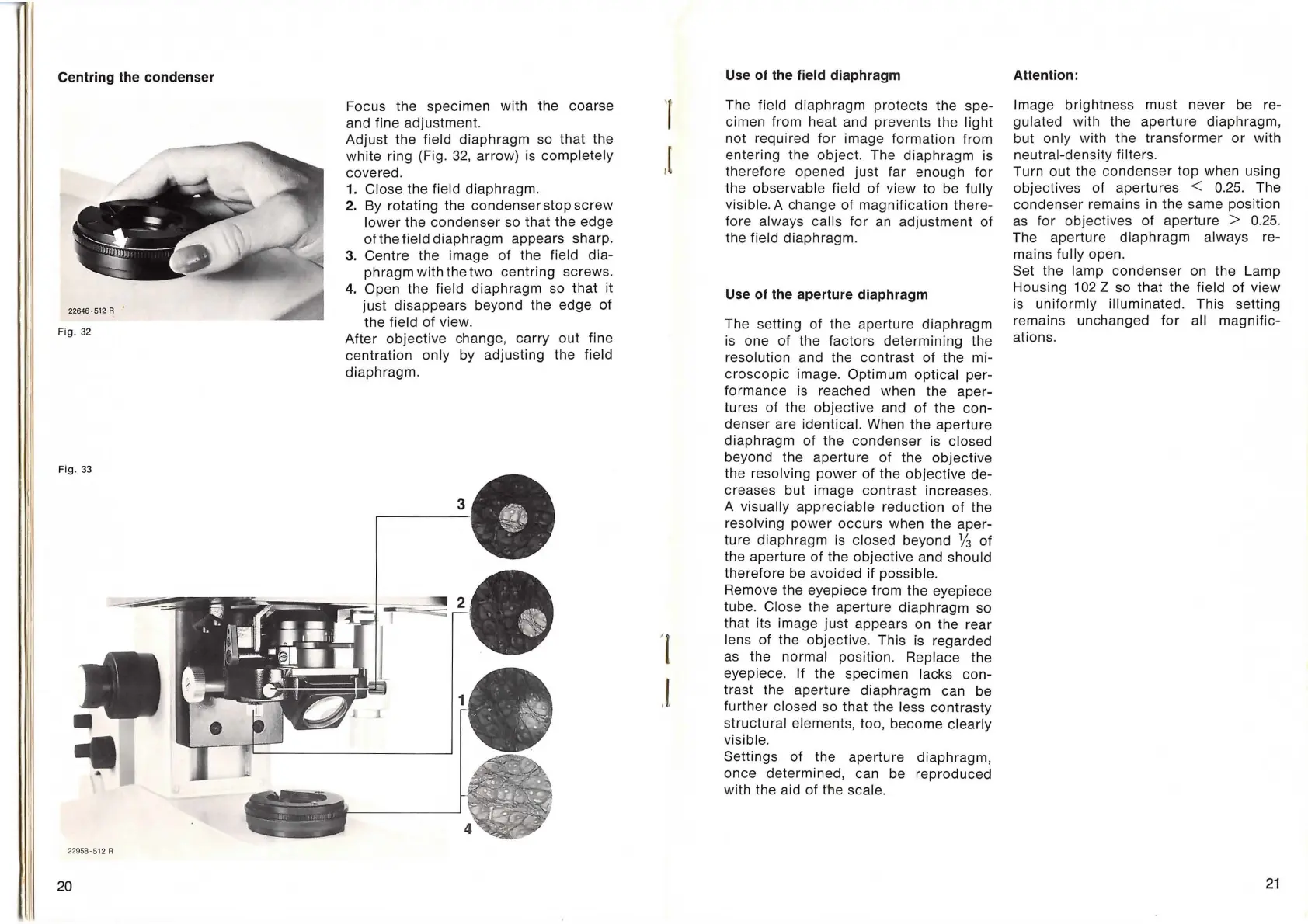
Focus the specimen with the coarse
and fine adjustment.
Adjust
the field
diaphragm
so
that
the
white ring (Fig.
32,
arrow) is
completely
covered.
1.
Close the field diaphragm.
2.
By rotating the
condenser
stop
screw
lower
the
condenser
so
that
the edge
of
the field diaphragm appears sharp.
3.
Centre the image
of
the field
dia-
phragm with the
two
centring
screws.
4. Open the field diaphragm so
that
it
just
disappears beyond the edge
of
the
field
of
view.
After
objective
change,
carry
out
fine
centration
only by adjusting the field
diaphragm.
'(
.l
Use of the field diaphragm
The field
diaphragm
protects
the spe-
cimen from heat and prevents the
light
not
required
for
image
formation
from
entering the object. The
diaphragm
is
therefore opened
just
far enough for
the observable
field of view to be fully
visible. A change of
magnification
there-
fore
always calls for
an
adjustment
of
the
field
diaphragm
.
Use of the aperture diaphragm
The setting of the aperture
diaphragm
is one of the
factors
determining
the
resolution and the
contrast
of
the
mi-
croscopic
image. Optimum
optical
per-
formance
is reached when the
aper-
tures of
the
objective
and
of
the
con-
denser
are identical. When the aperture
diaphragm
of
the
condenser
is closed
beyond the aperture
of
the
objective
the resolving
power
of
the
objective
de-
creases
but
image
contrast
increases.
A
visually
appreciable
reduction
of
the
resolving
power
occurs
when the aper-
ture
diaphragm
is closed beyond
v3
of
the aperture of the
objective
and should
therefore be avoided if possible.
Remove the eyepiece from the eyepiece
tube.
Close the aperture
diaphragm
so
that its image
just
appears on the rear
lens
of
the objective. This is regarded
as
the normal position. Replace the
eyepiece.
If the specimen lacks con-
trast
the
aperture
diaphragm
can be
further
closed so
that
the less
contrasty
structural
elements,
too
,
become
clearly
visible.
Settings of the aperture diaphragm,
once determined, can be reproduced
with the aid of the
scale.
Attention:
Image brightness must never be re-
gulated with the
aperture
diaphragm,
but
only
with
the
transformer
or
with
neutral-density filters.
Turn
out
the
condenser
top
when using
objectives
of apertures < 0.25. The
condenser
remains in the same position
as
for
objectives
of
aperture > 0.
25
.
The aperture
diaphragm
always re-
mains
fully open.
Set the
lamp
condenser
on the Lamp
Housing 102
Z so that the field
of
view
is
uniformly
illuminated. This setting
remains unchanged
for
all
magnific-
ations.
21



 To Next Page