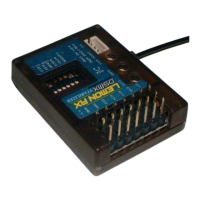
Lemon Microbrick Reference Guide
Page 16 of 20
(more up than down to compensate for adverse aileron drag). Unlike V-Tail and Elevon, where the mixing
happens in the stabilizer, aileron/flaperon mixing takes place in the transmitter.
For the stabilizer to fully apply corrections to both ailerons in response to wind gusts, etc., stabilization of
channel 6 must be ON. If it is OFF, only the right aileron (CH2) will have stabilizer action.
In the transmitter, wing type should be set to Dual Aileron or Flaperon, as appropriate. If flaperon is used, then
Flap mixing must be applied in the transmitter; this usually includes mixing to the elevator channel to
compensate for the pitch effects of flap action. Also, differential aileron can be applied if required.
In the receiver, the right and left aileron servos are plugged into the white JST-SH connectors for channels 2 and
6 respectively.
Reversing Controls and Corrections
The direction of response of the control surfaces to the transmitter inputs must be checked and corrected, if
necessary, AFTER any mixing is set up for V-Tail, Elevons and Flaperons. To avoid distracting control surface
motions, stabilizer action should be turned OFF with the channel 5 switch during this process (mixing occurs
whether the stabilizer is on or off).
When all control settings and mixing are completed, and the control directions are correct, the direction of the
stabilizer’s response to a flight disturbance must be set for each axis. Checking must be done with the stabilizer
turned ON and in accordance with the instructions provided earlier. To change the direction of response for an
axis, use the push button switch and blue LEDs as previously indicated.
Master Gain
Master Gain multiplies the three individual gain values set by the three gain pots by a constant factor. It is set by
the value of channel 8 and so is unavailable on transmitters with fewer channels. When channel 8 is at -100% the
multiplier is close to 0 and when at +100% it is close to 2x. At the midpoint (0%), the multiplier is 1x. Turning the
master gain down reduces the effect of all three set gains, while turning it up increases the gain. If the
transmitter has seven channels or less, Master Gain defaults to 1x and so has no effect.
Note that -100% on channel 8 is not exactly a master gain of zero; you may still see some very small stabilization
effect. If you want to completely eliminate stabilization, set the low value to -150% in the channel 8 servo travel
setting.
If you have Master Gain available, you can greatly speed up the process of setting individual gains. In the air,
advance the channel 8 (Aux3) control gradually until you observe oscillation on an axis. Note which axis is
involved, land and turn down the gain on the corresponding pot. Repeat until all three axes are set so that with
the Master Gain at midpoint, there is no oscillation. Turning up Master Gain to 2 or 3 o’clock should start to
show signs of oscillation.
Troubleshooting
Receiver Won’t Bind
The Microbrick is a sensitive receiver; it can get overloaded during the bind process if it is too close to the
transmitter or experiences multipath reception. Experience has shown that nearly all bind problems can be
solved by ensuring that the transmitter and receiver far enough apart and are not close to large metallic
surfaces. Generally, 1 to 2 metres/yards is far enough, but sometimes separation of several metres/yards is
needed.


 To Next Page